Encrinus
Encrinus is an extinct genus of crinoids, and "one of the most famous". It lived during the Late Silurian-Late Triassic, and its fossils have been found in Europe.

Ghedoghedo · CC BY-SA 3.0 · via Wikipedia/Commons. May be a photograph of a specimen, or an artist’s reconstruction — an interpretation of a skeleton, since colour and soft tissue are almost never preserved.
On record
Recorded, not inferred- Sits inside
- EncrinidaePBDB
- Diet
- suspension feederPBDB, for Encrinida
- Life habit
- epifaunalPBDB, for Encrinida
- Motility
- stationaryPBDB, for Encrinida
- Vision
- blindPBDB, for Crinoidea
- Environment
- marinePBDB, for Echinodermata
Time the record covers
At least 17 million years on record.
The record covers at least 244.4 Mya to 227.3 Mya. No occurrence read is dated outside 247 Mya to 205.7 Mya.
74 occurrences of Encrinus on record, most of them in the Middle Triassic. Bar height is expected occurrences, not a count: each fossil is spread across the span it is dated to, so a tall narrow bar means tight dating and a low wide one means loose.
When
74 occurrencesThese are dates about fossils, not the animal: the record can only begin after it arose and end before it died out, so either end may reach further. Shares are expected occurrences: a fossil dated to a span is counted partly in each period it straddles. More on what this infers.
Found in
17 formations
- Qingyan Formation23
- Trochitenkalk Formation · Muschelkalk Group5
- Pears Formation · Taringatura Group3
- brachiopod-limestone Formation3
- Cassian Formation2
- Luning Formation2
Loading coastlines…
The named rock units Encrinus has been recovered from, largest first. Drawn where the rock is now, not where it formed. 24 occurrences have no formation on record, which is common for older literature.
Encrinus and its relatives
Middle TriassicWhere Encrinus and its relatives were recorded in the Middle Triassic.
Found in the same rock
855 taxa- Cassianella24 sites
- Diholkorhynchia sinensis23 sites
- Mentzelia subspherica23 sites
- Bivalvia22 sites
- Cassianella simplex22 sites
- Cidaris22 sites
- Elegantinia elegans22 sites
- Newaagia22 sites
- Weixiserpula22 sites
- Gastropoda21 sites
- Lepismatina hsui21 sites
- Elegantinia20 sites
- Mentzelia mentzeli20 sites
- Praechlamys20 sites
- Protostrea sinensis20 sites
- Pteria20 sites
- Qingyanocrinus kueichounensis20 sites
- Solenopora20 sites
- Angustothyris angustaeformis19 sites
- Ostreoidea19 sites
- Pseudoplacunopsis19 sites
- Septaliphorioidea paucicostata19 sites
- Balanocrinus18 sites
- Elegantarca subareata18 sites
The Paleobiology Database records 63 sites for Encrinus, and this reads all of them. The number is how many of those sites it was catalogued from too. The 24 sharing the most are listed.
This is not a list of everything alive at the time. It is only what has come out of the same ground as this animal and been written down.
Entered from
32 references- Fossilvergesellschaftungen, Paläoökologie und paläosynökologische Entwicklung im Oberen Anisium (Mittlere Trias) von Qingyan, insbesondere Bangtoupo, Provinz Guizhou, Südwestchina23
- Etalian and Kaihikuan (Middle Triassic) Crinoidea (Echinodermata: Articulata) from Caroline Cutting, Oreti valley, Southland, New Zealand5
- Fossili di Cortina. Atlante degli Echinodermi Cassiani Trias Medio Superiore della regione dolomitica attorno a Cortina d'Ampezzo4
- Geologie der Umgebung von Sarajevo4
- Die stratigrafische Stellung der Gibsvorkommen in der Trias von Recoaro (Vicentin, Italien), [The stratigraphic position of the occurrence at the Triassic]3
- Der Obere Muschelkalk im nordwestlichen Niederhessen3
- Ueber einige Versteinerungen des unteren Muschelkalks von Jena3
- Middle Triassic holothurians from northern Spain2
- Neue Funde von Encrinus greppini De Loriol 1877 aus dem Oberen Muschelkalk von Südbaden und der Nordschweiz2
- Paleoecology, structure, and distribution of Triassic coral buildups in western North America2
- Ein Beitrag zur Genese mittletriassischer Crinoidenkalke im Gebiet von Reutte, Tirol (Nördliche Kalkalpen)2
- The Late Triassic black shales of the Guanling area, Guizhou province, south-west China: a unique marine reptile and pelagic crinoid fossil lagerstätte1
Each of the 74 occurrences read was entered from one of these publications, ordered by how many each accounts for. This is not a search for papers mentioning the name. 20 further references are not listed. Entries link to doi.org where the Paleobiology Database holds an identifier, and to its own record where it does not. Relayed as the Paleobiology Database holds them, not checked against what they resolve to.
Media and terms
Media content2

Picture of Encrinus
- Source
- Wikipedia/Commons
- Credit
- Ghedoghedo
- Licence
- CC BY-SA 3.0
- Commercial use
- the licence allows it
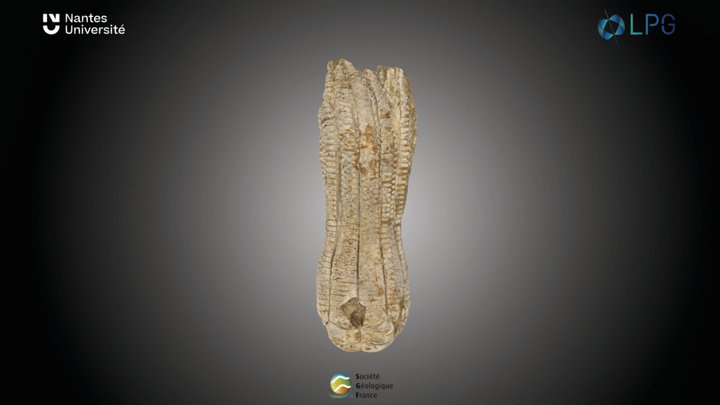
3D model
- Source
- Sketchfab
- Licence
- CC Attribution-NonCommercial-ShareAlike
- Commercial use
- the licence does not allow it
Smithsonian Open Access and MorphoSource were not reached for this taxon, so this list is what the others held rather than everything there is.
The description on this site
- Source
- Wikipedia, “Encrinus”
- Licence
- CC BY-SA 4.0
This is what the site found, which is not the same as what exists.
Keep going
What may have been alongside itEncrinidae through timeFormations of the Middle TriassicThe world it lived on
Occurrence data from the Paleobiology Database, CC BY 4.0. Lamarck 1801