Elephas hysudrindicus
Elephas hysudrindicus, commonly known also as the Blora elephant in Indonesia, is a species of extinct elephant from the Pleistocene of Java. It is anatomically distinct from the Asian elephant, the last remaining species of elephant under the genus Elephas. The species existed from around the end of the Early Pleistocene until the end of the Middle Pleistocene, when it was replaced by the modern Asian elephant in Java. It coexisted with the fellow proboscidean Stegodon trigonocephalus, as well as archaic humans belonging to the species Homo erectus.

KemejaAmir8876 · CC BY-SA 4.0 · via Wikipedia/Commons. May be a photograph of a specimen, or an artist’s reconstruction — an interpretation of a skeleton, since colour and soft tissue are almost never preserved.
On record
Recorded, not inferred- Sits inside
- ElephasPBDB
- Diet
- grazer, browserPBDB, for Elephantidae
- Life habit
- ground dwellingPBDB, for Elephantidae
- Motility
- actively mobilePBDB, for Osteichthyes
- Environment
- terrestrialPBDB, for Eutheria
Time the record covers
At least 645 thousand years on record.
The record covers at least 774 ka to 129 ka. No occurrence read is dated outside 2.58 Mya to 11.7 ka.
2 occurrences of Elephas hysudrindicus on record, most of them in the Pleistocene. Bar height is expected occurrences, not a count: each fossil is spread across the span it is dated to, so a tall narrow bar means tight dating and a low wide one means loose.
When
2 occurrences- Pleistocene100%
These are dates about fossils, not the animal: the record can only begin after it arose and end before it died out, so either end may reach further. Shares are expected occurrences: a fossil dated to a span is counted partly in each period it straddles. More on what this infers.
Elephas hysudrindicus and its relatives
PleistoceneWhere Elephas hysudrindicus and its relatives were recorded in the Pleistocene.
Found in the same rock
24 taxa- Bos (Bibos)2 sites
- Bubalus palaeokerabau2 sites
- Hexaprotodon sivalensis2 sites
- Homo erectus2 sites
- Panthera tigris2 sites
- Rusa2 sites
- Stegodon trigonocephalus2 sites
- Sus2 sites
- Tapirus indicus2 sites
- Cervidae1 site
- Cervus lydekkeri1 site
- Crocodylus siamensis1 site
- Duboisia santeng1 site
- Epileptobos groenveldtii1 site
- Gavialis bengawanicus1 site
- Lutrogale1 site
- Macaca1 site
- Manis1 site
- Muntiacus muntjak1 site
- Pachycrocuta brevirostris1 site
- Rhinoceros sondaicus1 site
- Rhinoceros unicornis kendengindicus1 site
- Stegodon hypsilophus1 site
- Sus brachygnathus1 site
The Paleobiology Database records 2 sites for Elephas hysudrindicus, and this reads all of them. The number is how many of those sites it was catalogued from too.
This is not a list of everything alive at the time. It is only what has come out of the same ground as this animal and been written down.
Entered from
1 referenceEach of the 2 occurrences read was entered from one of these publications, ordered by how many each accounts for. This is not a search for papers mentioning the name. Each entry links to the Paleobiology Database's own record for the work.
Media and terms
Media content1
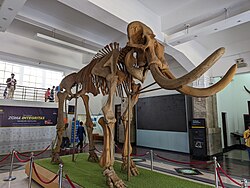
Picture of Elephas hysudrindicus
- Source
- Wikipedia/Commons
- Credit
- KemejaAmir8876
- Licence
- CC BY-SA 4.0
- Commercial use
- the licence allows it
No 3D scan of Elephas hysudrindicus was found in Sketchfab.
Smithsonian Open Access and MorphoSource were not reached for this taxon, so this list is what the others held rather than everything there is.
The description on this site
- Licence
- CC BY-SA 4.0
This is what the site found, which is not the same as what exists.
Keep going
What may have been alongside itElephas through timeFormations of the PleistoceneThe world it lived on
Occurrence data from the Paleobiology Database, CC BY 4.0. Dubois 1908