Dorcatherium
Dorcatherium is an extinct genus of tragulid ruminant which existed in Europe, East Africa, and the Siwaliks during the Miocene and possibly Pliocene.

Ghedoghedo · CC BY-SA 3.0 · via Wikipedia/Commons. May be a photograph of a specimen, or an artist’s reconstruction — an interpretation of a skeleton, since colour and soft tissue are almost never preserved.
On record
Recorded, not inferred- Sits inside
- TragulidaePBDB
- Diet
- frugivore, grazerPBDB, for Tragulidae
- Life habit
- ground dwellingPBDB, for Tragulidae
- Motility
- actively mobilePBDB, for Osteichthyes
- Environment
- terrestrialPBDB, for Artiodactyla
Time the record covers
At least 8.7 million years on record.
The record covers at least 15.98 Mya to 7.246 Mya. No occurrence read is dated outside 23.04 Mya to 2.58 Mya.
166 occurrences of Dorcatherium on record, most of them in the Miocene. Bar height is expected occurrences, not a count: each fossil is spread across the span it is dated to, so a tall narrow bar means tight dating and a low wide one means loose.
When
166 occurrencesThese are dates about fossils, not the animal: the record can only begin after it arose and end before it died out, so either end may reach further. Shares are expected occurrences: a fossil dated to a span is counted partly in each period it straddles. More on what this infers.
Found in
33 formations
- Maboko Formation13
- Chinji Formation · Siwalik Group7
- Brackwater Molasse Formation · Molasse Group5
- Lothidok Formation4
- Xiacaowan Formation4
- Dam Formation4
Loading coastlines…
The named rock units Dorcatherium has been recovered from, largest first. Drawn where the rock is now, not where it formed. 9 further formations hold fewer occurrences each and are not listed. 81 occurrences have no formation on record, which is common for older literature.
Dorcatherium and its relatives
MioceneWhere Dorcatherium and its relatives were recorded in the Miocene.
Found in the same rock
1,502 taxa- Rhinocerotidae24 sites
- Anchitherium aurelianense23 sites
- Bovidae22 sites
- Trionyx21 sites
- Aceratherium20 sites
- Gomphotherium angustidens19 sites
- Palaeomeryx19 sites
- Testudo18 sites
- Hyotherium soemmeringi17 sites
- Mustelidae17 sites
- Bunolistriodon16 sites
- Procervulus dichotomus16 sites
- Prodeinotherium bavaricum16 sites
- Prolagus oeningensis16 sites
- Brachypotherium brachypus15 sites
- Deinotherium giganteum15 sites
- Martes15 sites
- Steneofiber depereti15 sites
- Gazella14 sites
- Hyotherium14 sites
- Soricidae14 sites
- Gomphotheriidae13 sites
- Spermophilinus bredai13 sites
- Aureliachoerus aurelianensis12 sites
The Paleobiology Database records 113 sites for Dorcatherium, and this reads all of them. The number is how many of those sites it was catalogued from too. The 24 sharing the most are listed.
This is not a list of everything alive at the time. It is only what has come out of the same ground as this animal and been written down.
Entered from
86 references- Les fossiles de mammifères miocènes de la colletion de J.-P. Hartmann conservés dans le Musée du Savignéen9
- A comparison of larger fossil mammals in the stratotypes of the Chinji, Nagri and Dhok Pathan Formations (Punjab, Pakistan)9
- Stratigraphy and mammal faunas of the Brackwassermolasse in the surroundings of Ulm (Southwest Germany)6
- La succession des faunes de mammiferes miocenes de Pontigne (Maine-et-Loire, France)5
- Le gisement a mammiferes miocenes de Castelnau-d'Arbieu (Gers). Donnees nouvelles et implications biostratigraphiques4
- The Artiodactyla of Ramapithecus site, Lufeng, Yunnan4
- Preliminary report on the geology and vertebrate fauna of the Miocene Manchar Formation, Sind, Pakistan4
- The Aragonian vertebrate fauna of Xiacaowan, Jiangsu4
- New Higher Primate Fossils from the Middle Miocene Deposits at Majiwa and Kaloma, Western Kenya4
- The Lower Miocene Fauna of Al-Sarrar (Eastern Province, Saudi Arabia)4
- The Miocene fossil beds of Maboko Island, Kenya: Geology, age, taphonomy, and palaeontology4
- Descriptions of the molar teeth and other remains of Mammalia4
Each of the 166 occurrences read was entered from one of these publications, ordered by how many each accounts for. This is not a search for papers mentioning the name. 74 further references are not listed. Entries link to doi.org where the Paleobiology Database holds an identifier, and to its own record where it does not. Relayed as the Paleobiology Database holds them, not checked against what they resolve to.
Media and terms
Media content2
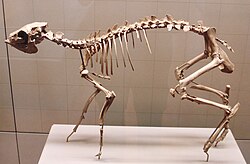
Picture of Dorcatherium
- Source
- Wikipedia/Commons
- Credit
- Ghedoghedo
- Licence
- CC BY-SA 3.0
- Commercial use
- the licence allows it
Structured light scan
- Source
- MorphoSource
- Licence
- In Copyright
- Commercial use
- cannot be read from the licence given — check the record
- Specimen
- Dorcatherium majus · YPM:VP:YPM VP 020153
Smithsonian Open Access was not reached for this taxon, so this list is what the others held rather than everything there is.
The description on this site
- Licence
- CC BY-SA 4.0
This is what the site found, which is not the same as what exists.
Keep going
What may have been alongside itTragulidae through timeFormations of the MioceneThe world it lived on
Occurrence data from the Paleobiology Database, CC BY 4.0. Kaup 1839