Dinomyidae
The Dinomyidae are a family of South American hystricognath rodents: the dinomyids were once a very speciose group, but now contain only a single living species, the pacarana. Several of the extinct dinomyids were among the largest rodents known to date; these included the bison-sized Josephoartigasia monesi and the smaller Josephoartigasia magna. The dinomyids are thought to have occupied ecological niches associated with large grazing mammals due to their ability to compete with the native ungulates of South America. Conversely, they could feed on aquatic or swampy plants along the ancient rivers. These large forms disappeared after the formation of a connection to North America. The modern pacarana is only modest, considerably smaller than the capybara.

Benjamin Frable · CC0 · via Wikipedia/Commons. May be a photograph of a specimen, or an artist’s reconstruction — an interpretation of a skeleton, since colour and soft tissue are almost never preserved.
On record
Recorded, not inferred- Sits inside
- ChinchilloideaPBDB
- Diet
- frugivore, folivorePBDB
- Life habit
- ground dwellingPBDB
- Motility
- actively mobilePBDB, for Osteichthyes
- Environment
- terrestrialPBDB, for Eutheria
Time the record covers
At least 17 million years on record.
The record covers at least 17.5 Mya to 11.7 ka. No occurrence read is dated outside 21 Mya to 0 Mya.
237 occurrences of Dinomyidae on record, most of them in the Miocene. The Paleobiology Database records this as a living group. Bar height is expected occurrences, not a count: each fossil is spread across the span it is dated to, so a tall narrow bar means tight dating and a low wide one means loose.
When
237 occurrences- Miocene90%
- Pliocene8%
- Pleistoceneunder 1%
- Holoceneunder 1%
These are dates about fossils, not the animal: the record can only begin after it arose and end before it died out, so either end may reach further. Shares are expected occurrences: a fossil dated to a span is counted partly in each period it straddles. More on what this infers.
Found in
33 formations
- Ituzaingo Formation50
- Solimoes Formation25
- Villavieja Formation · Honda Group25
- Chiquimil Formation13
- Pinturas Formation11
- Urumaco Formation11
Loading coastlines…
The named rock units Dinomyidae has been recovered from, largest first. Drawn where the rock is now, not where it formed. 9 further formations hold fewer occurrences each and are not listed. 24 occurrences have no formation on record, which is common for older literature.
Dinomyidae and its relatives
MioceneWhere Dinomyidae and its relatives were recorded in the Miocene.
Found in the same rock
972 taxa- Neoreomys australis14 sites
- Scleromys13 sites
- Octodontoidea12 sites
- Palaeothentes minutus11 sites
- Protypotherium11 sites
- Acarechimys minutissimus10 sites
- Acdestis oweni10 sites
- Cardiomys10 sites
- Luantus propheticus9 sites
- Orthomyctera9 sites
- Perimys erutus9 sites
- Potamarchus9 sites
- Prolagostomus9 sites
- Scleromys quadrangulatus9 sites
- Steiromys duplicatus9 sites
- Stichomys9 sites
- Tetrastylus9 sites
- Branisamyopsis praesigmoides8 sites
- Perimys8 sites
- Perimys intermedius8 sites
- Prostichomys bowni8 sites
- Proterotheriidae8 sites
- Acarechimys7 sites
- Acarechimys minutus7 sites
The Paleobiology Database records 83 sites for Dinomyidae, and this reads all of them. The number is how many of those sites it was catalogued from too. The 24 sharing the most are listed.
This is not a list of everything alive at the time. It is only what has come out of the same ground as this animal and been written down.
Entered from
60 references- Los roedores del “Mesopotamiense” (Mioceno tardío, Formación Ituzaingó) de la provincia de Entre Ríos (Ar- gentina)34
- Hystricomorph rodents from the late Miocene of Colombia, South America31
- Imigrantes em um continente perdido: O registro fossilífero de roedores Caviomorpha (Mammalia: Rodentia: Ctenohystrica) do Cenozoico do Brasil15
- Miocene vertebrates from Entre Rios province, eastern Argentina14
- Neoreomys and Scleromys (Rodentia, Hystricognathi) from the Pinturas Formation, late Early Miocene of Patagonia, Argentina12
- Taxonomic and ontogenetic diversity of Dinomyidae (Rodentia) from the late Miocene-early Pliocene of La Pampa province (Argentina) based on cranio-dental remains9
- Cronobioestratigrafía del Mioceno tardío – Plioceno temprano, Puerta de Corral Quemado y Villavil, provincia de Catamarca, Argentina9
- Bioestratigrafia de la fauna de mamíferos de las Formaciones Socorro, Urumaco y Codore (Mioceno medio - Plioceno temprno)de la región de Urumaco, Falcon, Venezuela9
- A 60-million-year Cenozoic history of western Amazonian ecosystems in Contamana, eastern Peru8
- Life in the proto-Amazonia: middle Miocene mammals from the Fitzcarrald Arch (Peruvian Amazonia)8
- The Acre vertebrate fauna: Age, diversity, and geography8
- Revision of the Miocene caviomorph rodents from the Río Santa Cruz (Argentinean Patagonia)6
Each of the 237 occurrences read was entered from one of these publications, ordered by how many each accounts for. This is not a search for papers mentioning the name. 48 further references are not listed. Entries link to doi.org where the Paleobiology Database holds an identifier, and to its own record where it does not. Relayed as the Paleobiology Database holds them, not checked against what they resolve to.
Media and terms
Media content1
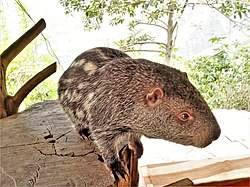
Picture of Dinomyidae
- Source
- Wikipedia/Commons
- Credit
- Benjamin Frable
- Licence
- CC0
- Commercial use
- the licence allows it
No 3D scan of Dinomyidae was found in Sketchfab.
Smithsonian Open Access and MorphoSource were not reached for this taxon, so this list is what the others held rather than everything there is.
The description on this site
- Source
- Wikipedia, “Dinomyidae”
- Licence
- CC BY-SA 4.0
This is what the site found, which is not the same as what exists.
Keep going
What may have been alongside itChinchilloidea through timeFormations of the MioceneThe world it lived on
Occurrence data from the Paleobiology Database, CC BY 4.0. Peters 1873