Dictyoconus
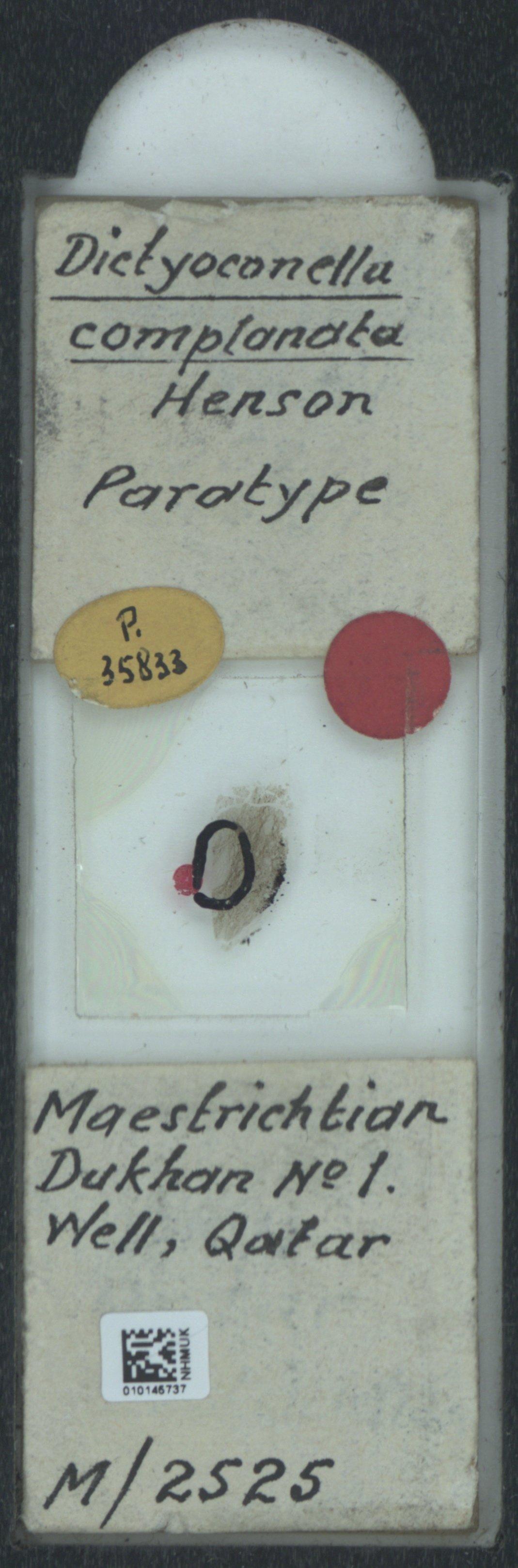
via iDigBio · CC BY · via iDigBio. May be a photograph of a specimen, or an artist’s reconstruction — an interpretation of a skeleton, since colour and soft tissue are almost never preserved.
On record
Recorded, not inferred- Sits inside
- OrbitolinidaePBDB
- Diet
- detritivorePBDB, for Textulariina
- Life habit
- infaunalPBDB, for Textulariina
- Motility
- stationaryPBDB, for Foraminifera
Time the record covers
At least 98 million years on record.
The record covers at least 121.4 Mya to 23.04 Mya. No occurrence read is dated outside 125.77 Mya to 15.98 Mya.
37 occurrences of Dictyoconus on record, most of them in the Paleocene. Bar height is expected occurrences, not a count: each fossil is spread across the span it is dated to, so a tall narrow bar means tight dating and a low wide one means loose.
When
37 occurrencesThese are dates about fossils, not the animal: the record can only begin after it arose and end before it died out, so either end may reach further. Shares are expected occurrences: a fossil dated to a span is counted partly in each period it straddles. More on what this infers.
Found in
9 formations
- Sinjar Formation7
- Stuart City Formation · Fredericksburg Group2
- Avon Park Formation1
- Inglis Limestone Formation · Ocala Group1
- Schrattenkalk Formation1
- Suwannee Limestone Formation · Vicksburg Group1
Loading coastlines…
The named rock units Dictyoconus has been recovered from, largest first. Drawn where the rock is now, not where it formed. 21 occurrences have no formation on record, which is common for older literature.
Dictyoconus and its relatives
PaleoceneWhere Dictyoconus and its relatives were recorded in the Paleocene.
Found in the same rock
251 taxa- Kathina10 sites
- Coskinon rajkae7 sites
- Elianella elegans7 sites
- Fallotella alavensis7 sites
- Globoflarina sphaeroidea7 sites
- Glomalveolina primaeva7 sites
- Hottingerina7 sites
- Idalina sinjarica7 sites
- Miliolida7 sites
- Soriella bitlisica7 sites
- Textulariida7 sites
- Thalmannita7 sites
- Vania anatolica7 sites
- Assilina6 sites
- Bryozoa6 sites
- Ranikothalia6 sites
- Rotalia trochidiformis6 sites
- Corallinales5 sites
- Miscellanea5 sites
- Orbitolites5 sites
- Polystrata alba5 sites
- Quinqueloculina5 sites
- Textularia5 sites
- Archaeolithothamnium4 sites
The Paleobiology Database records 28 sites for Dictyoconus, and this reads all of them. The number is how many of those sites it was catalogued from too. The 24 sharing the most are listed.
This is not a list of everything alive at the time. It is only what has come out of the same ground as this animal and been written down.
Entered from
14 references- Depositional History of a Paleogene Carbonate Ramp (Western Cephalonia, Ionian Islands, Greece)8
- A study of biostratigraphy of Sinjar Formation in selected sections from northern Iraq7
- Geology of the Republic of Haiti6
- L'Oligocene e il Miocene della Somalia. Stratigrafia, Tettonica, Paleontologia (Macroforaminferi, Coralli, Molluschi)5
- Eocene Mollusks from Citrus and Levy Counties, Florida2
- Albian rudist biostratigraphy (Bivalvia), Comanche shelf to shelf margin, Texas1
- Chronostratigraphy of Campanian-Maastrichtian platform carbonates and rudist associations of Salento (Apulia, Italy)1
- Barremian-Albian rudist zones, U.S. Gulf Coast1
- Taxonomic and Paelogeographic Approaches to the Dasyclad Algae in the Upper Jurassic (Kimmeridgian)-Upper Cretaceous (Cenomanian) Peritidal Carbonates of the Fele (YassÝbel) Area (Western Taurides, Turkey)1
- Aspects of the Cenozoic stratigraphy of the Northern Sulaiman Ranges, Pakistan1
- Bioherme und Biostrome im Allgäuer Schrattenkalk (Helvetikum, Unterkreide).1
- The Urgonian facies of the Soviet Carpathians1
Each of the 37 occurrences read was entered from one of these publications, ordered by how many each accounts for. This is not a search for papers mentioning the name. 2 further references are not listed. Entries link to doi.org where the Paleobiology Database holds an identifier, and to its own record where it does not. Relayed as the Paleobiology Database holds them, not checked against what they resolve to.
Media and terms
Media content1
Picture of Dictyoconus
- Source
- iDigBio
- Credit
- via iDigBio
- Licence
- CC BY
- Commercial use
- the licence allows it
No 3D scan was found. Smithsonian Open Access, MorphoSource and Sketchfab were all searched.
This is what the site found, which is not the same as what exists.
Keep going
What may have been alongside itOrbitolinidae through timeFormations of the PaleoceneThe world it lived on
Occurrence data from the Paleobiology Database, CC BY 4.0.