Dentalium
Searched as Dentalium sexangulum. The Paleobiology Database treats Dentalium as the accepted name.
Dentalium is a large genus of tooth shells or tusk shells, marine scaphopod molluscs in the family Dentaliidae. The genus contains 50 described species and about 50 extinct species.

H. Zell · CC BY-SA 3.0 · via Wikipedia/Commons. May be a photograph of a specimen, or an artist’s reconstruction — an interpretation of a skeleton, since colour and soft tissue are almost never preserved.
On record
Recorded, not inferred- Sits inside
- DentaliidaePBDB
- Diet
- deposit feederPBDB, for Dentaliida
- Life habit
- semi-infaunalPBDB, for Dentaliida
- Motility
- slow-movingPBDB, for Dentaliida
- Vision
- blindPBDB, for Scaphopoda
Time the record covers
At least 25 million years on record.
The record covers at least 27.3 Mya to 1.8 Mya. No occurrence read is dated outside 33.9 Mya to 774 ka.
14 occurrences of Dentalium on record, most of them in the Pliocene. The Paleobiology Database records this as a living group, and the chart stops with its fossils rather than at the present. Bar height is expected occurrences, not a count: each fossil is spread across the span it is dated to, so a tall narrow bar means tight dating and a low wide one means loose.
When
14 occurrences- Oligocene7%
- Pliocene64%
- Pleistocene29%
These are dates about fossils, not the animal: the record can only begin after it arose and end before it died out, so either end may reach further. Shares are expected occurrences: a fossil dated to a span is counted partly in each period it straddles. More on what this infers.
Found in
8 formations
- Tielrode Formation1
- Oosterhout Formation1
- Cipero Marl Formation1
- Ecija Formation1
- Blue Clays Formation1
- Monte Giogo Formation1
Loading coastlines…
The named rock units Dentalium has been recovered from, largest first. Drawn where the rock is now, not where it formed. 6 occurrences have no formation on record, which is common for older literature.
Dentalium and its relatives
PlioceneWhere Dentalium and its relatives were recorded in the Pliocene.
Found in the same rock
1,851 taxa- Nuculana111 sites
- Striarca98 sites
- Corbula88 sites
- Cymbophora79 sites
- Turritella73 sites
- Syncyclonema71 sites
- Vertebrata67 sites
- Crenella serica65 sites
- Anomia argentaria61 sites
- Cubitostrea tecticosta59 sites
- Ostrea52 sites
- Vetericardiella52 sites
- Caestocorbula (Caestocorbula) crassaplica51 sites
- Turritella bilira50 sites
- Euspira rectilabrum49 sites
- Crassatella vadosa47 sites
- Micrabacia46 sites
- Nemodon eufaulensis46 sites
- Nucula percrassa45 sites
- Cadulus44 sites
- Paladmete cancellaria44 sites
- Turritella trilira44 sites
- Hamulus onyx43 sites
- Camptonectes bubonis42 sites
The Paleobiology Database records 1,304 sites for Dentalium, and this reads 240 of them. The number is how many of those sites it was catalogued from too. The 24 sharing the most are listed.
This is not a list of everything alive at the time. It is only what has come out of the same ground as this animal and been written down.
Entered from
12 references- Ambergris cololites of Pleistocene sperm whales from central Italy and description of the new ichnogenus and ichnospecies Ambergrisichnus alleronae3
- Scavengers and opportunists at work on whale carcasses: decapods, echinoids and fishes1
- First record of the knifetooth sawfish Anoxypristis (Elasmobranchii: Rhinopristiformes) from the Pliocene of Tuscany (central Italy)1
- The marine fossils malacofauna in a Plio-Pleistocene section from Vallin Buio (Livorno, Italy)1
- Neogene stratigraphy of the Langenboom locality (Noord-Brabant, Netherlands)1
- Nuove specie di Gasteropodi del Piacenziano di rio Crevalese, Castell’Arquato (Piacenza, Italia)1
- Prospeccion paleontologica superficial en las margenes del Rio Guadaira, en el Termino municipal de Alcala de Guadaira (Sevilla)1
- Facies analysis, paleoecology and sequence stratigraphy in a Pliocene siliciclastic succession, Sanb Miniato (Pisa, Italy)1
- Palaeoecology of some Mollusca from the Tielrode Sands (Pliocene, Belgium)1
- Su alcuni Moluschi pliocenici della Val d'Era (Toscana) e su alcune anomalie di sviluppo [Pliocene molluscs from the Era Valley (Toscana)]1
- Description, correlation, and paleoecology of Tertiary Cipero Marl, Trinidad, BWI1
- I fossile del Monte Vaticano1
Each of the 14 occurrences read was entered from one of these publications, ordered by how many each accounts for. This is not a search for papers mentioning the name. Entries link to doi.org where the Paleobiology Database holds an identifier, and to its own record where it does not. Relayed as the Paleobiology Database holds them, not checked against what they resolve to.
Media and terms
Media content3
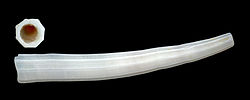
Picture of Dentalium
- Source
- Wikipedia/Commons
- Credit
- H. Zell
- Licence
- CC BY-SA 3.0
- Commercial use
- the licence allows it
CT scan
- Source
- MorphoSource
- Licence
- In Copyright
- Commercial use
- cannot be read from the licence given — check the record
- Specimen
- Dentalium sp. · MZRC:2082-2
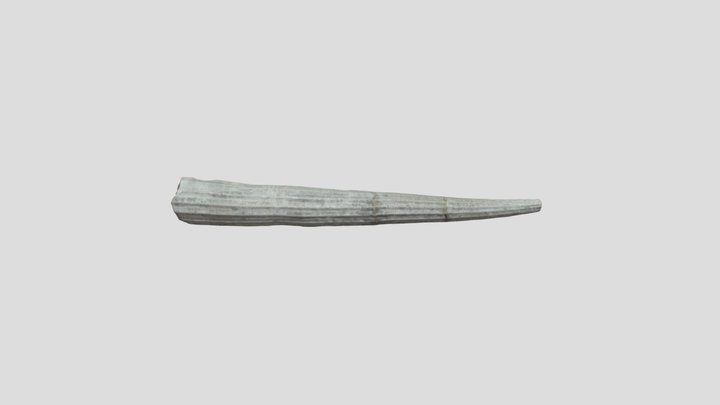
3D model
- Source
- Sketchfab
- Licence
- CC Attribution-NonCommercial
- Commercial use
- the licence does not allow it
Smithsonian Open Access was not reached for this taxon, so this list is what the others held rather than everything there is.
The description on this site
- Licence
- CC BY-SA 4.0
This is what the site found, which is not the same as what exists.
Keep going
What may have been alongside itDentaliidae through timeFormations of the PlioceneThe world it lived on
Occurrence data from the Paleobiology Database, CC BY 4.0. Linnaeus 1758