Daphnia
Daphnia is a genus of small planktonic crustaceans, 0.2–6.0 mm (0.01–0.24 in) in length. Daphnia are members of the order Anomopoda, and are one of the several small aquatic crustaceans commonly called water fleas because their saltatory swimming style resembles the movements of fleas. Daphnia spp. live in various aquatic environments ranging from acidic swamps to freshwater lakes and ponds.

(Photo: Paul Hebert) · CC BY 2.5 · via Wikipedia/Commons. May be a photograph of a specimen, or an artist’s reconstruction — an interpretation of a skeleton, since colour and soft tissue are almost never preserved.
On record
Recorded, not inferred- Sits inside
- CladoceraPBDB
- Diet
- suspension feeder, detritivorePBDB, for Branchiopoda
- Life habit
- nektobenthicPBDB, for Branchiopoda
- Motility
- slow-movingPBDB, for Branchiopoda
- Vision
- well-developedPBDB, for Branchiopoda
- Environment
- marine,brackish,freshwaterPBDB, for Branchiopoda
Time the record covers
At least 22 million years on record.
The record covers at least 23.04 Mya to 129 ka. No occurrence read is dated outside 27.3 Mya to 11.7 ka.
4 occurrences of Daphnia on record, most of them in the Pleistocene. The Paleobiology Database records this as a living group. Bar height is expected occurrences, not a count: each fossil is spread across the span it is dated to, so a tall narrow bar means tight dating and a low wide one means loose.
When
4 occurrences- Oligocene25%
- Miocene25%
- Pleistocene50%
These are dates about fossils, not the animal: the record can only begin after it arose and end before it died out, so either end may reach further. Shares are expected occurrences: a fossil dated to a span is counted partly in each period it straddles. More on what this infers.
Found in
1 formation
Loading coastlines…
The named rock units Daphnia has been recovered from, largest first. Drawn where the rock is now, not where it formed. 3 occurrences have no formation on record, which is common for older literature.
Daphnia and its relatives
PleistoceneWhere Daphnia and its relatives were recorded in the Pleistocene.
Found in the same rock
207 taxa- ? Pyrenomycetidae indet.1 site
- Acalles icarus1 site
- Acrididae1 site
- Aeolothripidae1 site
- Aeschna dido1 site
- Agabus (Acatodes) infuscatus1 site
- Agabus reductus1 site
- Agrilus baueri1 site
- Aleocharinae1 site
- Anisoptera1 site
- Anomala primigenia1 site
- Anomala thetis1 site
- Anomala tumulata1 site
- Anthophagus giebeli1 site
- Anthophorini1 site
- Aphodius1 site
- Aphodius krantzi1 site
- Apidae1 site
- Apioninae1 site
- Asilus1 site
- Asynarchus1 site
- Atheta1 site
- Bembidion1 site
- Bembidion (Plataphus) breve1 site
The Paleobiology Database records 4 sites for Daphnia, and this reads all of them. The number is how many of those sites it was catalogued from too. The 24 sharing the most are listed.
This is not a list of everything alive at the time. It is only what has come out of the same ground as this animal and been written down.
Entered from
4 references- Palaeoentomological study of the lacustrine oil-shales of the lower Miocene San Chils locality (Ribesalbes-Alcora Basin, Castellón province, Spain)1
- Environmental interpretation of fossil insect assemblages from MIS 5 at Ziegler Reservoir, Snowmass Village, Colorado1
- Interglacial remains of caribou (Rangifer tarandus) and lemming (Dicrostonyx torquatus (?)) from North Greenland1
- Gliederthiere aus der Braunkohle des Niederrhein's, der Wetterau und der Röhn1
Each of the 4 occurrences read was entered from one of these publications, ordered by how many each accounts for. This is not a search for papers mentioning the name. Entries link to doi.org where the Paleobiology Database holds an identifier, and to its own record where it does not. Relayed as the Paleobiology Database holds them, not checked against what they resolve to.
Media and terms
Media content2

Picture of Daphnia
- Source
- Wikipedia/Commons
- Credit
- (Photo: Paul Hebert)
- Licence
- CC BY 2.5
- Commercial use
- the licence allows it
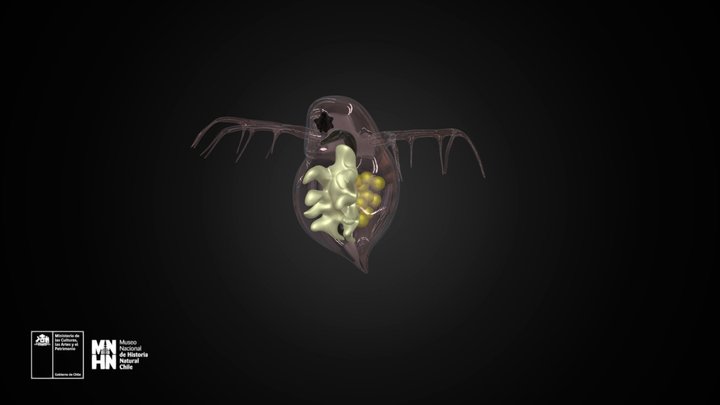
3D model
- Source
- Sketchfab
- Licence
- CC0 Public Domain
- Commercial use
- the licence allows it
Smithsonian Open Access and MorphoSource were not reached for this taxon, so this list is what the others held rather than everything there is.
The description on this site
- Source
- Wikipedia, “Daphnia”
- Licence
- CC BY-SA 4.0
This is what the site found, which is not the same as what exists.
Keep going
What may have been alongside itCladocera through timeFormations of the PleistoceneThe world it lived on
Occurrence data from the Paleobiology Database, CC BY 4.0. Muller 1785