Crustacea
Searched as Crustacea indet.. The Paleobiology Database treats Crustacea as the accepted name.
Crustaceans are mandibulate arthropods that are traditionally a part of the paraphyletic subphylum Crustacea. Crustaceans are mainly aquatic, including decapods, seed shrimps, branchiopods, fish lice, krill, remipedes, isopods, barnacles, copepods, opossum shrimps, amphipods and mantis shrimp. It is now well accepted that hexapods are cladistically crustaceans, with the two groups now combined in the monophyletic clade Pancrustacea. The three classes Cephalocarida, Branchiopoda, and Remipedia are more closely related to the hexapods than they are to any other crustaceans.

djpmapleferryman · CC BY 2.0 · via Wikipedia/Commons. May be a photograph of a specimen, or an artist’s reconstruction — an interpretation of a skeleton, since colour and soft tissue are almost never preserved.
On record
Recorded, not inferred- Also called
- crustaceanPBDB
- Sits inside
- ArthropodaPBDB
- Motility
- actively mobilePBDB, for Arthropoda
Time the record covers
At least 509 million years on record.
The record covers at least 509.7 Mya to 129 ka. No occurrence read is dated outside 515.3 Mya to 11.7 ka.
86 occurrences of Crustacea on record, most of them in the Late Cretaceous. The Paleobiology Database records this as a living group. Bar height is expected occurrences, not a count: each fossil is spread across the span it is dated to, so a tall narrow bar means tight dating and a low wide one means loose.
When
86 occurrences- Cambrian2%
- Ordovicianunder 1%
- Silurianunder 1%
- Devonian1%
- Carboniferous6%
- Early Triassic2%
- Late Triassic5%
- Early Jurassic11%
- Middle Jurassic10%
- Late Jurassic9%
- Early Cretaceous8%
- Late Cretaceous17%
- Paleocene2%
- Eocene5%
- Oligocene3%
- Miocene8%
- Pliocene4%
- Pleistocene5%
These are dates about fossils, not the animal: the record can only begin after it arose and end before it died out, so either end may reach further. Shares are expected occurrences: a fossil dated to a span is counted partly in each period it straddles. More on what this infers.
Found in
50 formations
- Pigeon Point Formation4
- Coleraine Formation2
- Chari Formation2
- Wild Cow Formation2
- Kinzers Formation2
- Osmington Oolite Formation1
Loading coastlines…
The named rock units Crustacea has been recovered from, largest first. Drawn where the rock is now, not where it formed. 26 further formations hold fewer occurrences each and are not listed. 29 occurrences have no formation on record, which is common for older literature.
Crustacea and its relatives
Late CretaceousWhere Crustacea and its relatives were recorded in the Late Cretaceous.
Found in the same rock
3,898 taxa- Balanus59 sites
- Ostrea46 sites
- Cirripedia41 sites
- Bryozoa31 sites
- Echinoidea30 sites
- Turritella29 sites
- Chlamys28 sites
- Serpula25 sites
- Cliona19 sites
- Gastropoda18 sites
- Dentalium16 sites
- Nucula (Nucula) proxima16 sites
- Spondylus16 sites
- Tellina16 sites
- Anomia simplex15 sites
- Arca15 sites
- Conradostrea sculpturata15 sites
- Mulinia lateralis15 sites
- Anomia13 sites
- Cardium12 sites
- Cibicides12 sites
- Crepidula fornicata12 sites
- Modiolus12 sites
- Nuculana acuta12 sites
The Paleobiology Database records 1,356 sites for Crustacea, and this reads 240 of them. The number is how many of those sites it was catalogued from too. The 24 sharing the most are listed.
This is not a list of everything alive at the time. It is only what has come out of the same ground as this animal and been written down.
Entered from
65 references- A temporary exposure of Lower Lias (Late Sinemurian) at Dimmer Camp, Castle Cary, Somerset, south-west England4
- Checklist of Mesozoic macrofossil localities in the Santa Cruz Mountains and vicinity4
- The Stratigraphical Palaeontology, ammonites excluded, of the Stowell Park borehole4
- Tendaguru3
- Early Jurassic Bivalvia of western Canada. Part I. Subclasses Palaeotaxodonta, Pteriomorpha, and Isofilibranchia3
- Unpublished data from Kachchh2
- Unpublished data2
- Miocene reef facies of the pelagian region (Central Mediterranean)2
- Sedimentary patterns in Pennsylvanian strata at the Kinney Brick Company Quarry, Bernalillo County, New Mexico2
- Fazielle und paläontologische Untersuchungen in oberrhätischen Riffen (Feichtenstein- und Gruberriff bei Hintersee, Salzburg, Nördliche Kalkalpen)2
- Cretaceous of the Mesabi Iron Range, Minnesota2
- Lower Cambrian Olenellus zone of the Appalachians2
Each of the 86 occurrences read was entered from one of these publications, ordered by how many each accounts for. This is not a search for papers mentioning the name. 53 further references are not listed. Entries link to doi.org where the Paleobiology Database holds an identifier, and to its own record where it does not. Relayed as the Paleobiology Database holds them, not checked against what they resolve to.
Media and terms
Media content2

Picture of Crustacea
- Source
- Wikipedia/Commons
- Credit
- djpmapleferryman
- Licence
- CC BY 2.0
- Commercial use
- the licence allows it
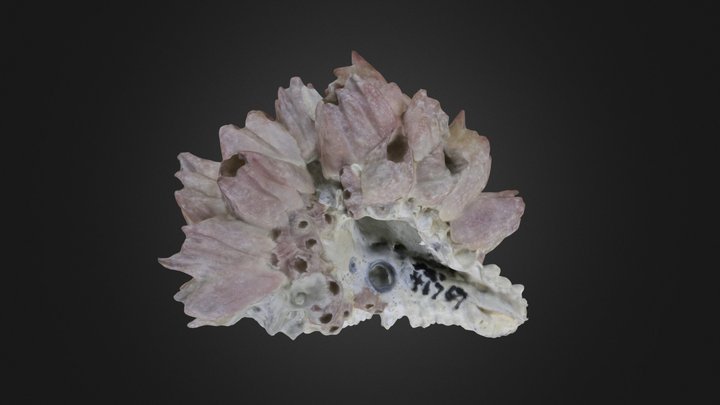
3D model
- Source
- Sketchfab
- Licence
- CC0 Public Domain
- Commercial use
- the licence allows it
Smithsonian Open Access was not reached for this taxon, so this list is what the others held rather than everything there is.
The description on this site
- Source
- Wikipedia, “Crustacean”
- Licence
- CC BY-SA 4.0
This is what the site found, which is not the same as what exists.
Keep going
What may have been alongside itArthropoda through timeFormations of the Late CretaceousThe world it lived on
Occurrence data from the Paleobiology Database, CC BY 4.0. (Brünnich 1772)