Corvaspis
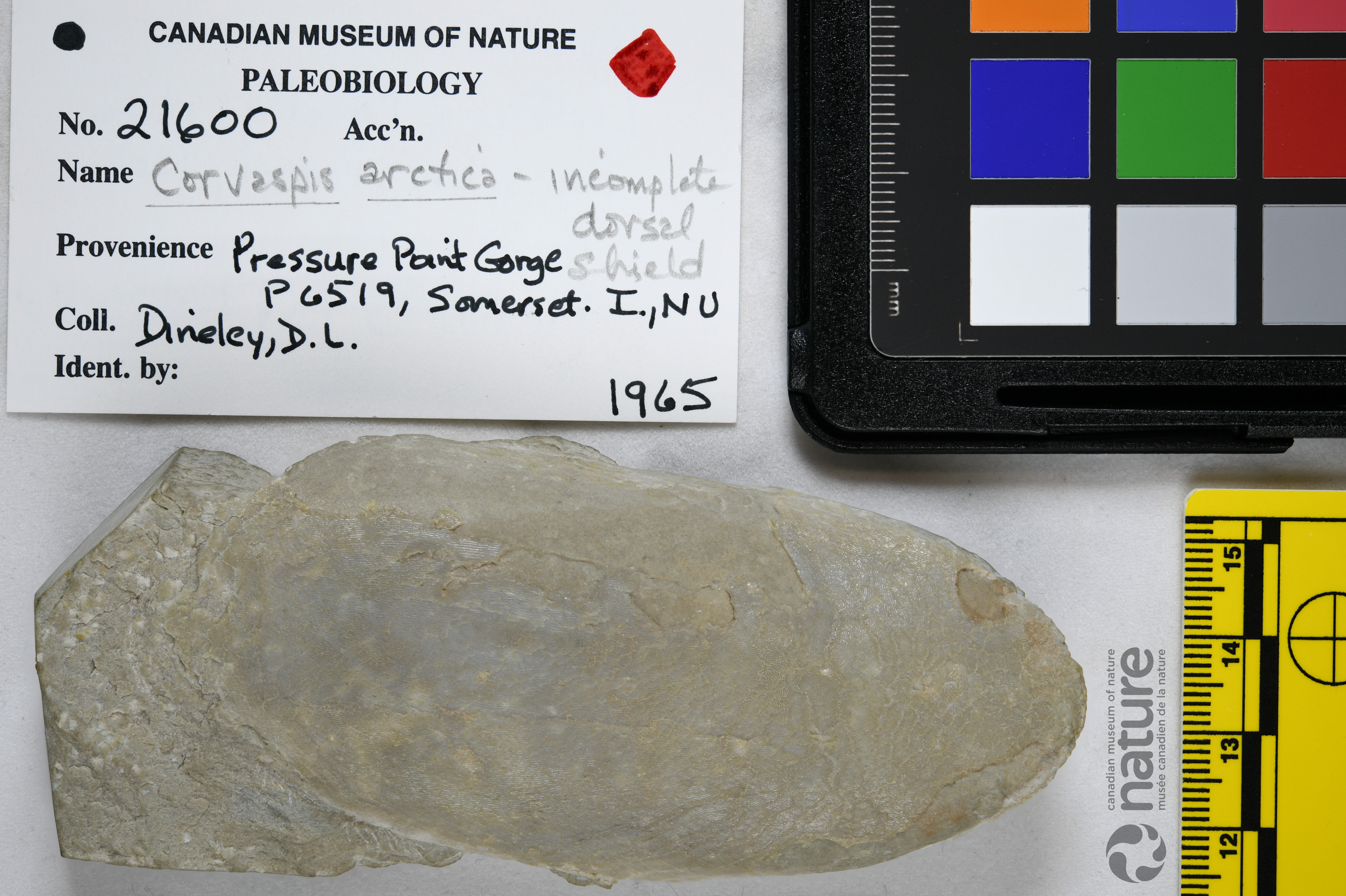
Canadian Museum of Nature · CC BY 4.0 · via GBIF. May be a photograph of a specimen, or an artist’s reconstruction — an interpretation of a skeleton, since colour and soft tissue are almost never preserved.
On record
Recorded, not inferred- Sits inside
- CorvaspididaePBDB
- Motility
- actively mobilePBDB, for Chordata
Time the record covers
At most 28 million years on record.
Every occurrence read is dated to somewhere between 426.7 Mya and 399.5 Mya, and nothing in the dating separates them, so that window is what the record shows rather than a span.
23 occurrences of Corvaspis on record, most of them in the Devonian. Bar height is expected occurrences, not a count: each fossil is spread across the span it is dated to, so a tall narrow bar means tight dating and a low wide one means loose.
When
23 occurrencesThese are dates about fossils, not the animal: the record can only begin after it arose and end before it died out, so either end may reach further. Shares are expected occurrences: a fossil dated to a span is counted partly in each period it straddles. More on what this infers.
Found in
10 formations
- Fraenkelryggen Formation6
- Peel Sound Formation4
- Ben Nevis Formation4
- Somerset Island Formation3
- Chortkov Formation1
- Delorme Formation1
Loading coastlines…
The named rock units Corvaspis has been recovered from, largest first. Drawn where the rock is now, not where it formed.
Corvaspis and its relatives
DevonianWhere Corvaspis and its relatives were recorded in the Devonian.
Found in the same rock
133 taxa- Traquairaspis15 sites
- Cephalaspis8 sites
- Poraspis8 sites
- Nikolivia elongata6 sites
- Turinia pagei6 sites
- Protopteraspis5 sites
- Torpedaspis elongata5 sites
- Alainaspis platyrhina4 sites
- Machairaspis4 sites
- Nikolivia depressa4 sites
- Pionaspis4 sites
- Poraspis polaris4 sites
- Acanthodii3 sites
- Boreania minima3 sites
- Canonia grossi3 sites
- Dinaspidella3 sites
- Homalaspidella3 sites
- Lingula3 sites
- Nikolivia gutta3 sites
- Nostolepis3 sites
- Pattenaspis3 sites
- Actinopterygii2 sites
- Anglaspis2 sites
- Bivalvia2 sites
The Paleobiology Database records 23 sites for Corvaspis, and this reads all of them. The number is how many of those sites it was catalogued from too. The 24 sharing the most are listed.
This is not a list of everything alive at the time. It is only what has come out of the same ground as this animal and been written down.
Entered from
9 references- The vertebrate stratigraphy of the Lower Devonian (Red Bay Group and Wood Bay Formation) of Spitsbergen9
- A New Heterostracan from the Upper Silurian of Northwest Territories, Canada4
- A new subfamily of the Pteraspididae (Agnatha, Heterostraci) from the Upper Silurian and Lower Devonian of Arctic Canada3
- Habitat of Llandoverian-Lochkovian eurypterids2
- The Early Devonian armoured agnathans of Podolia, Ukraine1
- Protopteraspis Gosseleti (Vertebrata: Pteraspidomorphi: Heterostraci) from the Lower Devonian of Shropshire, England1
- Late Silurian fossil fishes sites of the Welsh Borders1
- Ostracoderm faunas of the Delorne and associated Siluri-Devonian Formations, North Western Territories, Canada1
- Amphiaspidiformes (Heterostraci) from the Silurian of the Canadian Arctic archipelago1
Each of the 23 occurrences read was entered from one of these publications, ordered by how many each accounts for. This is not a search for papers mentioning the name. Entries link to doi.org where the Paleobiology Database holds an identifier, and to its own record where it does not. Relayed as the Paleobiology Database holds them, not checked against what they resolve to.
Media and terms
Media content1
Picture of Corvaspis
- Source
- GBIF
- Credit
- Canadian Museum of Nature
- Licence
- CC BY 4.0
- Commercial use
- the licence allows it
No 3D scan of Corvaspis was found in Sketchfab.
Smithsonian Open Access and MorphoSource were not reached for this taxon, so this list is what the others held rather than everything there is.
This is what the site found, which is not the same as what exists.
Keep going
What may have been alongside itCorvaspididae through timeFormations of the DevonianThe world it lived on
Occurrence data from the Paleobiology Database, CC BY 4.0. Woodward 1934