Coreidae
Coreidae is a large family of predominantly sap-sucking insects in the Hemipteran suborder Heteroptera. The name "Coreidae" derives from the genus Coreus, which derives from the Ancient Greek κόρις (kóris) meaning bug.

tonrulkens · CC BY-SA 2.0 · via Wikipedia/Commons. May be a photograph of a specimen, or an artist’s reconstruction — an interpretation of a skeleton, since colour and soft tissue are almost never preserved.
On record
Recorded, not inferred- Also called
- leaf-footed bugPBDB
- Sits inside
- CoreoideaPBDB
- Motility
- actively mobilePBDB, for Arthropoda
- Environment
- terrestrialPBDB, for Insecta
Time the record covers
At least 224 million years on record.
The record covers at least 227.3 Mya to 2.58 Mya. No occurrence read is dated outside 237 Mya to 1.8 Mya.
65 occurrences of Coreidae on record, most of them in the Miocene. The Paleobiology Database records this as a living group, and the chart stops with its fossils rather than at the present. Bar height is expected occurrences, not a count: each fossil is spread across the span it is dated to, so a tall narrow bar means tight dating and a low wide one means loose.
When
65 occurrences- Late Triassic2%
- Middle Jurassicunder 1%
- Late Jurassicunder 1%
- Early Cretaceous6%
- Late Cretaceous6%
- Paleoceneunder 1%
- Eocene27%
- Oligocene11%
- Miocene45%
- Pleistocene2%
These are dates about fossils, not the animal: the record can only begin after it arose and end before it died out, so either end may reach further. Shares are expected occurrences: a fossil dated to a span is counted partly in each period it straddles. More on what this infers.
Found in
12 formations
- Shanwang Formation15
- Florissant Formation14
- Upper Freshwater-Molasse Formation8
- Rott Formation3
- Shahai Formation3
- Niveau du gypse d'Aix Formation2
Loading coastlines…
The named rock units Coreidae has been recovered from, largest first. Drawn where the rock is now, not where it formed. 14 occurrences have no formation on record, which is common for older literature.
Coreidae and its relatives
MioceneWhere Coreidae and its relatives were recorded in the Miocene.
Found in the same rock
1,510 taxa- Curculionidae5 sites
- Lygaeidae5 sites
- Acrididae4 sites
- Pentatomidae4 sites
- Aphrophora spumarioides3 sites
- Bibionidae3 sites
- Cerambycidae3 sites
- Formica demersa3 sites
- Formicidae3 sites
- Hemiptera3 sites
- Ichneumonidae3 sites
- Libellulidae3 sites
- Penthetria3 sites
- Plecia3 sites
- Polyphaga3 sites
- Tettigoniidae3 sites
- Abia shandongensis2 sites
- Anisoptera2 sites
- Anomala furva2 sites
- Aphaena lithoecia2 sites
- Apis (Synapis) miocenica2 sites
- Bibio2 sites
- Bibio brevis2 sites
- Bibio cratopodus2 sites
The Paleobiology Database records 31 sites for Coreidae, and this reads all of them. The number is how many of those sites it was catalogued from too. The 24 sharing the most are listed.
This is not a list of everything alive at the time. It is only what has come out of the same ground as this animal and been written down.
Entered from
24 references- The Tertiary Insects of North America14
- Heer, 185313
- Zhang et al., 19946
- Zhang, 19893
- The study of Early Cretaceous insects of Kezuo, west Liaoning3
- Miocene Heteroptera and Coleoptera (Insecta) from Shanwang of Shandong Province, China3
- Geocorisae (Landwanzen) aus den Oberoligocanen Ablagerungen von Rott3
- Fossil insects of cicada (Homoptera) and true bugs (Heteroptera) from Shanwang, Shandong2
- Insecta2
- Fossil insects from Yunnan2
- An additional Cretaceous Ferriantenna Cumming & Le Tirant, 2021 species with wildly exaggerated antennae (Hemiptera, Coreidae)1
- Drawing the Excalibur bug from the stone: adding credibility to the double-edged sword hypothesis of coreid evolution (Hemiptera, Coreidae)1
Each of the 65 occurrences read was entered from one of these publications, ordered by how many each accounts for. This is not a search for papers mentioning the name. 12 further references are not listed. Entries link to doi.org where the Paleobiology Database holds an identifier, and to its own record where it does not. Relayed as the Paleobiology Database holds them, not checked against what they resolve to.
Media and terms
Media content2

Picture of Coreidae
- Source
- Wikipedia/Commons
- Credit
- tonrulkens
- Licence
- CC BY-SA 2.0
- Commercial use
- the licence allows it
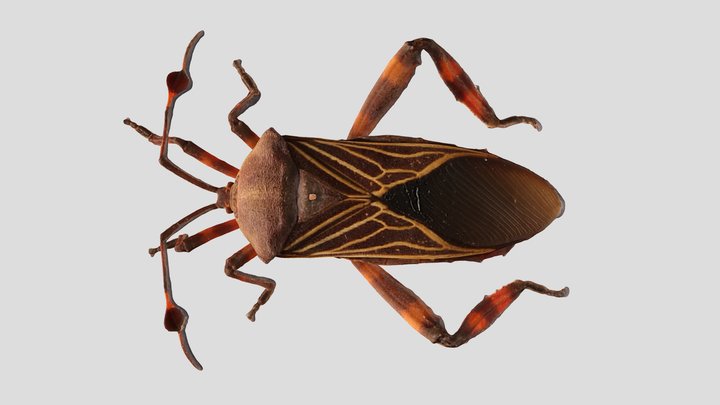
3D model
- Source
- Sketchfab
- Credit
- Yale Peabody Museum
- Licence
- CC Attribution
- Commercial use
- cannot be read from the licence given — check the record
Smithsonian Open Access was not reached for this taxon, so this list is what the others held rather than everything there is.
The description on this site
- Source
- Wikipedia, “Coreidae”
- Licence
- CC BY-SA 4.0
This is what the site found, which is not the same as what exists.
Keep going
What may have been alongside itCoreoidea through timeFormations of the MioceneThe world it lived on
Occurrence data from the Paleobiology Database, CC BY 4.0. Leach 1815