Cordia
Cordia is a genus of flowering plants in the family Cordiaceae. It contains 228 species of shrubs and trees, that are found in tropical and subtropical regions worldwide. Many of the species are commonly called manjack, while bocote may refer to several Central American species in Spanish.

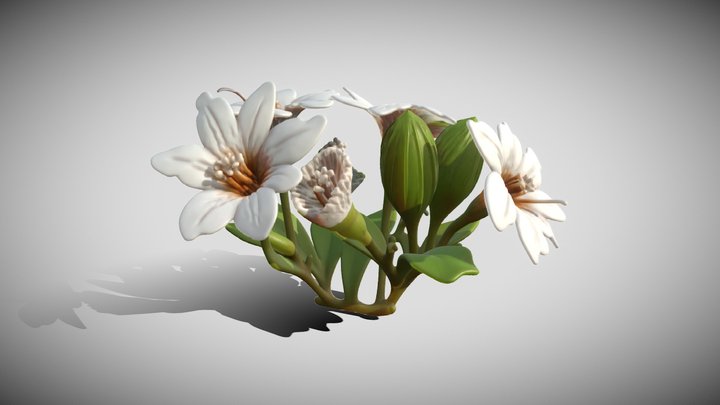
Stan Shebs · CC BY-SA 3.0 · via Wikipedia/Commons. May be a photograph of a specimen, or an artist’s reconstruction — an interpretation of a skeleton, since colour and soft tissue are almost never preserved.
On record
Recorded, not inferred- Sits inside
- BoraginaceaePBDB
- Diet
- "photoautotroph"PBDB, for Angiospermae
Time the record covers
At least 63 million years on record.
The record covers at least 66 Mya to 2.58 Mya. No occurrence read is dated outside 100.5 Mya to 0 Mya.
14 occurrences of Cordia on record, most of them in the Eocene. The Paleobiology Database records this as a living group. Bar height is expected occurrences, not a count: each fossil is spread across the span it is dated to, so a tall narrow bar means tight dating and a low wide one means loose.
When
14 occurrences- Late Cretaceous21%
- Eocene57%
- Miocene7%
- Pleistocene14%
- Holoceneunder 1%
These are dates about fossils, not the animal: the record can only begin after it arose and end before it died out, so either end may reach further. Shares are expected occurrences: a fossil dated to a span is counted partly in each period it straddles. More on what this infers.
Found in
4 formations
- Okinoyama Formation · Ube Group7
- Tuscaloosa Formation3
- Valentine Formation · Ogallala Group1
- Ackerman Formation · Wilcox Group1
Loading coastlines…
The named rock units Cordia has been recovered from, largest first. Drawn where the rock is now, not where it formed. 2 occurrences have no formation on record, which is common for older literature.
Cordia and its relatives
EoceneWhere Cordia and its relatives were recorded in the Eocene.
Found in the same rock
251 taxa- Cinnamomum4 sites
- Diospyros4 sites
- Ilex4 sites
- Leguminosites4 sites
- Maackia4 sites
- Metasequoia occidentalis4 sites
- Myrica4 sites
- Platycarya4 sites
- Andromeda parlatorii3 sites
- Bauhinia marylandica3 sites
- Caesalpinea ubensis3 sites
- Cinnamomum newberryi3 sites
- Diospyros primaeva3 sites
- Ficus daphnogenoides3 sites
- Ficus krausiana3 sites
- Ficus woolsoni3 sites
- Magnolia speciosa3 sites
- Myrsine3 sites
- Pasania3 sites
- Pinus3 sites
- Podocarpus eocenica3 sites
- Pterospermites carolinensis3 sites
- Sabal3 sites
- Salix lesquereuxii3 sites
The Paleobiology Database records 12 sites for Cordia, and this reads all of them. The number is how many of those sites it was catalogued from too. The 24 sharing the most are listed.
This is not a list of everything alive at the time. It is only what has come out of the same ground as this animal and been written down.
Entered from
5 references- The Eocene flora of the Ube coal-field, southwest Honshu, Japan7
- Upper Cretaceous floras of the eastern Gulf region in Tennessee, Mississippi, Alabama, and Georgia3
- The fossil avifauna of the tar seeps Las Breas de San Felipe, Matanzas, Cuba2
- The Kilgore Flora: A Late Miocene Flora from Northern Nebraska1
- The Lower Eocene floras of Southeastern North America1
Each of the 14 occurrences read was entered from one of these publications, ordered by how many each accounts for. This is not a search for papers mentioning the name. Entries link to doi.org where the Paleobiology Database holds an identifier, and to its own record where it does not. Relayed as the Paleobiology Database holds them, not checked against what they resolve to.
Media and terms
Media content2

Picture of Cordia
- Source
- Wikipedia/Commons
- Credit
- Stan Shebs
- Licence
- CC BY-SA 3.0
- Commercial use
- the licence allows it
Smithsonian Open Access and MorphoSource were not reached for this taxon, so this list is what the others held rather than everything there is.
The description on this site
- Source
- Wikipedia, “Cordia”
- Licence
- CC BY-SA 4.0
This is what the site found, which is not the same as what exists.
Keep going
What may have been alongside itBoraginaceae through timeFormations of the EoceneThe world it lived on
Occurrence data from the Paleobiology Database, CC BY 4.0. Linnaeus 1753