Corbula (Tenuicorbula)
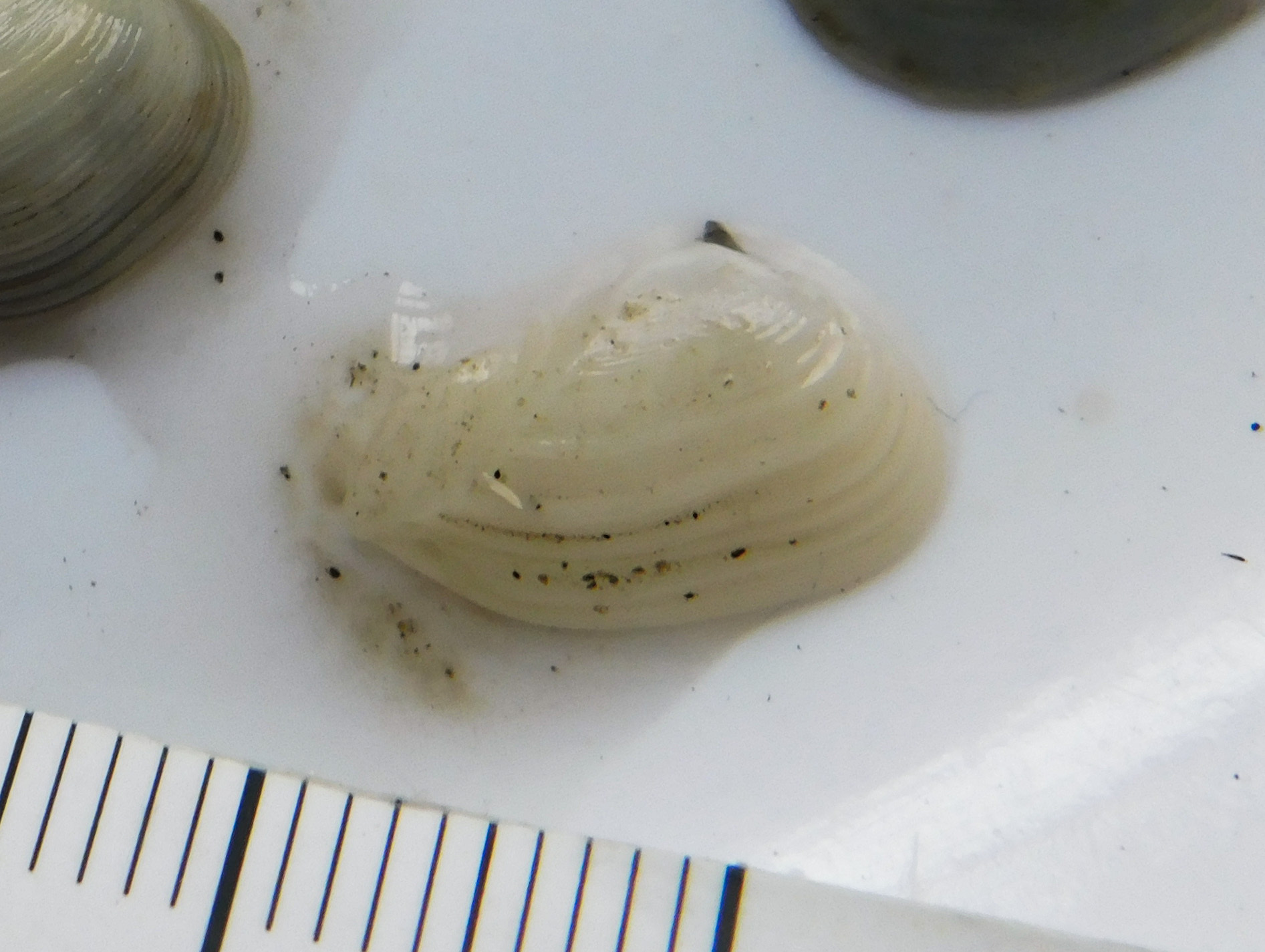
Not Corbula (Tenuicorbula). This is Tenuicorbula lyoni (Pilsbry, 1897), a relative — both are Corbulidae.
Valentín Alfano · CC BY-NC 4.0 · via GBIF. May be a photograph of a specimen, or an artist’s reconstruction — an interpretation of a skeleton, since colour and soft tissue are almost never preserved.
On record
Recorded, not inferred- Sits inside
- CorbulaPBDB
- Diet
- suspension feederPBDB
- Life habit
- infaunalPBDB
- Motility
- stationary, attachedPBDB
- Vision
- blindPBDB, for Bivalvia
Time the record covers
At least 47 million years on record.
The record covers at least 48.07 Mya to 129 ka. No occurrence read is dated outside 56 Mya to 0 Mya.
24 occurrences of Corbula (Tenuicorbula) on record, most of them in the Miocene. The Paleobiology Database records this as a living group. Bar height is expected occurrences, not a count: each fossil is spread across the span it is dated to, so a tall narrow bar means tight dating and a low wide one means loose.
When
24 occurrences- Eocene21%
- Miocene58%
- Pliocene8%
- Pleistocene12%
- Holoceneunder 1%
These are dates about fossils, not the animal: the record can only begin after it arose and end before it died out, so either end may reach further. Shares are expected occurrences: a fossil dated to a span is counted partly in each period it straddles. More on what this infers.
Found in
11 formations
- Springvale Formation5
- Zorritos Formation4
- Jama Formation2
- Ferrotepec Formation2
- Reklaw Formation · Claiborne Group2
- Castilletes Formation2
Loading coastlines…
The named rock units Corbula (Tenuicorbula) has been recovered from, largest first. Drawn where the rock is now, not where it formed. 2 occurrences have no formation on record, which is common for older literature.
Corbula (Tenuicorbula) and its relatives
MioceneWhere Corbula (Tenuicorbula) and its relatives were recorded in the Miocene.
Found in the same rock
1,038 taxa- Anadara7 sites
- Naticarius canrena7 sites
- Argopecten6 sites
- Caryocorbula (Caryocorbula)6 sites
- Dentalium (Dentalium)6 sites
- Lucinisca roigi6 sites
- Saccella6 sites
- Tenuicorbula melajoensis6 sites
- Trigoniocardia (Trigoniocardia)6 sites
- Anomia simplex5 sites
- Calliostoma (Elmerlinia) olssoni5 sites
- Clementia (Clementia) dariena5 sites
- Corbula (Notocorbula)5 sites
- Pitar (Lamelliconcha)5 sites
- Turbonilla5 sites
- Turritella (Broderiptella) planigyrata5 sites
- Anadara (Sectiarca) inaequilateralis4 sites
- Atrina4 sites
- Calyptraea centralis4 sites
- Eulima4 sites
- Eupleura lehneri4 sites
- Eurytellina aequicincta4 sites
- Fusinus4 sites
- Gordanops baranoanus4 sites
The Paleobiology Database records 18 sites for Corbula (Tenuicorbula), and this reads all of them. The number is how many of those sites it was catalogued from too. The 24 sharing the most are listed.
This is not a list of everything alive at the time. It is only what has come out of the same ground as this animal and been written down.
Entered from
13 references- Miocene and Pliocene mollusks from Trinidad6
- Neogene molluscs, shallow marine paleoenvironments, and chronostratigraphy of the Guajira Peninsula, Colombia2
- Sequence stratigraphy of the Punta Ballena Member of the Jama Formation (Early Pleistocene, Ecuador): insights from integrated sedimentologic, taphonomic and paleoecologic analysis of molluscan shell concentrations2
- Bivalvos y gasterópodos de la formacion Ferrotepec (Mioceno Medio) de Michoacan2
- Brackish molluscan fauna (upper Eocene) from the Silantek Formation in west Sarawak, Malaysia2
- Contributions to the Tertiary Paleontology of Northern Peru: Part 5, Miocene Mollusca2
- The Paleontology of the Zorritos Formation of the North Peruvian Oil Fields2
- Resilience of marine invertebrate communities during the early Cenozoic hyperthermals1
- Quaternary invertebrate fossil assemblages from coastal marine ecosystems of Bahia de Panama, Panama1
- The Molluscan Macrofauna of the Reklaw Formation, Marquez Member (Eocene: Lower Claibornian), in Texas1
- Five shallow benthic mollusc faunas from the Upper Eocene (Baron, Priabona, Garoowe, Nanggulan, Takashima)1
- Miocene Mollusca from the Paraguana Peninsula, Venezuela1
Each of the 24 occurrences read was entered from one of these publications, ordered by how many each accounts for. This is not a search for papers mentioning the name. 1 further reference is not listed. Entries link to doi.org where the Paleobiology Database holds an identifier, and to its own record where it does not. Relayed as the Paleobiology Database holds them, not checked against what they resolve to.
Media and terms
Media content1
Picture of Tenuicorbula lyoni (Pilsbry, 1897)
- Source
- GBIF
- Credit
- Valentín Alfano
- Licence
- CC BY-NC 4.0
- Commercial use
- the licence does not allow it
No 3D scan was found. Smithsonian Open Access, MorphoSource and Sketchfab were all searched.
This is what the site found, which is not the same as what exists.
Keep going
What may have been alongside itCorbula through timeFormations of the MioceneThe world it lived on
Occurrence data from the Paleobiology Database, CC BY 4.0. (Olsson 1932)