Pitar (Lamelliconcha)
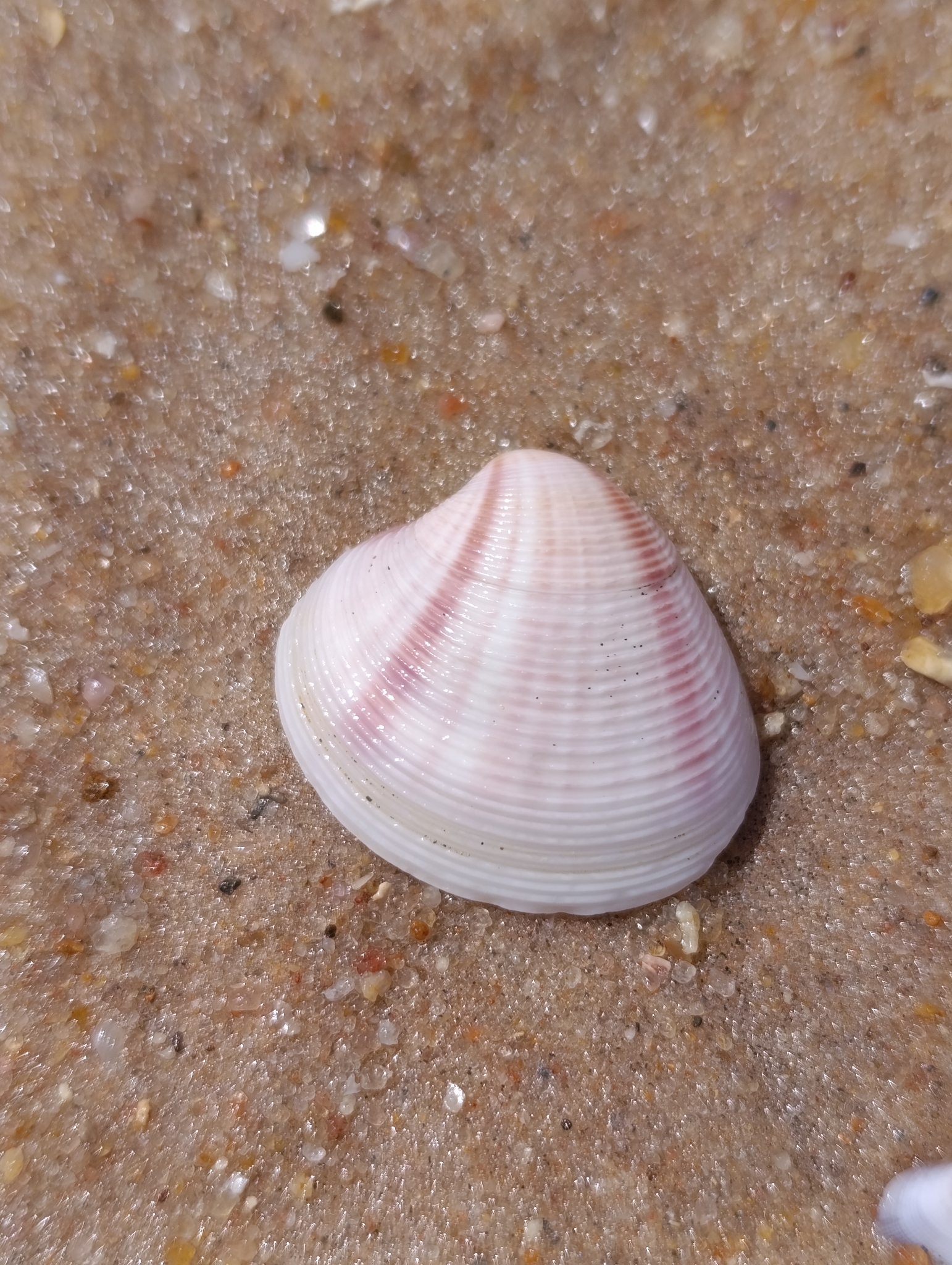
Not Pitar (Lamelliconcha). This is Lamelliconcha circinata (Born, 1778), a relative — both are Veneridae.
Thiago de Freitas Cordeiro · CC BY-NC 4.0 · via GBIF. May be a photograph of a specimen, or an artist’s reconstruction — an interpretation of a skeleton, since colour and soft tissue are almost never preserved.
On record
Recorded, not inferred- Sits inside
- PitarPBDB
- Diet
- suspension feederPBDB, for Pitar
- Life habit
- infaunalPBDB, for Pitar
- Motility
- facultatively mobilePBDB, for Pitar
- Vision
- blindPBDB, for Bivalvia
Time the record covers
At least 90 million years on record.
The record covers at least 93.9 Mya to 3.6 Mya. No occurrence read is dated outside 100.5 Mya to 2.58 Mya.
71 occurrences of Pitar (Lamelliconcha) on record, most of them in the Eocene. The Paleobiology Database records this as a living group, and the chart stops with its fossils rather than at the present. Bar height is expected occurrences, not a count: each fossil is spread across the span it is dated to, so a tall narrow bar means tight dating and a low wide one means loose.
When
71 occurrences- Late Cretaceous3%
- Eocene44%
- Oligocene6%
- Miocene32%
- Pliocene15%
These are dates about fossils, not the animal: the record can only begin after it arose and end before it died out, so either end may reach further. Shares are expected occurrences: a fossil dated to a span is counted partly in each period it straddles. More on what this infers.
Found in
22 formations
- Juncal Formation13
- Springvale Formation11
- Pirabas Formation10
- Morne l'Enfer Formation8
- Byram Formation4
- Ardath Formation · La Jolla Group3
Loading coastlines…
The named rock units Pitar (Lamelliconcha) has been recovered from, largest first. Drawn where the rock is now, not where it formed. 3 occurrences have no formation on record, which is common for older literature.
Pitar (Lamelliconcha) and its relatives
EoceneWhere Pitar (Lamelliconcha) and its relatives were recorded in the Eocene.
Found in the same rock
870 taxa- Naticarius canrena23 sites
- Anadara18 sites
- Trigoniocardia (Trigoniocardia)18 sites
- Caryocorbula (Caryocorbula)17 sites
- Lucinisca roigi17 sites
- Argopecten16 sites
- Dentalium (Dentalium)16 sites
- Saccella16 sites
- Anomia simplex14 sites
- Cylichnina tantilla14 sites
- Ectinochilus (Macilentos) macilentus14 sites
- Lirophora14 sites
- Calyptraea centralis13 sites
- Cerithium13 sites
- Noetia (Eontia) centrota13 sites
- Tellina (Eurytellina)12 sites
- Glycymeris (Glycymerita) sagittata11 sites
- Nassarius trinitatensis11 sites
- Turritella buwaldana11 sites
- Calliostoma (Elmerlinia) olssoni10 sites
- Dosinia (Dosinia)10 sites
- Lunarca billingsiana10 sites
- Teinostoma (Aepystoma)10 sites
- Tellina (Moerella)10 sites
The Paleobiology Database records 56 sites for Pitar (Lamelliconcha), and this reads all of them. The number is how many of those sites it was catalogued from too. The 24 sharing the most are listed.
This is not a list of everything alive at the time. It is only what has come out of the same ground as this animal and been written down.
Entered from
24 references- Miocene and Pliocene mollusks from Trinidad21
- Localidades fossiliferas da Formacao Pirabas (Mioceno Inferior)9
- Eocene Macropaleontology of Northern Lockwood Valley, Ventura County, California9
- Lower Oligocene Bivalvia of the Vicksburg Group in Mississippi4
- Eocene molluscan paleontology of the Whitaker Peak area, Los Angeles and Ventura counties, California3
- Catalogue of the Paleocene and Eocene mollusca of the southern and eastern United States. Part 1. Pelecypoda, Amphineura, Pteropoda, Scaphopoda and Cephalopoda3
- Eocene megapaleontology, stratigraphy, and depositional environments, Elsmere Canyon, Los Angeles County, California2
- Molluscan Paleontology of the Lower Eocene Maniobra Formation, Orocopia Mountains, Southern California2
- Eocene molluscan stages and their correlation, San Diego area, California2
- Geology and coal resources of the Cumberland. Hobart, and Maple Valley Quadrangles, King County, Washington2
- Occurrence of the Rare Genus Anapteris (Bivalvia: Corbulidae) in the Eocene of California1
- Paleontology of the Eocene Bateque Formation, Baja California Sur, Mexico1
Each of the 71 occurrences read was entered from one of these publications, ordered by how many each accounts for. This is not a search for papers mentioning the name. 12 further references are not listed. Entries link to doi.org where the Paleobiology Database holds an identifier, and to its own record where it does not. Relayed as the Paleobiology Database holds them, not checked against what they resolve to.
Media and terms
Media content2
Picture of Lamelliconcha circinata (Born, 1778)
- Source
- GBIF
- Credit
- Thiago de Freitas Cordeiro
- Licence
- CC BY-NC 4.0
- Commercial use
- the licence does not allow it
CT scan
- Source
- MorphoSource
- Licence
- In Copyright
- Commercial use
- cannot be read from the licence given — check the record
- Specimen
- Pitar circinatus · FMNH:Invertebrate Zoology:78390
Smithsonian Open Access was not reached for this taxon, so this list is what the others held rather than everything there is.
This is what the site found, which is not the same as what exists.
Keep going
What may have been alongside itPitar through timeFormations of the EoceneThe world it lived on
Occurrence data from the Paleobiology Database, CC BY 4.0. Dall 1902