Coraciiformes
The Coraciiformes are a group of usually colourful birds including the kingfishers, the bee-eaters, the rollers, the motmots, and the todies. They generally have syndactyly, with three forward-pointing toes, though in many kingfishers one of these is missing.

Christian Svane · CC BY-SA 2.5 · via Wikipedia/Commons. May be a photograph of a specimen, or an artist’s reconstruction — an interpretation of a skeleton, since colour and soft tissue are almost never preserved.
On record
Recorded, not inferred- Sits inside
- PasserimorphaePBDB
- Diet
- carnivorePBDB, for Coelurosauria
- Life habit
- ground dwelling, solitaryPBDB, for Theropoda
- Motility
- actively mobilePBDB, for Theropoda
- Environment
- terrestrialPBDB, for Theropoda
Time the record covers
At least 51 million years on record.
The record covers at least 51.1 Mya to 11.7 ka. No occurrence read is dated outside 56 Mya to 0 Mya.
84 occurrences of Coraciiformes on record, most of them in the Eocene. The Paleobiology Database records this as a living group. Bar height is expected occurrences, not a count: each fossil is spread across the span it is dated to, so a tall narrow bar means tight dating and a low wide one means loose.
When
84 occurrencesThese are dates about fossils, not the animal: the record can only begin after it arose and end before it died out, so either end may reach further. Shares are expected occurrences: a fossil dated to a span is counted partly in each period it straddles. More on what this infers.
Found in
8 formations
- London Clay Formation7
- Messel Formation4
- Green River Formation3
- Bridger Formation1
- Perrière Formation1
- Tielt Formation1
Loading coastlines…
The named rock units Coraciiformes has been recovered from, largest first. Drawn where the rock is now, not where it formed. 65 occurrences have no formation on record, which is common for older literature.
Coraciiformes and its relatives
EoceneWhere Coraciiformes and its relatives were recorded in the Eocene.
Found in the same rock
1,827 taxa- Tyto alba10 sites
- Halcyon9 sites
- Zapornia tabuensis8 sites
- Columbidae7 sites
- Accipitridae6 sites
- Ducula6 sites
- Geranopterus alatus6 sites
- Todiramphus chloris6 sites
- Alopecoenas stairi5 sites
- Anas5 sites
- Aplonis tabuensis5 sites
- Didunculus placopedetes5 sites
- Ducula pacifica5 sites
- Foulehaio carunculatus5 sites
- Gallirallus philippensis5 sites
- Gallus gallus5 sites
- Lalage maculosa5 sites
- Passeriformes5 sites
- Todiramphus tutus5 sites
- Accipiter striatus4 sites
- Alopecoenas erythropterus4 sites
- Anguini4 sites
- Anous stolidus4 sites
- Ardenna pacifica4 sites
The Paleobiology Database records 72 sites for Coraciiformes, and this reads all of them. The number is how many of those sites it was catalogued from too. The 24 sharing the most are listed.
This is not a list of everything alive at the time. It is only what has come out of the same ground as this animal and been written down.
Entered from
48 references- Late Pleistocene-Holocene non-passerine avifauna of Liang Bua (Flores, Indonesia)13
- Rollers (Aves: Coraciiformes s.s.) from the Middle Eocene of Messel (Germany) and the Upper Eocene of the Quercy (France)9
- The Picocoraciades (hoopoes, rollers, woodpeckers, and allies) from the early Eocene London Clay of Walton‑on‑the‑Naze4
- Biogeography of Tongan birds before and after human impact4
- Extinction of birds in eastern Polynesia: A review of the record, and comparison with other Pacific island groups4
- Osteology and systematic position of the Eocene Primobucconidae (Aves, Coraciiformes sensu stricto), with first records from Europe3
- Subfossil lemur discoveries from the Beanka Protected Area in western Madagascar2
- Faunal extinction and human habitation in New Caledonia: initial results and implications of new research at the Pindai Caves2
- Prehistoric exploitation of birds on the Pacific coast of Chiapas, Mexico2
- Extinct and extirpated birds from Aitutaki and Atiu, southern Cook Islands2
- Fossil birds from the Dominican Republic2
- The Rauenberg fossil Lagerstätte (Baden-Württemberg, Germany): A window into early Oligocene marine and coastal ecosystems of Central Europe1
Each of the 84 occurrences read was entered from one of these publications, ordered by how many each accounts for. This is not a search for papers mentioning the name. 36 further references are not listed. Entries link to doi.org where the Paleobiology Database holds an identifier, and to its own record where it does not. Relayed as the Paleobiology Database holds them, not checked against what they resolve to.
Media and terms
Media content1
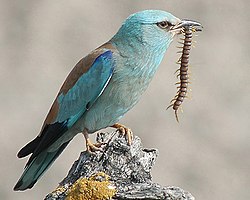
Picture of Coraciiformes
- Source
- Wikipedia/Commons
- Credit
- Christian Svane
- Licence
- CC BY-SA 2.5
- Commercial use
- the licence allows it
No 3D scan of Coraciiformes was found in Sketchfab.
Smithsonian Open Access and MorphoSource were not reached for this taxon, so this list is what the others held rather than everything there is.
The description on this site
- Licence
- CC BY-SA 4.0
This is what the site found, which is not the same as what exists.
Keep going
What may have been alongside itPasserimorphae through timeFormations of the EoceneThe world it lived on
Occurrence data from the Paleobiology Database, CC BY 4.0. (Forbes 1884)