Compsognathidae
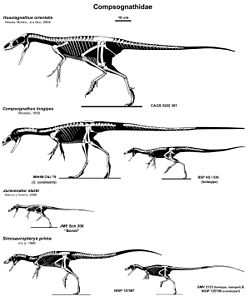
Compsognathidae is a potentially polyphyletic family of coelurosaurian theropod dinosaurs. Compsognathids were small carnivores, generally conservative in form, hailing from the Jurassic and Cretaceous Periods. The bird-like features of these species, along with other dinosaurs such as Archaeopteryx inspired the idea for the connection between dinosaur reptiles and modern-day avian species. Compsognathid fossils preserve diverse integument — skin impressions are known from four genera commonly placed in the group, Compsognathus, Sinosauropteryx, Sinocalliopteryx and Juravenator. While the latter three show evidence of a covering of some of the earliest primitive feathers over much of the body, Juravenator and Compsognathus also show evidence of scales on the tail or hind legs. "Ubirajara jubatus", informally described in 2020, had elaborate integumentary structures on its back and shoulders superficially similar to the display feathers of a standardwing bird-of-paradise, and unlike any other non-avian dinosaur currently described.

Jaime A. Headden ( User:Qilong ) · CC BY 3.0 · via Wikipedia/Commons. May be a photograph of a specimen, or an artist’s reconstruction — an interpretation of a skeleton, since colour and soft tissue are almost never preserved.
On record
Recorded, not inferred- Also called
- compsognathidPBDB
- Sits inside
- CoelurosauriaPBDB
- Diet
- carnivorePBDB, for Coelurosauria
- Life habit
- ground dwelling, solitaryPBDB, for Theropoda
- Motility
- actively mobilePBDB, for Theropoda
- Environment
- terrestrialPBDB, for Theropoda
Time the record covers
At least 51 million years on record.
The record covers at least 152.21 Mya to 100.5 Mya. No occurrence read is dated outside 157.9 Mya to 89.8 Mya.
18 occurrences of Compsognathidae on record, most of them in the Early Cretaceous. Bar height is expected occurrences, not a count: each fossil is spread across the span it is dated to, so a tall narrow bar means tight dating and a low wide one means loose.
When
18 occurrencesThese are dates about fossils, not the animal: the record can only begin after it arose and end before it died out, so either end may reach further. Shares are expected occurrences: a fossil dated to a span is counted partly in each period it straddles. More on what this infers.
Found in
8 formations
- Morrison Formation4
- Yixian Formation · Jehol Group4
- Sao Khua Formation · Khorat Group1
- Alcobaça Formation1
- Painten Formation1
- Bajo Barreal Formation · Chubut Group1
Loading coastlines…
The named rock units Compsognathidae has been recovered from, largest first. Drawn where the rock is now, not where it formed. 4 occurrences have no formation on record, which is common for older literature.
Compsognathidae and its relatives
Early CretaceousWhere Compsognathidae and its relatives were recorded in the Early Cretaceous.
Found in the same rock
329 taxa- Camarasaurus4 sites
- Apatosaurus3 sites
- Brachiosaurus3 sites
- Camptosaurus3 sites
- Ceratosaurus3 sites
- Compsognathus longipes3 sites
- Diplodocus3 sites
- Ornithopoda3 sites
- Sauropoda3 sites
- Testudinata3 sites
- Theropoda3 sites
- Actinopterygii2 sites
- Allosaurus fragilis2 sites
- Allosaurus jimmadseni2 sites
- Ankylosauria2 sites
- Anura2 sites
- Barosaurus2 sites
- Belonostomus2 sites
- Ceratodus2 sites
- Coelurus2 sites
- Cteniogenys antiquus2 sites
- Dinochelys whitei2 sites
- Diplodocidae2 sites
- Dromaeosauridae2 sites
The Paleobiology Database records 18 sites for Compsognathidae, and this reads all of them. The number is how many of those sites it was catalogued from too. The 24 sharing the most are listed.
This is not a list of everything alive at the time. It is only what has come out of the same ground as this animal and been written down.
Entered from
18 references- A new compsognathid theropod dinosaur from the oldest assemblage of the Jehol Biota in the Lower Cretaceous Huajiying Formation, northeastern China1
- A new species of compsognathid from the Early Cretaceous Yixian Formation of western Liaoning, China1
- Abdominal contents from two large early cretaceous compsognathids (Dinosauria: Theropoda) demonstrate feeding on confuciusornithids and dromaeosaurids1
- A New Basal Diplodocoid Species, Amphicoelias brontodiplodocus from the Morrison Formation, Big Horn Basin, Wyoming, with Taxonomic Reevaluation of Diplodocus, Apatosaurus, Barosaurus and Other Genera1
- A new giant compsognathid dinosaur with long filamentous integuments from Lower Cretaceous of northeastern China1
- Paleoecology of the Quarry 9 vertebrate assemblage from Como Bluff, Wyoming (Morrison Formation, Late Jurassic)1
- Aniksosaurus darwini gen. et sp. nov., a new coelurosaurian theropod from the early Late Cretaceous of central Patagonia, Argentina1
- A large compsognathid from the Early Cretaceous Yixian Formation of China1
- Saurischian dinosaurs 2: theropods1
- The dinosaur fauna from the Guimarota mina1
- Description of the type and referred material of <i>Phuwiangosaurus sirindhornae</i> Martin, Buffetaut and Suteethorn, 1994, a sauropod from the Lower Cretaceous of Thailand1
- Exceptional soft-tissue preservation in a theropod dinosaur from Italy1
Each of the 18 occurrences read was entered from one of these publications, ordered by how many each accounts for. This is not a search for papers mentioning the name. 6 further references are not listed. Entries link to doi.org where the Paleobiology Database holds an identifier, and to its own record where it does not. Relayed as the Paleobiology Database holds them, not checked against what they resolve to.
Media and terms
Media content1
Picture of Compsognathidae
- Source
- Wikipedia/Commons
- Credit
- Jaime A. Headden ( User:Qilong )
- Licence
- CC BY 3.0
- Commercial use
- the licence allows it
No 3D scan of Compsognathidae was found in MorphoSource and Sketchfab.
Smithsonian Open Access was not reached for this taxon, so this list is what the others held rather than everything there is.
The description on this site
- Licence
- CC BY-SA 4.0
This is what the site found, which is not the same as what exists.
Keep going
What may have been alongside itCoelurosauria through timeFormations of the Early CretaceousThe world it lived on
Occurrence data from the Paleobiology Database, CC BY 4.0. (Cope 1871)