Clinocardium
Clinocardium is a genus of marine bivalve molluscs in the family Cardiidae, the cockles. This genera mainly contains extinct members, only being represented by the single living species Clinocardium nuttallii, also known as the basket cockle, heart cockle, or Nuttall's cockle, a large edible saltwater clam. This species was originally described in the genus Cardium, with the species name being after zoologist, Thomas Nuttall, in 1837, with the type locality being from the Columbia River estuary in Oregon. Cardium was eventually split into multiple genera, where C. nuttallii was moved to its current genera Clinocardium in 1936. This species also has a history in the fossil record with its earliest known appearance being from Asagai Formation from the Oligocene in Fukushima, Japan. Fossils have so far been uncovered in the United States, Japan, Russia, and Canada.

Светлана Царахова · CC0 · via Wikipedia/Commons. May be a photograph of a specimen, or an artist’s reconstruction — an interpretation of a skeleton, since colour and soft tissue are almost never preserved.
On record
Recorded, not inferred- Sits inside
- ClinocardiinaePBDB
- Diet
- suspension feederPBDB, for Cardiidae
- Life habit
- infaunalPBDB, for Cardiidae
- Motility
- facultatively mobilePBDB, for Cardiidae
- Vision
- blindPBDB, for Bivalvia
Time the record covers
At least 47 million years on record.
The record covers at least 48.07 Mya to 129 ka. No occurrence read is dated outside 56 Mya to 0 Mya.
220 occurrences of Clinocardium on record, most of them in the Miocene. The Paleobiology Database records this as a living group. Bar height is expected occurrences, not a count: each fossil is spread across the span it is dated to, so a tall narrow bar means tight dating and a low wide one means loose.
When
220 occurrencesThese are dates about fossils, not the animal: the record can only begin after it arose and end before it died out, so either end may reach further. Shares are expected occurrences: a fossil dated to a span is counted partly in each period it straddles. More on what this infers.
Found in
73 formations
- Tachilni Formation31
- Careaga Sandstone Formation25
- Omagari Formation11
- Timms Point Silt Formation7
- Palos Verdes Sand Formation6
- San Pedro Sand Formation5
Loading coastlines…
The named rock units Clinocardium has been recovered from, largest first. Drawn where the rock is now, not where it formed. 49 further formations hold fewer occurrences each and are not listed. 24 occurrences have no formation on record, which is common for older literature.
Clinocardium and its relatives
MioceneWhere Clinocardium and its relatives were recorded in the Miocene.
Found in the same rock
1,572 taxa- Callianax biplicata30 sites
- Cryptomya californica28 sites
- Cryptonatica affinis26 sites
- Leukoma staminea26 sites
- Tresus nuttallii25 sites
- Macoma nasuta24 sites
- Glossaulax reclusiana23 sites
- Lucinoma annulata22 sites
- Nutricola tantilla21 sites
- Solen sicarius21 sites
- Cyclocardia20 sites
- Mitrella gausapata20 sites
- Pododesmus (Monia) macrochisma20 sites
- Chlamys hastata19 sites
- Macoma19 sites
- Saccella taphria19 sites
- Turritella cooperi19 sites
- Tivela (Pachydesma) stultorum18 sites
- Mitrella tuberosa17 sites
- Calliostoma ligatum16 sites
- Epilucina californica16 sites
- Paciocinebrina lurida16 sites
- Anadara trilineata15 sites
- Buccinum15 sites
The Paleobiology Database records 119 sites for Clinocardium, and this reads all of them. The number is how many of those sites it was catalogued from too. The 24 sharing the most are listed.
This is not a list of everything alive at the time. It is only what has come out of the same ground as this animal and been written down.
Entered from
66 references- Molluscan paleontology, paleoecology, and North Pacific correlations of the Miocene Tachilni Formation, Alaska Peninsula, Alaska31
- Geology and paleontology of the Santa Maria District California19
- Neogene and Paleogene Molluscan (Bivalvia) Cenozones of the Russian Northeast.17
- Neogene and Paleogene Molluscan (Bivalvia) Cenozones of Sakhalin and Kurile Islands12
- Paleogene molluscan faunas from the Kushiro Coal Field, Eastern Hokkaido12
- A review of the Quaternary Mollusca of the Palos Verdes Peninsula10
- The cool-water Timms Point Pleistocene horizon at San Pedro, California8
- On the reconciliation of biostratigraphy and strontium isotope stratigraphy of three southern Californian Plio-Pleistocene formations6
- Bivalve seashells of western North America6
- Warm-water influx into Japan Sea in the middle Pliocene - Molluscan faunas from the Tentokuji FOrmation around Mt. Taihei in Akita Prefecture4
- Raschleneniye oligotsen-nizhnemiotsenovykh tolshch vostochnoy Kamchatki (zaliv Korfa). Subdivision of Oligocene-lower Miocene layers of eastern Kamchatka, Gulf of Korfa4
- A late Oligocene or earliest Miocene molluscan fauna from Sitkinak Island, Alaska4
Each of the 220 occurrences read was entered from one of these publications, ordered by how many each accounts for. This is not a search for papers mentioning the name. 54 further references are not listed. Entries link to doi.org where the Paleobiology Database holds an identifier, and to its own record where it does not. Relayed as the Paleobiology Database holds them, not checked against what they resolve to.
Media and terms
Media content3

Picture of Clinocardium
- Source
- Wikipedia/Commons
- Credit
- Светлана Царахова
- Licence
- CC0
- Commercial use
- the licence allows it
CT scan
- Source
- MorphoSource
- Licence
- In Copyright
- Commercial use
- cannot be read from the licence given — check the record
- Specimen
- Clinocardium nuttallii · fmnh:invertebrate zoology:8995
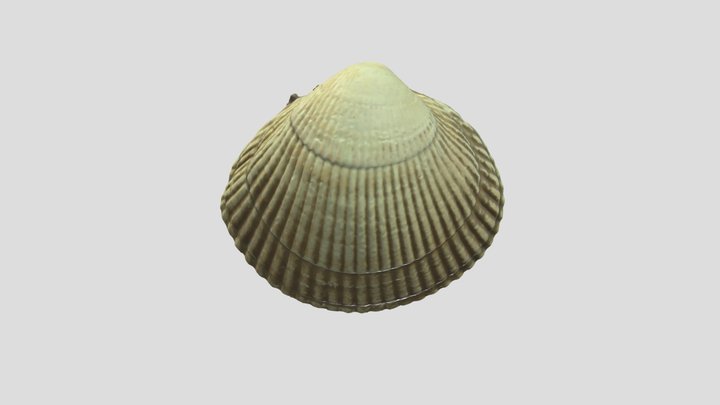
3D model
- Source
- Sketchfab
- Licence
- CC Attribution-NonCommercial
- Commercial use
- the licence does not allow it
Smithsonian Open Access was not reached for this taxon, so this list is what the others held rather than everything there is.
The description on this site
- Licence
- CC BY-SA 4.0
This is what the site found, which is not the same as what exists.
Keep going
What may have been alongside itClinocardiinae through timeFormations of the MioceneThe world it lived on
Occurrence data from the Paleobiology Database, CC BY 4.0. (Keen 1936)