Clariidae
Airbreathing catfish comprise the family Clariidae of the order Siluriformes. This family is made up of seventeen genera and about 123 species, all of which inhabit freshwater. Clariids are called the airbreathing catfishes because of their possession of a suprabranchial respiratory organ that allows aerial respiration. Other catfishes are also known to facultatively breathe air, such as the Callichthyidae and Loricariidae. However, clariids are the only catfishes known to possess an accessory breathing organ.

Mistvan · CC BY-SA 3.0 · via Wikipedia/Commons. May be a photograph of a specimen, or an artist’s reconstruction — an interpretation of a skeleton, since colour and soft tissue are almost never preserved.
On record
Recorded, not inferred- Also called
- airbreathing catfishPBDB
- Sits inside
- SiluroideiPBDB
- Diet
- carnivorePBDB, for Siluriformes
- Life habit
- nektobenthicPBDB, for Siluriformes
- Motility
- actively mobilePBDB, for Siluriformes
- Environment
- freshwaterPBDB, for Siluriformes
Time the record covers
At least 41 million years on record.
The record covers at least 41.03 Mya to 11.7 ka. No occurrence read is dated outside 56 Mya to 0 Mya.
167 occurrences of Clariidae on record, most of them in the Pleistocene. The Paleobiology Database records this as a living group. Bar height is expected occurrences, not a count: each fossil is spread across the span it is dated to, so a tall narrow bar means tight dating and a low wide one means loose.
When
167 occurrences- Eocene1%
- Miocene18%
- Pliocene14%
- Pleistocene61%
- Holocene6%
These are dates about fossils, not the animal: the record can only begin after it arose and end before it died out, so either end may reach further. Shares are expected occurrences: a fossil dated to a span is counted partly in each period it straddles. More on what this infers.
Found in
31 formations
- Koobi Fora Formation · Omo Group27
- Olduvai Formation · Vogel River Series Group14
- Gebel Silsila-YCS Formation11
- Wembere-Manonga Formation11
- Gabal Silsila Formation6
- Olorgesailie Formation5
Loading coastlines…
The named rock units Clariidae has been recovered from, largest first. Drawn where the rock is now, not where it formed. 7 further formations hold fewer occurrences each and are not listed. 45 occurrences have no formation on record, which is common for older literature.
Clariidae and its relatives
PleistoceneWhere Clariidae and its relatives were recorded in the Pleistocene.
Found in the same rock
835 taxa- Clarias128 sites
- Hippopotamus amphibius42 sites
- Crocodylus41 sites
- Alcelaphus buselaphus37 sites
- Bovidae33 sites
- Polypterus32 sites
- Protopterus32 sites
- Lates30 sites
- Synodontis30 sites
- Cichlidae29 sites
- Trionyx27 sites
- Crocodylus niloticus24 sites
- Alcelaphini22 sites
- Gazella dorcas22 sites
- Lates niloticus22 sites
- Suidae22 sites
- Hipparion21 sites
- Palaeoloxodon recki21 sites
- Euthecodon brumpti20 sites
- Geochelone18 sites
- Hydrocynus18 sites
- Mammalia17 sites
- Barbus16 sites
- Bos primigenius16 sites
The Paleobiology Database records 159 sites for Clariidae, and this reads all of them. The number is how many of those sites it was catalogued from too. The 24 sharing the most are listed.
This is not a list of everything alive at the time. It is only what has come out of the same ground as this animal and been written down.
Entered from
66 references- Kom Ombo: Preliminary Report on the Fauna of Late Paleolithic Sites in Upper Egypt26
- Wendorf and Schild, 197611
- Koobi Fora Research Project The Fossil Ungulates: Proboscidea, Perissodactyla, Suidae8
- The bone assemblages from the excavated sites7
- Intoduction: Paleontological and Geological Research in the Manonga Valley, Tanzania7
- The Vertebrate Taphonomy and Paleoecology of the Olorgesailie Formation (Middle Pleistocene, Kenya)5
- Extinct large Colobines from the Plio-Pleistocene of Africa5
- Late Pleistocene hunter-gatherers at Ishango (eastern Zaire): the faunal evidence4
- Early hominid from Baringo,Kenya4
- The Lower Miocene Fauna of Al-Sarrar (Eastern Province, Saudi Arabia)4
- Lakeside cemeteries in the Sahara: 5000 years of Holocene population and environmental change3
- A middle stone age worked bone industry from Katanda,Upper Semliki Valley,Zaire3
Each of the 167 occurrences read was entered from one of these publications, ordered by how many each accounts for. This is not a search for papers mentioning the name. 54 further references are not listed. Entries link to doi.org where the Paleobiology Database holds an identifier, and to its own record where it does not. Relayed as the Paleobiology Database holds them, not checked against what they resolve to.
Media and terms
Media content1
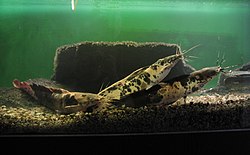
Picture of Clariidae
- Source
- Wikipedia/Commons
- Credit
- Mistvan
- Licence
- CC BY-SA 3.0
- Commercial use
- the licence allows it
No 3D scan of Clariidae was found in MorphoSource and Sketchfab.
Smithsonian Open Access was not reached for this taxon, so this list is what the others held rather than everything there is.
The description on this site
- Licence
- CC BY-SA 4.0
This is what the site found, which is not the same as what exists.
Keep going
What may have been alongside itSiluroidei through timeFormations of the PleistoceneThe world it lived on
Occurrence data from the Paleobiology Database, CC BY 4.0. Bonaparte 1846