Chladocrinus
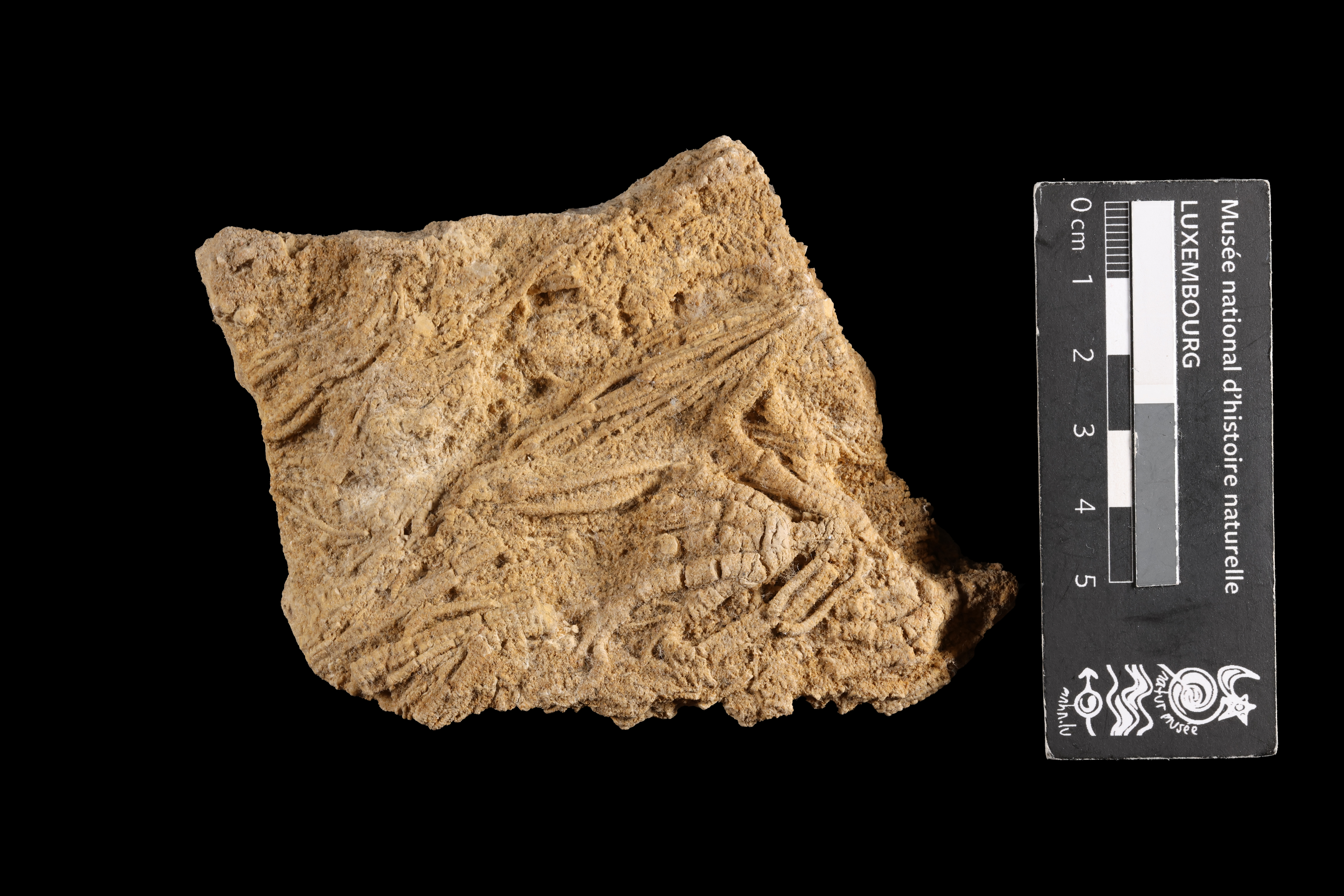
Not Chladocrinus. This is Chladocrinus Agassiz, 1836, a relative — both are Isocrinidae.
Kurt Meiers · CC0 · via GBIF. May be a photograph of a specimen, or an artist’s reconstruction — an interpretation of a skeleton, since colour and soft tissue are almost never preserved.
On record
Recorded, not inferred- Sits inside
- IsocrininaePBDB
- Diet
- suspension feederPBDB, for Isocrinidae
- Life habit
- upper-level epifaunalPBDB, for Isocrinidae
- Motility
- stationary, attachedPBDB, for Isocrinidae
- Vision
- blindPBDB, for Crinoidea
- Environment
- marinePBDB, for Echinodermata
Time the record covers
At least 79 million years on record.
The record covers at least 199.5 Mya to 119.57 Mya. No occurrence read is dated outside 201.4 Mya to 113.2 Mya.
48 occurrences of Chladocrinus on record, most of them in the Early Jurassic. The Paleobiology Database records this as a living group, and the chart stops with its fossils rather than at the present. Bar height is expected occurrences, not a count: each fossil is spread across the span it is dated to, so a tall narrow bar means tight dating and a low wide one means loose.
When
48 occurrencesThese are dates about fossils, not the animal: the record can only begin after it arose and end before it died out, so either end may reach further. Shares are expected occurrences: a fossil dated to a span is counted partly in each period it straddles. More on what this infers.
Found in
5 formations
- Hiraiga Formation · Miyako Group8
- Tolo Channel Formation2
- Charmouth Mudstone Formation1
- Lower Lias Formation · Lias Group1
- Whitby Mudstone Formation1
Loading coastlines…
The named rock units Chladocrinus has been recovered from, largest first. Drawn where the rock is now, not where it formed. 35 occurrences have no formation on record, which is common for older literature.
Chladocrinus and its relatives
Early JurassicWhere Chladocrinus and its relatives were recorded in the Early Jurassic.
Found in the same rock
224 taxa- Isocrinus (Chladocrinus) basaltiformis11 sites
- Astarte9 sites
- Isocrinus (Chladocrinus)8 sites
- Balanocrinus subsulcatus6 sites
- Balanocrinus moniliferus5 sites
- Gryphaea cymbium5 sites
- Oxytoma inequivalvis5 sites
- Plicatula5 sites
- Amaltheocrinus hausmanni4 sites
- Cardinia hybrida4 sites
- Entolium4 sites
- Liostrea4 sites
- Lobothyris punctata4 sites
- Modiolus4 sites
- Myoconcha decorata4 sites
- Parallelodon4 sites
- Pecten priscus4 sites
- Venericardia4 sites
- Aequipecten3 sites
- Arcomya3 sites
- Cardinia concinna3 sites
- Chlamys substriata3 sites
- Entolium callosum3 sites
- Grandirhynchia3 sites
The Paleobiology Database records 36 sites for Chladocrinus, and this reads all of them. The number is how many of those sites it was catalogued from too. The 24 sharing the most are listed.
This is not a list of everything alive at the time. It is only what has come out of the same ground as this animal and been written down.
Entered from
13 references- Die Crinoiden aus dem Pliensbachium (mittlerer Lias) von Rottorf am Klei und Empelde (Süd-Niedersachsen)24
- Early Cretaceous Isocrinus from Northeast Japan8
- The Lower Jurassic Rocks of East Greenland Part 14
- Holothurien (Echinodermata) aus Kelloway-Geschieben (Dogger: Callovium)2
- Permian and Jurassic corals, crinoid stems, and scaphopods from Ma Shi Chau, Hong Kong, and other areas2
- Emergence and early radiation of cyrtocrinids, with new species from a Lower to Middle Jurassic rock reef of Feuguerolles (Normandy, France)1
- The Impact of Global Warming and Anoxia on Marine Benthic Community Dynamics: an Example from the Toarcian (Early Jurassic)1
- Redescription and interpretation of the asteroid species Tropidaster pectinatus from the Jurassic of England1
- Fossilien aus der Tongrube Sachsenhagen1
- Echinodermen im Unteren Lias (bucklandi- und semicostatum-zone) zwischen Ellange und Elvange (SE-Luxemburg)1
- Zur Invertebratenfauna und Stratigraphie des oberen Pliensbachien von Grimmen (DDR), Echinodermata1
- Schlangensterne und Seelilien aus dem unteren Lias von Hallau (Kanton Schaffausen)1
Each of the 48 occurrences read was entered from one of these publications, ordered by how many each accounts for. This is not a search for papers mentioning the name. 1 further reference is not listed. Entries link to doi.org where the Paleobiology Database holds an identifier, and to its own record where it does not. Relayed as the Paleobiology Database holds them, not checked against what they resolve to.
Media and terms
Media content1
Picture of Chladocrinus Agassiz, 1836
- Source
- GBIF
- Credit
- Kurt Meiers
- Licence
- CC0
- Commercial use
- the licence allows it
No 3D scan of Chladocrinus was found in Sketchfab.
Smithsonian Open Access and MorphoSource were not reached for this taxon, so this list is what the others held rather than everything there is.
This is what the site found, which is not the same as what exists.
Keep going
What may have been alongside itIsocrininae through timeFormations of the Early JurassicThe world it lived on
Occurrence data from the Paleobiology Database, CC BY 4.0. Agassiz 1836