Chelydropsis
Chelydropsis is an extinct genus in the family of pan-chelydrids, relatives of modern snapping turtles, that lived from the Eocene to the Pliocene in Asia and Europe.

H. Zell · CC BY-SA 3.0 · via Wikipedia/Commons. May be a photograph of a specimen, or an artist’s reconstruction — an interpretation of a skeleton, since colour and soft tissue are almost never preserved.
On record
Recorded, not inferred- Sits inside
- ChelydridaePBDB
- Diet
- piscivorePBDB, for Chelydridae
- Life habit
- aquatic, solitaryPBDB, for Chelydridae
- Motility
- actively mobilePBDB, for Osteichthyes
- Environment
- freshwaterPBDB, for Chelydridae
Time the record covers
At least 37 million years on record.
The record covers at least 41.03 Mya to 3.55 Mya. No occurrence read is dated outside 48.07 Mya to 1.8 Mya.
66 occurrences of Chelydropsis on record, most of them in the Miocene. Bar height is expected occurrences, not a count: each fossil is spread across the span it is dated to, so a tall narrow bar means tight dating and a low wide one means loose.
When
66 occurrences- Eocene3%
- Oligocene16%
- Miocene73%
- Pliocene7%
- Pleistoceneunder 1%
These are dates about fossils, not the animal: the record can only begin after it arose and end before it died out, so either end may reach further. Shares are expected occurrences: a fossil dated to a span is counted partly in each period it straddles. More on what this infers.
Found in
9 formations
- Tudela Formation17
- Upper Freshwater Molasse Formation · Molasse Group2
- Ville Formation1
- Brackwater Molasse Formation · Molasse Group1
- Kuyal'nikian Formation1
- Koryakovskaya Formation1
Loading coastlines…
The named rock units Chelydropsis has been recovered from, largest first. Drawn where the rock is now, not where it formed. 40 occurrences have no formation on record, which is common for older literature.
Chelydropsis and its relatives
MioceneWhere Chelydropsis and its relatives were recorded in the Miocene.
Found in the same rock
956 taxa- Diplocynodon19 sites
- Trionyx18 sites
- Testudo16 sites
- Ophisaurus11 sites
- Ptychogaster10 sites
- Trionychinae9 sites
- Ptychogaster (Temnoclemmys) bardenensis8 sites
- Anchitherium aurelianense7 sites
- Eryx7 sites
- Lacerta7 sites
- Vipera7 sites
- Aves6 sites
- Brachypotherium brachypus6 sites
- Colubrinae6 sites
- Ergilemys6 sites
- Mauremys pygolopha6 sites
- Andrias scheuchzeri5 sites
- Blackia miocaenica5 sites
- Clemmydopsis turnauensis5 sites
- Dorcatherium crassum5 sites
- Emydidae5 sites
- Pelobates5 sites
- Pliopithecus antiquus5 sites
- Prolagus oeningensis5 sites
The Paleobiology Database records 61 sites for Chelydropsis, and this reads all of them. The number is how many of those sites it was catalogued from too. The 24 sharing the most are listed.
This is not a list of everything alive at the time. It is only what has come out of the same ground as this animal and been written down.
Entered from
28 references- Amphibians and reptiles from the Early Miocene of the Bardenas Reales of Navarre (Ebro Basin, Iberian Peninsula)16
- Contribution a l'etude des Cheloniens. Cheloniens continentaux due Cretace et du Tertiare de France15
- Neogene Testudines of Germany. Their stratigraphical and ecological evaluation5
- A Review of the Fossil Record of Turtles of the Clade Pan-Chelydridae4
- Die fossilen Schildkröten aus der Molasse von Oberschwaben mit taxonomischen Notizen zu „Promalacoclemmys Reinach, 1900“ und Testudo antiqua Bronn, 1831 (Testudines: Cryptodira)3
- A new Miocene ape and locomotion in the ancestor of great apes and humans1
- Le site paléontologique du Grand Morier (Pont-Boutard, Indre-et-Loire, France): contexte géologique et détail biostratigraphique des formations cénozoïques à partir des assemblages de vertébrés fossiles1
- Vertebrates from the Pontian of the Shkodova Gora Locality (Northwestern Black Sea Region, Upper Miocene)1
- Ectothermic vertebrates from the late Middle Miocene of Gratkorn (Austria, Styria)1
- Fossil turtles of Slovakia: New material and a review of the previous record1
- Ectothermic vertebrates (Teleostei, Allocaudata, Urodela, Anura, Testudines, Choristodera, Crocodylia, Squamata) from the Upper Oligocene of Oberleichtersbach (Northern Bavaria, Germany)1
- Die Schildkroten (Reptilia: Testudines) aus dem Mittel-Miozan von Hambach (Niederrheinische Bucht, NW-Deutschland)1
Each of the 66 occurrences read was entered from one of these publications, ordered by how many each accounts for. This is not a search for papers mentioning the name. 16 further references are not listed. Entries link to doi.org where the Paleobiology Database holds an identifier, and to its own record where it does not. Relayed as the Paleobiology Database holds them, not checked against what they resolve to.
Media and terms
Media content1
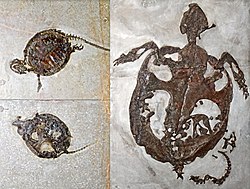
Picture of Chelydropsis
- Source
- Wikipedia/Commons
- Credit
- H. Zell
- Licence
- CC BY-SA 3.0
- Commercial use
- the licence allows it
No 3D scan of Chelydropsis was found in Sketchfab.
Smithsonian Open Access and MorphoSource were not reached for this taxon, so this list is what the others held rather than everything there is.
The description on this site
- Licence
- CC BY-SA 4.0
This is what the site found, which is not the same as what exists.
Keep going
What may have been alongside itChelydridae through timeFormations of the MioceneThe world it lived on
Occurrence data from the Paleobiology Database, CC BY 4.0. Peters 1868