Chapmanina
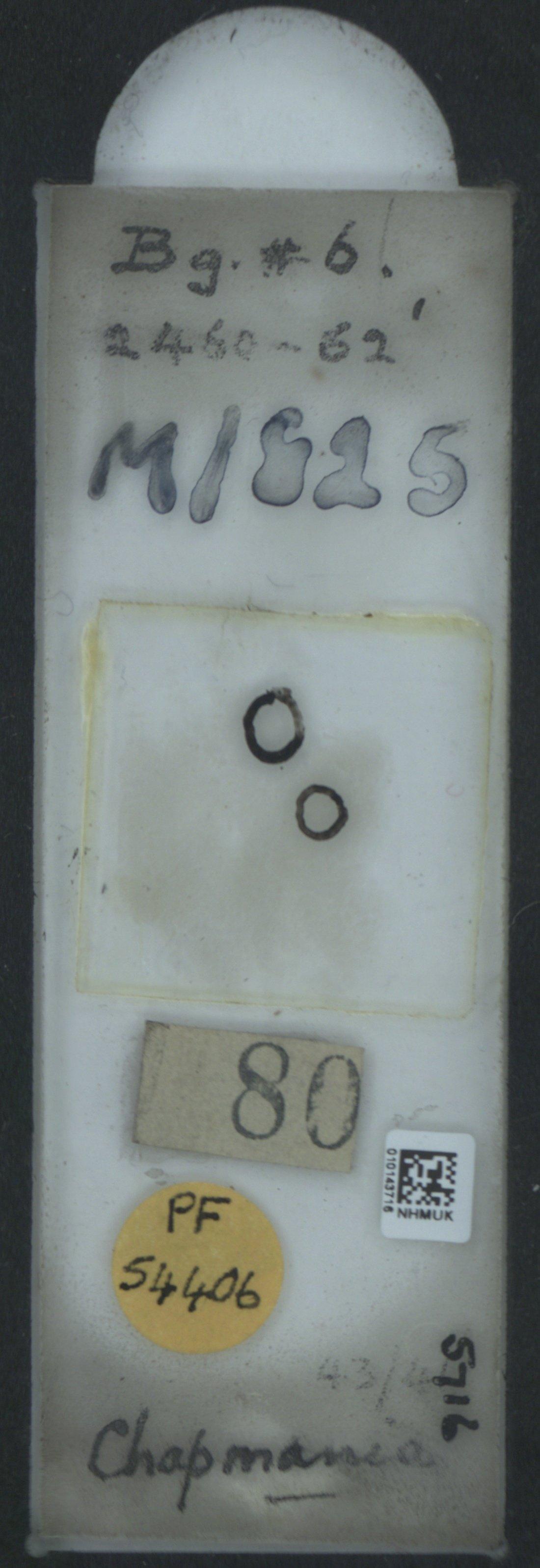
via iDigBio · CC BY · via iDigBio. May be a photograph of a specimen, or an artist’s reconstruction — an interpretation of a skeleton, since colour and soft tissue are almost never preserved.
On record
Recorded, not inferred- Sits inside
- ForaminiferaPBDB
- Diet
- omnivorePBDB, for Foraminifera
- Life habit
- semi-infaunalPBDB, for Foraminifera
- Motility
- stationaryPBDB, for Foraminifera
Time the record covers
At most 21 million years on record.
Every occurrence read is dated to somewhere between 48.07 Mya and 27.3 Mya, and nothing in the dating separates them, so that window is what the record shows rather than a span.
16 occurrences of Chapmanina on record, most of them in the Eocene. Bar height is expected occurrences, not a count: each fossil is spread across the span it is dated to, so a tall narrow bar means tight dating and a low wide one means loose.
When
16 occurrencesThese are dates about fossils, not the animal: the record can only begin after it arose and end before it died out, so either end may reach further. Shares are expected occurrences: a fossil dated to a span is counted partly in each period it straddles. More on what this infers.
Found in
4 formations
Loading coastlines…
The named rock units Chapmanina has been recovered from, largest first. Drawn where the rock is now, not where it formed. 6 occurrences have no formation on record, which is common for older literature.
Chapmanina and its relatives
EoceneWhere Chapmanina and its relatives were recorded in the Eocene.
Found in the same rock
72 taxa- Pellatispira madaraszi10 sites
- Polystrata alba10 sites
- Lithothamnion9 sites
- Mesophyllum9 sites
- Sphaerogypsina9 sites
- Sporolithon9 sites
- Lithoporella melobesioides8 sites
- Nummulites incrassatus8 sites
- Acervulinoidea7 sites
- Assilina alpina7 sites
- Asterocyclina alticostata7 sites
- Discocyclina dispansa7 sites
- Discocyclina pratti7 sites
- Eorupertia7 sites
- Fabiania7 sites
- Heterostegina7 sites
- Nemkovella strophiolata7 sites
- Nummulites chavannesi7 sites
- Nummulites stellatus7 sites
- Spiroclypeus granulosus7 sites
- Spongites7 sites
- Nummulites6 sites
- Discocyclina4 sites
- Asterocyclina3 sites
The Paleobiology Database records 14 sites for Chapmanina, and this reads all of them. The number is how many of those sites it was catalogued from too. The 24 sharing the most are listed.
This is not a list of everything alive at the time. It is only what has come out of the same ground as this animal and been written down.
Entered from
7 references- Larger foraminiferal and coralline algal facies in an Upper Eocene storm-influenced, shallow-water carbonate platform (Colli Berici, north-eastern Italy)7
- The lower Rupelian cluster reefs of Majella platform, the shallow water record of Eocene to Oligocene transition2
- Depositional History of a Paleogene Carbonate Ramp (Western Cephalonia, Ionian Islands, Greece)2
- Die Flyschzonen Griechenlands II; Zur Stratigraphie der basalen Schichten (Uebergangsserie) des ionischen Flysches im Epiros und suedlich anschliessenden Gebiet2
- Upper Eocene-Lower Oligocene Shaghap reef (Armenia): composition and paleoenvironment1
- The Upper Eocene crustose coralline algal pavement in the Colli Berici, north-eastern Italy1
- Palaeogene microfacies in some calcareous blocks of the Roaia Formation (Wildflysch Nappe-Maramures)1
Each of the 16 occurrences read was entered from one of these publications, ordered by how many each accounts for. This is not a search for papers mentioning the name. Entries link to doi.org where the Paleobiology Database holds an identifier, and to its own record where it does not. Relayed as the Paleobiology Database holds them, not checked against what they resolve to.
Media and terms
Media content1
Picture of Chapmanina
- Source
- iDigBio
- Credit
- via iDigBio
- Licence
- CC BY
- Commercial use
- the licence allows it
No 3D scan of Chapmanina was found in Sketchfab.
Smithsonian Open Access and MorphoSource were not reached for this taxon, so this list is what the others held rather than everything there is.
This is what the site found, which is not the same as what exists.
Keep going
What may have been alongside itForaminifera through timeFormations of the EoceneThe world it lived on
Occurrence data from the Paleobiology Database, CC BY 4.0.