Chamelea gallina
Chamelea gallina is a species of small saltwater clam, a marine bivalve in the family Veneridae, the venus clams.

Didier Descouens · CC BY-SA 3.0 · via Wikipedia/Commons. May be a photograph of a specimen, or an artist’s reconstruction — an interpretation of a skeleton, since colour and soft tissue are almost never preserved.
On record
Recorded, not inferred- Sits inside
- ChameleaPBDB
- Diet
- suspension feederPBDB, for Veneridae
- Life habit
- infaunalPBDB, for Veneridae
- Motility
- facultatively mobilePBDB, for Veneridae
- Vision
- blindPBDB, for Bivalvia
Time the record covers
At least 3.5 million years on record.
The record covers at least 3.6 Mya to 11.7 ka. No occurrence read is dated outside 5.333 Mya to 0 Mya.
12 occurrences of Chamelea gallina on record, most of them in the Pleistocene. The Paleobiology Database records this as a living group. Bar height is expected occurrences, not a count: each fossil is spread across the span it is dated to, so a tall narrow bar means tight dating and a low wide one means loose.
When
12 occurrences- Pliocene25%
- Pleistocene67%
- Holocene8%
These are dates about fossils, not the animal: the record can only begin after it arose and end before it died out, so either end may reach further. Shares are expected occurrences: a fossil dated to a span is counted partly in each period it straddles. More on what this infers.
Found in
3 formations
Loading coastlines…
The named rock units Chamelea gallina has been recovered from, largest first. Drawn where the rock is now, not where it formed. 8 occurrences have no formation on record, which is common for older literature.
Chamelea gallina and its relatives
PleistoceneWhere Chamelea gallina and its relatives were recorded in the Pleistocene.
Found in the same rock
319 taxa- Calyptraea chinensis4 sites
- Cerithium (Thericium) vulgatum4 sites
- Gibbula4 sites
- Pitar (Pitar) rudis4 sites
- Turbonilla4 sites
- Varicorbula gibba4 sites
- Alvania3 sites
- Anomia ephippium3 sites
- Arca noae3 sites
- Bolma rugosus3 sites
- Caecum3 sites
- Cerastoderma edule3 sites
- Donax3 sites
- Glycymeris3 sites
- Jujubinus3 sites
- Rissoa3 sites
- Solen marginatus3 sites
- Tricolia3 sites
- Venus3 sites
- Vermetus3 sites
- Anadara2 sites
- Apicularia sulzeriana2 sites
- Aporrhais2 sites
- Bittium deshayesi2 sites
The Paleobiology Database records 5 sites for Chamelea gallina, and this reads all of them. The number is how many of those sites it was catalogued from too. The 24 sharing the most are listed.
This is not a list of everything alive at the time. It is only what has come out of the same ground as this animal and been written down.
Entered from
7 references- Molluscos del Tirreniense (Pleistoceno Superior) de la Playa la Araña-Cala de Moral (Málaga)3
- Ostracods and bivalves from an Upper Pleistocene (Tyrrhenian) marine terrace near Altinova (Izmit Province, Turkey)2
- Facies analysis, paleoecology and sequence stratigraphy in a Pliocene siliciclastic succession, Sanb Miniato (Pisa, Italy)2
- Recherches sur le Neogene et le Quaternaire marins de la cote Atlantique du Maroc2
- The marine fossils malacofauna in a Plio-Pleistocene section from Vallin Buio (Livorno, Italy)1
- Nuove specie di Gasteropodi del Piacenziano di rio Crevalese, Castell’Arquato (Piacenza, Italia)1
- Povoado muculmano na Ponta do Castelo (Aljezur)1
Each of the 12 occurrences read was entered from one of these publications, ordered by how many each accounts for. This is not a search for papers mentioning the name. Each entry links to the Paleobiology Database's own record for the work.
Media and terms
Media content2
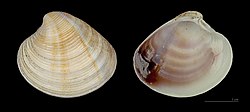
Picture of Chamelea gallina
- Source
- Wikipedia/Commons
- Credit
- Didier Descouens
- Licence
- CC BY-SA 3.0
- Commercial use
- the licence allows it
CT scan
- Source
- MorphoSource
- Licence
- In Copyright
- Commercial use
- cannot be read from the licence given — check the record
- Specimen
- Chamelea gallina · fmnh:invertebrate zoology:320496
Smithsonian Open Access was not reached for this taxon, so this list is what the others held rather than everything there is.
The description on this site
- Licence
- CC BY-SA 4.0
This is what the site found, which is not the same as what exists.
Keep going
What may have been alongside itChamelea through timeFormations of the PleistoceneThe world it lived on
Occurrence data from the Paleobiology Database, CC BY 4.0. (Linneus 1758)