Bythinella
Bythinella is a genus of very small freshwater snails, an aquatic gastropod mollusk in the family Bythinellidae.

Dieter Schmitt · CC BY-SA 3.0 · via Wikipedia/Commons. May be a photograph of a specimen, or an artist’s reconstruction — an interpretation of a skeleton, since colour and soft tissue are almost never preserved.
On record
Recorded, not inferred- Sits inside
- HydrobiinaePBDB
- Life habit
- epifaunalPBDB, for Gastropoda
- Motility
- actively mobilePBDB, for Gastropoda
- Vision
- limitedPBDB, for Gastropoda
- Environment
- brackish,freshwaterPBDB, for Hydrobiidae
Time the record covers
At least 59 million years on record.
The record covers at least 61.66 Mya to 1.8 Mya. No occurrence read is dated outside 66 Mya to 774 ka.
10 occurrences of Bythinella on record, most of them in the Eocene. Bar height is expected occurrences, not a count: each fossil is spread across the span it is dated to, so a tall narrow bar means tight dating and a low wide one means loose.
When
10 occurrences- Paleocene30%
- Eocene50%
- Miocene10%
- Pleistocene10%
These are dates about fossils, not the animal: the record can only begin after it arose and end before it died out, so either end may reach further. Shares are expected occurrences: a fossil dated to a span is counted partly in each period it straddles. More on what this infers.
Found in
3 formations
Loading coastlines…
The named rock units Bythinella has been recovered from, largest first. Drawn where the rock is now, not where it formed. 6 occurrences have no formation on record, which is common for older literature.
Bythinella and its relatives
EoceneWhere Bythinella and its relatives were recorded in the Eocene.
Found in the same rock
507 taxa- Hydrobia6 sites
- Cerithium (Ptychocerithium)4 sites
- Euspira4 sites
- Zebinella4 sites
- Alvania (Arsenia)3 sites
- Balcis3 sites
- Cirsotrema3 sites
- Clava (Semivertagus)3 sites
- Dissostoma3 sites
- Ficus3 sites
- Globularia3 sites
- Halloysia3 sites
- Hipponix3 sites
- Hydrobia (Peringia)3 sites
- Keilostoma3 sites
- Lapparentia3 sites
- Melanella (Polygyreulima)3 sites
- Melanopsis3 sites
- Pirenella3 sites
- Potamides3 sites
- Potamides (Potamides)3 sites
- Potamides (Ptychopotamides)3 sites
- Sigmesalia3 sites
- Stalioa3 sites
The Paleobiology Database records 8 sites for Bythinella, and this reads all of them. The number is how many of those sites it was catalogued from too. The 24 sharing the most are listed.
This is not a list of everything alive at the time. It is only what has come out of the same ground as this animal and been written down.
Entered from
4 references- Les Mesogastropoda Fossiles du Cenozoïque étranger des Collections de L'Institute Royale des Sciences Naturelles de Belgique: Cyclophoridae à Stilifetidae6
- Revision des Gastropoda du Danien et du Montien de la Belgique. I, Les Gastropoda du Calcaire de Mons2
- Une faune tres diversifee du Pleistocene inferieur de la Sierra de Quibas (province de Murcia, Espagne)1
- Lower Tertiary strata exposed in a temporary excavation at Well Hall, Eltham, south east London1
Each of the 10 occurrences read was entered from one of these publications, ordered by how many each accounts for. This is not a search for papers mentioning the name. Entries link to doi.org where the Paleobiology Database holds an identifier, and to its own record where it does not. Relayed as the Paleobiology Database holds them, not checked against what they resolve to.
Media and terms
Media content1
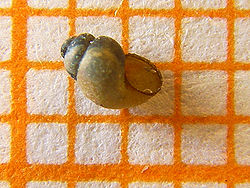
Picture of Bythinella
- Source
- Wikipedia/Commons
- Credit
- Dieter Schmitt
- Licence
- CC BY-SA 3.0
- Commercial use
- the licence allows it
No 3D scan of Bythinella was found in MorphoSource and Sketchfab.
Smithsonian Open Access was not reached for this taxon, so this list is what the others held rather than everything there is.
The description on this site
- Source
- Wikipedia, “Bythinella”
- Licence
- CC BY-SA 4.0
This is what the site found, which is not the same as what exists.
Keep going
What may have been alongside itHydrobiinae through timeFormations of the EoceneThe world it lived on
Occurrence data from the Paleobiology Database, CC BY 4.0. Moquin-Tandon 1856