Beryx
Beryx is a genus of alfonsinos found in deep oceanic waters. Two of its member species, B. decadactylus and B. splendens, are found across nearly the entire globe and are of some commercial importance.

Dr. Ken Sulak, USGS · Public Domain · via Wikipedia/Commons. May be a photograph of a specimen, or an artist’s reconstruction — an interpretation of a skeleton, since colour and soft tissue are almost never preserved.
On record
Recorded, not inferred- Sits inside
- BerycidaePBDB
- Diet
- carnivorePBDB, for Beryciformes
- Life habit
- nektonicPBDB, for Beryciformes
- Motility
- actively mobilePBDB, for Beryciformes
Time the record covers
At least 42 million years on record.
The record covers at least 66 Mya to 23.04 Mya. No occurrence read is dated outside 83.6 Mya to 15.98 Mya.
8 occurrences of Beryx on record, most of them in the Eocene. The Paleobiology Database records this as a living group, and the chart stops with its fossils rather than at the present. Bar height is expected occurrences, not a count: each fossil is spread across the span it is dated to, so a tall narrow bar means tight dating and a low wide one means loose.
When
8 occurrences- Late Cretaceous13%
- Eocene50%
- Oligocene25%
- Miocene13%
These are dates about fossils, not the animal: the record can only begin after it arose and end before it died out, so either end may reach further. Shares are expected occurrences: a fossil dated to a span is counted partly in each period it straddles. More on what this infers.
Found in
5 formations
- Tumey Formation2
- Pierre Shale Formation1
- Temblor Formation1
- Mission Valley Formation · Poway Group1
- Miretrain Marl Formation1
Loading coastlines…
The named rock units Beryx has been recovered from, largest first. Drawn where the rock is now, not where it formed. 2 occurrences have no formation on record, which is common for older literature.
Beryx and its relatives
EoceneWhere Beryx and its relatives were recorded in the Eocene.
Found in the same rock
128 taxa- "Batrachoides" trapezoidalis1 site
- Abdounia1 site
- Aeoliscus heinrichi1 site
- Albulidae1 site
- Allomorone1 site
- Alosa sculptata1 site
- Ampheristus1 site
- Anenchelum glarisianum1 site
- Antigonia angusta1 site
- Apogon1 site
- Apogon glaber1 site
- Archelon ischyros1 site
- Argyropelecus cosmovicii1 site
- Ariidae1 site
- Ariosoma1 site
- Bathyclupea1 site
- Bathygadus novus1 site
- Bauzaia1 site
- Beckius plicatus1 site
- Blenniidae1 site
- Bothus1 site
- Branchiostegus brevis1 site
- Brazosiella1 site
- Bregmaceros1 site
The Paleobiology Database records 6 sites for Beryx, and this reads all of them. The number is how many of those sites it was catalogued from too. The 24 sharing the most are listed.
This is not a list of everything alive at the time. It is only what has come out of the same ground as this animal and been written down.
Entered from
5 references- Some typical Upper Eocene fish scales from California3
- Fauna Fosila din Oligocenul de la Piatra Neamt2
- Fish otoliths from the Lutetian of the Aquitaine Basin (SW France), a breakthrough in the knowledge of the European Eocene ichthyofauna1
- A fossil fish fauna from the Upper Eocene Mission Valley Formation at the Lake Miramar Filtration Plant, San Diego, San Diego County, California1
- Archelon ischyros: a new gigantic cryptodire testudinate from the Fort Pierre Cretaceous of South Dakota1
Each of the 8 occurrences read was entered from one of these publications, ordered by how many each accounts for. This is not a search for papers mentioning the name. Entries link to doi.org where the Paleobiology Database holds an identifier, and to its own record where it does not. Relayed as the Paleobiology Database holds them, not checked against what they resolve to.
Media and terms
Media content2
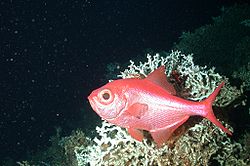
Picture of Beryx
- Source
- Wikipedia/Commons
- Credit
- Dr. Ken Sulak, USGS
- Licence
- Public Domain
- Commercial use
- the licence allows it
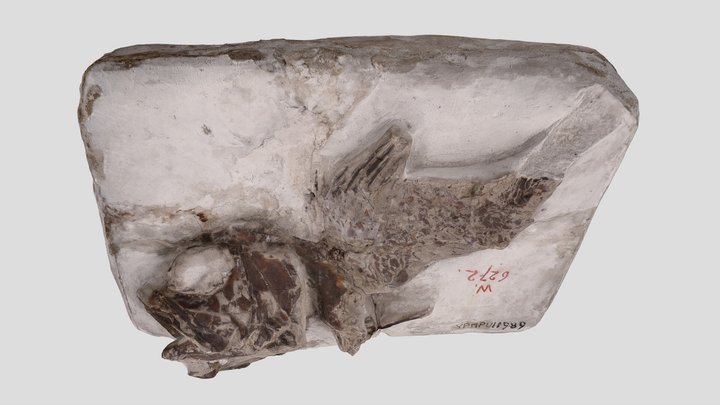
3D model
- Source
- Sketchfab
- Credit
- Yale Peabody Museum
- Licence
- CC Attribution
- Commercial use
- cannot be read from the licence given — check the record
Smithsonian Open Access and MorphoSource were not reached for this taxon, so this list is what the others held rather than everything there is.
The description on this site
- Source
- Wikipedia, “Beryx”
- Licence
- CC BY-SA 4.0
This is what the site found, which is not the same as what exists.
Keep going
What may have been alongside itBerycidae through timeFormations of the EoceneThe world it lived on
Occurrence data from the Paleobiology Database, CC BY 4.0. Cuvier 1829