Baryonyx
Baryonyx is a genus of theropod dinosaur which lived in the Barremian stage of the Early Cretaceous period, about 130–125 million years ago. The first skeleton was discovered in 1983 in the Smokejack Clay Pit, of Surrey, England, in sediments of the Weald Clay Formation, and became the holotype specimen of Baryonyx walkeri, named by palaeontologists Alan J. Charig and Angela C. Milner in 1986. The genus name Baryonyx comes from Ancient Greek βαρύς (barús), meaning "heavy" or "strong", and ὄνυξ (ónux), meaning "claw", alluding to the animal's very large claw on the first finger; the specific name, walkeri, refers to its discoverer, amateur fossil collector William J. Walker. The holotype specimen is one of the most complete theropod skeletons from the UK, and its discovery attracted media attention. Specimens later discovered in other parts of the United Kingdom and Iberia have also been assigned to the genus, though many have since been moved to new genera.

★Kumiko★ · CC BY-SA 2.0 · via Wikipedia/Commons. May be a photograph of a specimen, or an artist’s reconstruction — an interpretation of a skeleton, since colour and soft tissue are almost never preserved.
On record
Recorded, not inferred- Sits inside
- BaryonychinaePBDB
- Diet
- carnivorePBDB, for Theropoda
- Life habit
- ground dwelling, solitaryPBDB, for Theropoda
- Motility
- actively mobilePBDB, for Theropoda
- Environment
- terrestrialPBDB, for Theropoda
- Length
- 10 mWikidata
- Mass
- 1.9 tonneWikidata
Time the record covers
At least 13 million years on record.
The record covers at least 132.6 Mya to 119.57 Mya. No occurrence read is dated outside 139.1 Mya to 110.1 Mya.
12 occurrences of Baryonyx on record, most of them in the Early Cretaceous. Bar height is expected occurrences, not a count: each fossil is spread across the span it is dated to, so a tall narrow bar means tight dating and a low wide one means loose.
When
12 occurrences- Early Cretaceous100%
These are dates about fossils, not the animal: the record can only begin after it arose and end before it died out, so either end may reach further. Shares are expected occurrences: a fossil dated to a span is counted partly in each period it straddles. More on what this infers.
Found in
7 formations
- Pinilla de los Moros Formation · Urbión Group3
- Weald Clay Formation · Wealden Group2
- Wessex Formation · Wealden Group1
- Wadhurst Clay Formation · Wealden Group1
- Papo Seco Formation1
- Aïn el Guettar Formation1
Loading coastlines…
The named rock units Baryonyx has been recovered from, largest first. Drawn where the rock is now, not where it formed. 2 occurrences have no formation on record, which is common for older literature.
Baryonyx and its relatives
Early CretaceousWhere Baryonyx and its relatives were recorded in the Early Cretaceous.
Found in the same rock
179 taxa- Theropoda5 sites
- Dromaeosauridae3 sites
- Ornithocheiridae3 sites
- Crocodylia2 sites
- Goniopholididae2 sites
- Helochelydra nopcsai2 sites
- Iguanodon2 sites
- Lepidotes2 sites
- Mantellisaurus atherfieldensis2 sites
- Pterosauria2 sites
- Sauropoda2 sites
- "Clockhousea" sp.1 site
- Abietineaepollenites1 site
- Aequitriradites verrucosus1 site
- Aeschnidiidae1 site
- Aigialosauridae1 site
- Albuliformes1 site
- Alisporites bilateralis1 site
- Allosauroidea1 site
- Amiiformes1 site
- Anteophthalmosuchus1 site
- Anura1 site
- Archisphex boothi1 site
- Arcodonichthys1 site
The Paleobiology Database records 12 sites for Baryonyx, and this reads all of them. The number is how many of those sites it was catalogued from too. The 24 sharing the most are listed.
This is not a list of everything alive at the time. It is only what has come out of the same ground as this animal and been written down.
Entered from
10 references- Dientes de dinosaurios terópodos (cf. Baryonyx) en el Weald de Burgos (España) [Teeth of theropod dinosaurs (cf. Baryonyx) in the Weald of Burgos (Spain)]3
- New dinosaur tracks from the lower Barremian of Portugal (Areia do Mastro Formation, Cape Espichel)1
- Nuevos vertebrados fósiles de la Formación El Castellar en Gúdar, Teruel, España (Barremiense inferior, Cretácico Inferior) [New vertebrate fossils from the El Castellar Formation in Gúdar, Teruel, Spain (lower Barremian, Lower Cretaceous)]1
- Vertebrate fauna from Ashdown Brickworks, Bexhill, East Sussex1
- Position stratigraphique des niveaux à vertébrés du Mésozoïque Sud-Est de la Tunisie [Stratigraphic position of beds with Mesozoic vertebrates from southeastern Tunisia]1
- Los restos directos de dinosaurios teropódos (excluyendo Aves) en España [Direct remains of theropod dinosaurs (excluding Aves) in Spain]1
- Dinosaurios (Saurischia, Ornithischia) en el Barremiense (Cretácico Inferior) de la península Ibérica [Dinosaurs (Saurischia, Ornithischia) in the Barremian (Lower Cretaceous) of the Iberian peninsula]1
- Saurischian dinosaurs 2: theropods1
- Baryonyx walkeri, a fish-eating dinosaur from the Wealden of Surrey1
- Baryonyx, a remarkable new theropod dinosaur1
Each of the 12 occurrences read was entered from one of these publications, ordered by how many each accounts for. This is not a search for papers mentioning the name. Entries link to doi.org where the Paleobiology Database holds an identifier, and to its own record where it does not. Relayed as the Paleobiology Database holds them, not checked against what they resolve to.
Media and terms
Media content3

Picture of Baryonyx
- Source
- Wikipedia/Commons
- Credit
- ★Kumiko★
- Licence
- CC BY-SA 2.0
- Commercial use
- the licence allows it
CT scan
- Source
- MorphoSource
- Licence
- In Copyright
- Commercial use
- cannot be read from the licence given — check the record
- Specimen
- Baryonyx walkeri · NHMUK:PAL:PV R 9951 a
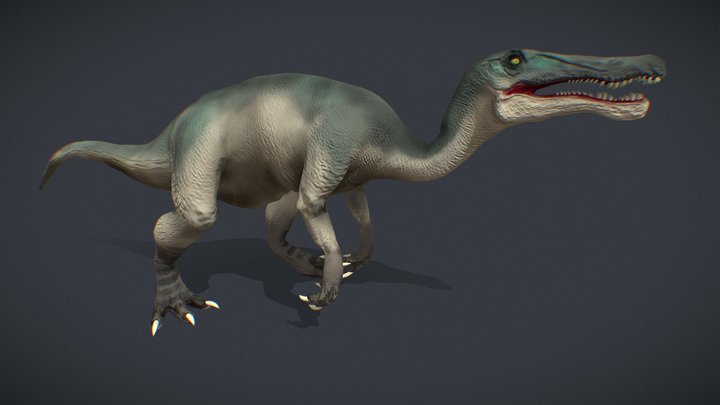
3D model
- Source
- Sketchfab
- Credit
- Paleo Modelist
- Licence
- CC Attribution
- Commercial use
- cannot be read from the licence given — check the record
The description on this site
- Source
- Wikipedia, “Baryonyx”
- Licence
- CC BY-SA 4.0
This is what the site found, which is not the same as what exists.
Keep going
What may have been alongside itBaryonychinae through timeFormations of the Early CretaceousThe world it lived on
Occurrence data from the Paleobiology Database, CC BY 4.0. Charig and Milner 1986