Artiodactyla
Searched as Artiodactyla indet.. The Paleobiology Database treats Artiodactyla as the accepted name.
Artiodactyla is an order of placental mammals. Typically, they are ungulates which bear weight equally on two of their five toes. The other three toes are either present, absent, vestigial, or pointing posteriorly. By contrast, most perissodactyls bear weight on an odd number of the five toes. Another difference between the two orders is that many artiodactyls digest plant cellulose in one or more stomach chambers rather than in their intestine. Molecular biology, along with fossil discoveries, has found that cetaceans fall within this taxonomic branch, being most closely related to hippopotamuses. Some modern taxonomists thus apply the name Cetartiodactyla to this group, while others opt to include cetaceans within the existing name of Artiodactyla. Some researchers use "even-toed ungulates" to exclude cetaceans and only include terrestrial artiodactyls, making the term paraphyletic in nature.

LittleJerry · CC BY-SA 4.0 · via Wikipedia/Commons. May be a photograph of a specimen, or an artist’s reconstruction — an interpretation of a skeleton, since colour and soft tissue are almost never preserved.
On record
Recorded, not inferred- Also called
- even-toed ungulatePBDB
- Sits inside
- ArtiodactylamorphaPBDB
- Diet
- grazer, browserPBDB
- Life habit
- ground dwellingPBDB
- Motility
- actively mobilePBDB, for Osteichthyes
- Environment
- terrestrialPBDB
Time the record covers
At least 51 million years on record.
The record covers at least 51.1 Mya to 11.7 ka. No occurrence read is dated outside 66 Mya to 0 Mya.
139 occurrences of Artiodactyla on record, most of them in the Miocene. The Paleobiology Database records this as a living group. Bar height is expected occurrences, not a count: each fossil is spread across the span it is dated to, so a tall narrow bar means tight dating and a low wide one means loose.
When
139 occurrencesThese are dates about fossils, not the animal: the record can only begin after it arose and end before it died out, so either end may reach further. Shares are expected occurrences: a fossil dated to a span is counted partly in each period it straddles. More on what this infers.
Found in
51 formations
- Uinta Formation9
- Chitarwata Formation8
- Vihowa Formation7
- Santiago Formation4
- Corçà Formation4
- Chu Formation3
Loading coastlines…
The named rock units Artiodactyla has been recovered from, largest first. Drawn where the rock is now, not where it formed. 27 further formations hold fewer occurrences each and are not listed. 54 occurrences have no formation on record, which is common for older literature.
Artiodactyla and its relatives
MioceneWhere Artiodactyla and its relatives were recorded in the Miocene.
Found in the same rock
1,259 taxa- Hyopsodus99 sites
- Coryphodon80 sites
- Diacodexis73 sites
- Phenacodus vortmani60 sites
- Paramys excavatus56 sites
- Paramys copei53 sites
- Haplomylus speirianus50 sites
- Phenacolemurinae50 sites
- Sifrhippus grangeri49 sites
- Phenacodus48 sites
- Didymictis47 sites
- Esthonyx bisulcatus45 sites
- Prototomus41 sites
- Hyracotherium38 sites
- Cantius34 sites
- Prodiacodon tauricinerei34 sites
- Vulpavus australis34 sites
- Ectocion osbornianus32 sites
- Viverravus32 sites
- Bunophorus31 sites
- Microsyopidae31 sites
- Cantius abditus30 sites
- Apheliscus29 sites
- Esthonyx spatularius29 sites
The Paleobiology Database records at least 866 sites for Artiodactyla, and this reads 240 of them. The number is how many of those sites it was catalogued from too. The 24 sharing the most are listed.
This is not a list of everything alive at the time. It is only what has come out of the same ground as this animal and been written down.
Entered from
88 references- Will Downs and the Zinda Pir Dome15
- Geometric morphometrics and anatomical network analyses reveal ecospace partitioning among geoemydid turtles from the Uinta Formation, Utah7
- Summary of known occurrences of terrestrial vertebrates from Eocene strata of southern California5
- Rodent faunas from the Paleogene of south-east Serbia4
- Landscape and Biotic Evolution of the Kochkor Basin, Kyrgyzstan4
- Stratigraphy and mammal faunas of the Brackwassermolasse in the surroundings of Ulm (Southwest Germany)4
- Catalogue of Tertiary Fossil Sites of the Land Mammals in the U.S.S.R.4
- New lower Eocene fossil sites with primate remains from the Iberian Peninsula3
- The Northernmost Ruins of the Globe3
- Empreintes de pas de mammiferes Midi Mediterraneen. [Footprints of southern Mediterranean mammals.]3
- Paleofauna de vertebrados, com ênfase em répteis e mamíferos, dos depósitos quartenários da região da Serra da Bodoquena, Mato Grosso do Sul, Brasil2
- Stratigraphic Distribution of Upper Middle Eocene Fossil Vertebrate Localities in the Eastern Uinta Basin, Utah, With Comments on Uintan Biostratigraphy2
Each of the 139 occurrences read was entered from one of these publications, ordered by how many each accounts for. This is not a search for papers mentioning the name. 76 further references are not listed. Entries link to doi.org where the Paleobiology Database holds an identifier, and to its own record where it does not. Relayed as the Paleobiology Database holds them, not checked against what they resolve to.
Media and terms
Media content2

Picture of Artiodactyla
- Source
- Wikipedia/Commons
- Credit
- LittleJerry
- Licence
- CC BY-SA 4.0
- Commercial use
- the licence allows it
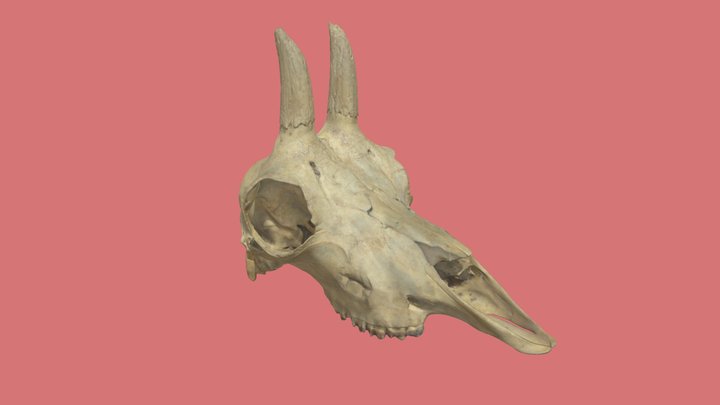
3D model
- Source
- Sketchfab
- Credit
- SchmalhausenEvolMorph
- Licence
- CC Attribution
- Commercial use
- cannot be read from the licence given — check the record
Smithsonian Open Access and MorphoSource were not reached for this taxon, so this list is what the others held rather than everything there is.
The description on this site
- Licence
- CC BY-SA 4.0
This is what the site found, which is not the same as what exists.
Keep going
What may have been alongside itArtiodactylamorpha through timeFormations of the MioceneThe world it lived on
Occurrence data from the Paleobiology Database, CC BY 4.0. (Owen 1848)