Araripesuchus gomesii
No picture of Araripesuchus gomesii was found. Wikidata and iDigBio were searched and had none. Wikipedia and Smithsonian Open Access did not answer, so this is what the others held rather than everything there is. GBIF was asked, and what came back is not recorded: nothing, or a picture this site could not tie to Araripesuchus gomesii, or no answer at all. This entry cannot say which.
On record
Recorded, not inferred- Sits inside
- AraripesuchusPBDB
- Diet
- carnivorePBDB, for Pseudosuchia
- Motility
- actively mobilePBDB, for Osteichthyes
- Environment
- marinePBDB, for Mesoeucrocodylia
Time the record covers
At most 6.4 million years on record.
Every occurrence read is dated to somewhere between 119.57 Mya and 113.2 Mya, and nothing in the dating separates them, so that window is what the record shows rather than a span.
2 occurrences of Araripesuchus gomesii on record, most of them in the Early Cretaceous. Bar height is expected occurrences, not a count: each fossil is spread across the span it is dated to, so a tall narrow bar means tight dating and a low wide one means loose.
When
2 occurrences- Early Cretaceous100%
These are dates about fossils, not the animal: the record can only begin after it arose and end before it died out, so either end may reach further. Shares are expected occurrences: a fossil dated to a span is counted partly in each period it straddles. More on what this infers.
Found in
1 formation
- Romualdo Formation · Santana Group2
Loading coastlines…
The named rock units Araripesuchus gomesii has been recovered from, largest first. Drawn where the rock is now, not where it formed.
Araripesuchus gomesii and its relatives
Early CretaceousWhere Araripesuchus gomesii and its relatives were recorded in the Early Cretaceous.
Found in the same rock
39 taxa- Anhanguera1 site
- Anhanguera araripensis1 site
- Anhanguera blittersdorffi1 site
- Anhanguera ligabuei1 site
- Anhanguera robustus1 site
- Anhanguera santanae1 site
- Araripecarcinus ferreirae1 site
- Azhdarchoidea1 site
- Banguela oberlii1 site
- Barbosania gracilirostris1 site
- Brasilemys josai1 site
- Brasileodactylus1 site
- Brasileodactylus araripensis1 site
- Caririsuchus camposi1 site
- Cearadactylus atrox1 site
- Iemanja palma1 site
- Kariridraco dianae1 site
- Lepidotes wenzae1 site
- Maaradactylus spielbergi1 site
- Megaraptora1 site
- Microdon penalvai1 site
- Obaichthys decoratus1 site
- Obaichthys laevis1 site
- Oshunia brevis1 site
The Paleobiology Database records 2 sites for Araripesuchus gomesii, and this reads all of them. The number is how many of those sites it was catalogued from too. The 24 sharing the most are listed.
This is not a list of everything alive at the time. It is only what has come out of the same ground as this animal and been written down.
Entered from
2 referencesEach of the 2 occurrences read was entered from one of these publications, ordered by how many each accounts for. This is not a search for papers mentioning the name. Each entry links to the Paleobiology Database's own record for the work.
Media and terms
Media content2
CT scan
- Source
- MorphoSource
- Licence
- In Copyright
- Commercial use
- cannot be read from the licence given — check the record
- Specimen
- Araripesuchus gomesii · amnh:farb:24450
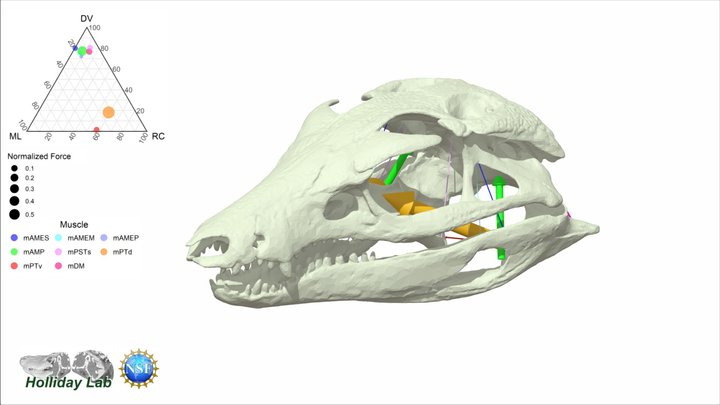
3D model
- Source
- Sketchfab
- Credit
- Holliday Lab
- Licence
- CC Attribution
- Commercial use
- cannot be read from the licence given — check the record
No picture of Araripesuchus gomesii was found. Wikidata and iDigBio were searched and had none.
Wikipedia and Smithsonian Open Access did not answer, so this is what the others held rather than everything there is.
GBIF was asked, and what came back is not recorded: nothing, or a picture this site could not tie to Araripesuchus gomesii, or no answer at all. This entry cannot say which.
Smithsonian Open Access was not reached for this taxon, so this list is what the others held rather than everything there is.
This is what the site found, which is not the same as what exists.
Keep going
What may have been alongside itAraripesuchus through timeFormations of the Early CretaceousThe world it lived on
Occurrence data from the Paleobiology Database, CC BY 4.0. Price 1959