Anhanguera
Anhanguera is a genus of pterodactyloid pterosaur known from the Early Cretaceous Romualdo Formation of Brazil and the Late Cretaceous Kem Kem Group of Morocco. This pterosaur is closely related to Ornithocheirus, but belongs in the family Anhangueridae. The generic name comes from the Tupi words añanga, meaning "spirit protector of the animals" + wera "bygone".

FELIPE L. PINHEIRO, ALEXANDER W.A. KELLNER, JOÃO L. DA SILVA, RUDAH R.C. DUQUE, JULIANA M. SAYÃO, ESAÚ V. DE ARAÚJO,… · CC BY 4.0 · via Wikipedia/Commons. May be a photograph of a specimen, or an artist’s reconstruction — an interpretation of a skeleton, since colour and soft tissue are almost never preserved.
On record
Recorded, not inferred- Sits inside
- OrnithocheiroideaPBDB
- Diet
- piscivorePBDB, for Pterosauria
- Life habit
- volantPBDB, for Pterosauria
- Motility
- actively mobilePBDB, for Osteichthyes
- Environment
- marinePBDB, for Pterosauria
Time the record covers
At least 32 million years on record.
The record covers at least 132.6 Mya to 100.5 Mya. No occurrence read is dated outside 137.05 Mya to 93.9 Mya.
18 occurrences of Anhanguera on record, most of them in the Early Cretaceous. Bar height is expected occurrences, not a count: each fossil is spread across the span it is dated to, so a tall narrow bar means tight dating and a low wide one means loose.
When
18 occurrencesThese are dates about fossils, not the animal: the record can only begin after it arose and end before it died out, so either end may reach further. Shares are expected occurrences: a fossil dated to a span is counted partly in each period it straddles. More on what this infers.
Found in
6 formations
- Romualdo Formation · Santana Group10
- West Melbury Marly Chalk Formation · Chalk Group3
- Toolebuc Formation · Rolling Downs Group2
- Ifezouane Formation · Kem Kem Group1
- Bahariya Formation1
- Rosa Blanca Formation1
Loading coastlines…
The named rock units Anhanguera has been recovered from, largest first. Drawn where the rock is now, not where it formed.
Anhanguera and its relatives
Early CretaceousWhere Anhanguera and its relatives were recorded in the Early Cretaceous.
Found in the same rock
79 taxa- Pterodactyloidea3 sites
- Ornithocheirus simus2 sites
- Osteichthyes2 sites
- Tupuxuara longicristatus2 sites
- Abelisauridae1 site
- Aerodraco sedgwickii1 site
- Alanqa saharica1 site
- Apatorhamphus gyrostega1 site
- Araripecarcinus ferreirae1 site
- Araripemys barretoi1 site
- Araripesuchus gomesii1 site
- Aves1 site
- Azhdarchoidea1 site
- Banguela oberlii1 site
- Barbosania gracilirostris1 site
- Brasilemys josai1 site
- Brasileodactylus1 site
- Brasileodactylus araripensis1 site
- Camposipterus nasutus1 site
- Caririemys violetae1 site
- Caririsuchus camposi1 site
- Cearachelys placidoi1 site
- Cearadactylus atrox1 site
- Cetarthrosaurus walkeri1 site
The Paleobiology Database records 9 sites for Anhanguera, and this reads all of them. The number is how many of those sites it was catalogued from too. The 24 sharing the most are listed.
This is not a list of everything alive at the time. It is only what has come out of the same ground as this animal and been written down.
Entered from
13 references- Neue Pterosaurier aus der Santana-Formation (Apt) der Chapada do Araripe, Brasilien3
- Seeley, 18703
- New pterosaur fossils from the Early Cretaceous (Albian) of Queensland, Australia2
- New pterosaur fossils from the Early Cretaceous of Colombia1
- Salem, 20231
- New toothed pterosaurs (Pterosauria: Ornithocheiridae) from the middle Cretaceous Kem Kem beds of Morocco and implications for pterosaur palaeobiogeography and diversity1
- Description of two pterosaur (Pterodactyloidea) mandibles from the Lower Cretaceous Santana Formation, Brazil1
- First record of Coloborhynchus (Pterosauria) from the Santana Formation (Lower Cretaceous) of the Chapada do Araripe, Brazil1
- Description of a new species of Anhangueridae (Pterodactyloidea) with comments on the pterosaur fauna from the Santana Formation (Aptian-Albian), northeastern Brazil1
- Cearadactylus? ligabuei nov. sp., a new early Cretaceous (Aptian) pterosaur from Chapada do Araripe (Northeastern Brazil)1
- Weitere Pterosaurierfunde aus der Santana-Formation (Apt) der Chapada do Araripe, Brasilien1
- New crested pterosaurs from the Lower Cretaceous of Brazil1
Each of the 18 occurrences read was entered from one of these publications, ordered by how many each accounts for. This is not a search for papers mentioning the name. 1 further reference is not listed. Entries link to doi.org where the Paleobiology Database holds an identifier, and to its own record where it does not. Relayed as the Paleobiology Database holds them, not checked against what they resolve to.
Media and terms
Media content2

Picture of Anhanguera
- Source
- Wikipedia/Commons
- Credit
- FELIPE L. PINHEIRO, ALEXANDER W.A. KELLNER, JOÃO L. DA SILVA, RUDAH R.C. DUQUE, JULIANA M. SAYÃO, ESAÚ V. DE ARAÚJO,…
- Licence
- CC BY 4.0
- Commercial use
- the licence allows it
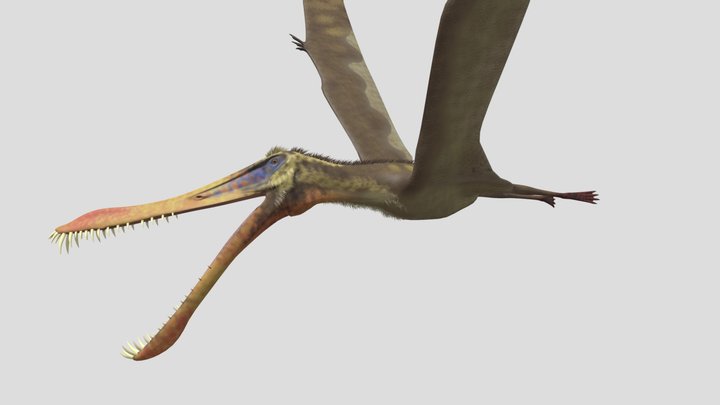
3D model
- Source
- Sketchfab
- Credit
- seth the yutyrannus
- Licence
- CC Attribution
- Commercial use
- cannot be read from the licence given — check the record
Smithsonian Open Access and MorphoSource were not reached for this taxon, so this list is what the others held rather than everything there is.
The description on this site
- Source
- Wikipedia, “Anhanguera”
- Licence
- CC BY-SA 4.0
This is what the site found, which is not the same as what exists.
Keep going
What may have been alongside itOrnithocheiroidea through timeFormations of the Early CretaceousThe world it lived on
Occurrence data from the Paleobiology Database, CC BY 4.0. Campos and Kellner 1985