Anteosaurus
Anteosaurus is an extinct genus of large carnivorous dinocephalian synapsid. It lived at the end of the Guadalupian during the Capitanian age, about 262 to 260 million years ago, in what is now South Africa. It is mainly known from cranial remains and few postcranial bones found in rocks of the Tapinocephalus Assemblage Zone. Measuring 5–6 m (16–20 ft) long and weighing about 600 kg (1,300 lb), Anteosaurus was the largest known carnivorous non-mammalian synapsid and the largest terrestrial predator of the Permian period. Occupying the top of the food chain in the Middle Permian, its skull, jaws and teeth show adaptations to capture large prey, such as giant titanosuchid and tapinocephalid dinocephalians and large pareiasaurs.

Iziko South African Museum in July, 2018 – 53.jpg : Jnanaranjan sahu derivative work: Taxon34 · CC BY-SA 4.0 · via Wikipedia/Commons. May be a photograph of a specimen, or an artist’s reconstruction — an interpretation of a skeleton, since colour and soft tissue are almost never preserved.
On record
Recorded, not inferred- Sits inside
- AnteosaurinaePBDB
- Motility
- actively mobilePBDB, for Osteichthyes
- Environment
- terrestrialPBDB, for Amniota
Time the record covers
At most 47 million years on record.
Every occurrence read is dated to somewhere between 298.9 Mya and 251.902 Mya, and nothing in the dating separates them, so that window is what the record shows rather than a span.
21 occurrences of Anteosaurus on record, most of them in the Permian. Bar height is expected occurrences, not a count: each fossil is spread across the span it is dated to, so a tall narrow bar means tight dating and a low wide one means loose.
When
21 occurrences- Permian100%
These are dates about fossils, not the animal: the record can only begin after it arose and end before it died out, so either end may reach further. Shares are expected occurrences: a fossil dated to a span is counted partly in each period it straddles. More on what this infers.
Found in
2 formations
- Abrahamskraal Formation · Beaufort Group6
- Koonap Formation · Beaufort Group1
Loading coastlines…
The named rock units Anteosaurus has been recovered from, largest first. Drawn where the rock is now, not where it formed. 14 occurrences have no formation on record, which is common for older literature.
Anteosaurus and its relatives
PermianWhere Anteosaurus and its relatives were recorded in the Permian.
Found in the same rock
28 taxa- Struthiocephalus whaitsi4 sites
- Bradysaurus seeleyi3 sites
- Bradysaurus2 sites
- Bradysaurus baini2 sites
- Jonkeria2 sites
- Titanosuchus ferox2 sites
- Alopecideops gracilis1 site
- Avenantia kruisvleiensis1 site
- Brachyprosopus broomi1 site
- Broomia perplexa1 site
- Dicynodon1 site
- Diictodon1 site
- Embrithosaurus1 site
- Emydops1 site
- Eriphostoma1 site
- Gorgonopsia1 site
- Moschops1 site
- Pristerognathidae1 site
- Pristerognathinae1 site
- Procolophonoidea1 site
- Rhinesuchoides capensis1 site
- Rhinesuchoides tenuiceps1 site
- Rhinesuchus whaitsi1 site
- Scymnosaurus1 site
The Paleobiology Database records 15 sites for Anteosaurus, and this reads all of them. The number is how many of those sites it was catalogued from too. The 24 sharing the most are listed.
This is not a list of everything alive at the time. It is only what has come out of the same ground as this animal and been written down.
Entered from
5 references- The fauna of the Tapinocephalus Zone (Beaufort Beds of the Karoo)16
- The distribution of the Karroo vertebrate fauna2
- Eotherapsids from the East European Placket (Late Permian)1
- A dinocephalian therapsid fauna on the Ecca–Beaufort contact in Eastern Cape Province, South Africa1
- The oldest procolophonoid (Amniota: Parareptilia) - new discovery from the lower beaufort of South Africa1
Each of the 21 occurrences read was entered from one of these publications, ordered by how many each accounts for. This is not a search for papers mentioning the name. Each entry links to the Paleobiology Database's own record for the work.
Media and terms
Media content3
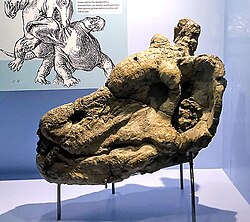
Picture of Anteosaurus
- Source
- Wikipedia/Commons
- Credit
- Iziko South African Museum in July, 2018 – 53.jpg : Jnanaranjan sahu derivative work: Taxon34
- Licence
- CC BY-SA 4.0
- Commercial use
- the licence allows it
Structured light scan
- Source
- MorphoSource
- Licence
- In Copyright
- Commercial use
- cannot be read from the licence given — check the record
- Specimen
- Anteosaurus magnificus · NHMUK:PAL:PV R 5742
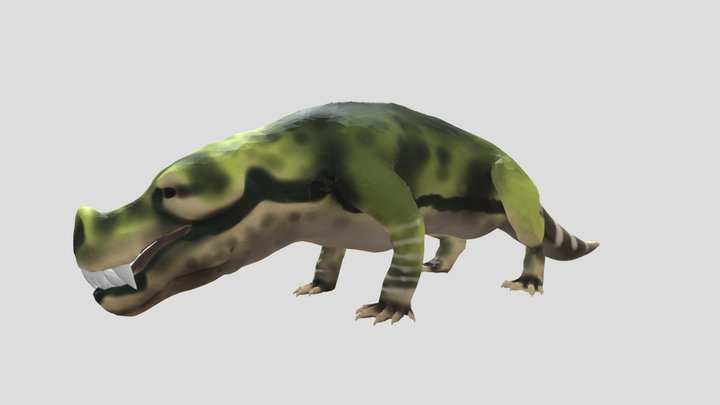
3D model
- Source
- Sketchfab
- Credit
- Robert_the_whale
- Licence
- CC Attribution
- Commercial use
- cannot be read from the licence given — check the record
The description on this site
- Source
- Wikipedia, “Anteosaurus”
- Licence
- CC BY-SA 4.0
This is what the site found, which is not the same as what exists.
Keep going
What may have been alongside itAnteosaurinae through timeFormations of the PermianThe world it lived on
Occurrence data from the Paleobiology Database, CC BY 4.0. Watson 1921