Gorgonopsia
Gorgonopsia is an extinct clade of sabre-toothed therapsids from the Middle to the Upper Permian, roughly between 270 and 252 million years ago. They are characterised by a long and narrow skull, as well as elongated upper and sometimes lower canine teeth and incisors which were likely used as slashing and stabbing weapons. Postcanine teeth are generally reduced or absent. For hunting large prey, they possibly used a bite-and-retreat tactic, ambushing and taking a debilitating bite out of the target, and following it at a safe distance before its injuries exhausted it, whereupon the gorgonopsian would grapple the animal and deliver a killing bite. They would have had an exorbitant gape, possibly in excess of 90°, without having to unhinge the jaw.

Uncredited · CC BY-SA 3.0 · via Wikipedia/Commons. May be a photograph of a specimen, or an artist’s reconstruction — an interpretation of a skeleton, since colour and soft tissue are almost never preserved.
On record
Recorded, not inferred- Sits inside
- TherapsidaPBDB
- Diet
- carnivorePBDB
- Motility
- actively mobilePBDB, for Osteichthyes
- Environment
- terrestrialPBDB, for Amniota
Time the record covers
At least 12 million years on record.
The record covers at least 266.9 Mya to 254.14 Mya. No occurrence read is dated outside 283.3 Mya to 251.902 Mya.
290 occurrences of Gorgonopsia on record, most of them in the Permian. Bar height is expected occurrences, not a count: each fossil is spread across the span it is dated to, so a tall narrow bar means tight dating and a low wide one means loose.
When
290 occurrences- Permian100%
These are dates about fossils, not the animal: the record can only begin after it arose and end before it died out, so either end may reach further. Shares are expected occurrences: a fossil dated to a span is counted partly in each period it straddles. More on what this infers.
Found in
20 formations
- Balfour Formation · Beaufort Group27
- Usili Formation · Songea Group24
- Teekloof Formation · Beaufort Group19
- Abrahamskraal Formation · Beaufort Group16
- Madumabisa Mudstone Formation · Lower Karoo Group16
- Chiweta Beds Formation6
Loading coastlines…
The named rock units Gorgonopsia has been recovered from, largest first. Drawn where the rock is now, not where it formed. 148 occurrences have no formation on record, which is common for older literature.
Gorgonopsia and its relatives
PermianWhere Gorgonopsia and its relatives were recorded in the Permian.
Found in the same rock
432 taxa- Diictodon feliceps6 sites
- Dvinosaurus primus6 sites
- Theriognathus microps6 sites
- Microphon exiguus5 sites
- Chroniosaurus dongusensis4 sites
- Dicynodontia4 sites
- Isadia aristoviensis4 sites
- Karpinskiosaurus secundus4 sites
- Oudenodon bainii4 sites
- Pareiasaurus serridens4 sites
- Scutosaurus karpinskii4 sites
- Toyemia blumentalis4 sites
- Aelurognathus tigriceps3 sites
- Annatherapsidus petri3 sites
- Cistecephalus microrhinus3 sites
- Daptocephalus leoniceps3 sites
- Diictodon3 sites
- Eriphostoma microdon3 sites
- Gorgonopidae3 sites
- Inostrancevia3 sites
- Inostrancevia latifrons3 sites
- Isadia suchonensis3 sites
- Jonkeria3 sites
- Pelanomodon moschops3 sites
The Paleobiology Database records 64 sites for Gorgonopsia, and this reads all of them. The number is how many of those sites it was catalogued from too. The 24 sharing the most are listed.
This is not a list of everything alive at the time. It is only what has come out of the same ground as this animal and been written down.
Entered from
55 references- Theriodontia I: Phthinosuchia, Biarmosuchia, Eotitanosuchia, Gorgonopsia81
- The distribution of the Karroo vertebrate fauna38
- Systematics of the Rubidgeinae (Therapsida: Gorgonopsia)37
- Eotherapsids from the East European Placket (Late Permian)29
- A Contribution to our Knowledge of the Vertebrates of the Karroo Beds of South Africa11
- New information on the morphology and stratigraphic range of the mid‐Permian gorgonopsian Eriphostoma microdon Broom, 19119
- Die Theriodontier des ostafrikanischen Ruhuhu-Gebietes in der Tuebinger Sammlung8
- A re-examination of the Karroo succession and fossil localities of part of the Upper Luangwa Valley6
- On Karroo vertebrates from Nyasaland5
- The Vertebrate Fauna of the Upper Permian of Niger. VI. First Evidence of a Gorgonopsian Therapsid4
- Studies on new specimens of the Gorgonopsia4
- Permian-Triassic vertebrate footprints from South Africa: Ichnotaxonomy, producers and biostratigraphy through two major faunal crises3
Each of the 290 occurrences read was entered from one of these publications, ordered by how many each accounts for. This is not a search for papers mentioning the name. 42 further references are not listed. Entries link to doi.org where the Paleobiology Database holds an identifier, and to its own record where it does not. Relayed as the Paleobiology Database holds them, not checked against what they resolve to.
Media and terms
Media content2
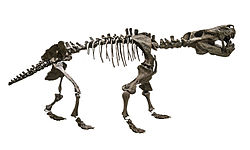
Picture of Gorgonopsia
- Source
- Wikipedia/Commons
- Credit
- nobody named on the record
- Licence
- CC BY-SA 3.0
- Commercial use
- the licence allows it

Photography scan
- Source
- MorphoSource
- Licence
- not stated by the source
- Commercial use
- cannot be read from the licence given — check the record
- Specimen
- Gorgonopsia indet. · bp:1:1258
Smithsonian Open Access was not reached for this taxon, so this list is what the others held rather than everything there is.
The description on this site
- Source
- Wikipedia, “Gorgonopsia”
- Licence
- CC BY-SA 4.0
This is what the site found, which is not the same as what exists.
Keep going
What may have been alongside itTherapsida through timeFormations of the PermianThe world it lived on
Occurrence data from the Paleobiology Database, CC BY 4.0. (Seeley 1894)