Inostrancevia
Inostrancevia is an extinct genus of large carnivorous therapsids which lived during the Late Permian in what is now European Russia and Southern Africa. The first-known fossils of this gorgonopsian were discovered in the context of a long series of excavations carried out from 1899 to 1914 in the Northern Dvina, Russia. Among these are two near-complete skeletons embodying the first described specimens of this genus, being also the first gorgonopsian identified in Russia. Several other fossil materials were discovered there, and the various finds led to confusion as to the exact number of valid species, before only two of them were formally recognized, namely I. alexandri and I. latifrons. A third species, I. uralensis, was erected in 1974, but the fossil remains of this taxon are very thin and could come from another genus. More recent research carried out in Southern Africa has discovered specimens identified as belonging to this genus, being classified within the species I. africana. The genus name honors Alexander Inostrantsev, professor of Vladimir P. Amalitsky, the paleontologist who described the taxon.

Uncredited · CC BY-SA 3.0 · via Wikipedia/Commons. May be a photograph of a specimen, or an artist’s reconstruction — an interpretation of a skeleton, since colour and soft tissue are almost never preserved.
On record
Recorded, not inferred- Sits inside
- InostranceviidaePBDB
- Diet
- carnivorePBDB, for Gorgonopsia
- Motility
- actively mobilePBDB, for Osteichthyes
- Environment
- terrestrialPBDB, for Amniota
Time the record covers
At most 11 million years on record.
Every occurrence read is dated to somewhere between 264.28 Mya and 254.14 Mya, and nothing in the dating separates them, so that window is what the record shows rather than a span.
12 occurrences of Inostrancevia on record, most of them in the Permian. Bar height is expected occurrences, not a count: each fossil is spread across the span it is dated to, so a tall narrow bar means tight dating and a low wide one means loose.
When
12 occurrences- Permian100%
These are dates about fossils, not the animal: the record can only begin after it arose and end before it died out, so either end may reach further. Shares are expected occurrences: a fossil dated to a span is counted partly in each period it straddles. More on what this infers.
Found in
3 formations
- Salarevo Formation5
- Kutuluk Formation1
- Usili Formation · Songea Group1
Loading coastlines…
The named rock units Inostrancevia has been recovered from, largest first. Drawn where the rock is now, not where it formed. 5 occurrences have no formation on record, which is common for older literature.
Inostrancevia and its relatives
PermianWhere Inostrancevia and its relatives were recorded in the Permian.
Found in the same rock
34 taxa- Annatherapsidus petri3 sites
- Dvinosaurus primus3 sites
- Karpinskiosaurus secundus3 sites
- Scutosaurus karpinskii3 sites
- Vivaxosaurus trautscholdi3 sites
- Chroniosuchus licharevi2 sites
- Elph borealis2 sites
- Isadia aristoviensis2 sites
- Toyemia blumentalis2 sites
- Burnetiidae1 site
- Chroniosuchus paradoxus1 site
- Chroniosuchus vjuschkovi1 site
- Darwinuloides svijazhicus1 site
- Dicynodontidae1 site
- Dicynodontoides kubwa1 site
- Dvinia prima1 site
- Dvinosaurus1 site
- Endothiodon1 site
- Gerdalia1 site
- Kotlassia prima1 site
- Pareiasauria1 site
- Peltobatrachus pustulatus1 site
- Peramodon amalitzkii1 site
- Placidea lutkevichi1 site
The Paleobiology Database records 7 sites for Inostrancevia, and this reads all of them. The number is how many of those sites it was catalogued from too. The 24 sharing the most are listed.
This is not a list of everything alive at the time. It is only what has come out of the same ground as this animal and been written down.
Entered from
5 references- Eotherapsids from the East European Placket (Late Permian)8
- Earliest evidence of Inostrancevia in the southern hemisphere: new data from the Usili Formation of Tanzania1
- Type and reference sections of the Permian–Triassic continental sequences of the East European Platform: main isotope, magnetic, and biotic events1
- Permian and Triassic therocephals (Eutherapsida) of Eastern Europe1
- Predvaritel'noye opisaniye novykh form permskoy i triasovoy fauny nazemnykh pozvonochnykh SSSR [Preliminary description of new forms from the Permian and Triassic terrestrial vertebrate fauna of the USSR]1
Each of the 12 occurrences read was entered from one of these publications, ordered by how many each accounts for. This is not a search for papers mentioning the name. Entries link to doi.org where the Paleobiology Database holds an identifier, and to its own record where it does not. Relayed as the Paleobiology Database holds them, not checked against what they resolve to.
Media and terms
Media content3
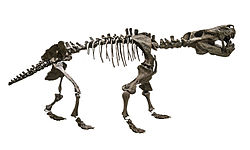
Picture of Inostrancevia
- Source
- Wikipedia/Commons
- Credit
- nobody named on the record
- Licence
- CC BY-SA 3.0
- Commercial use
- the licence allows it

Photography scan
- Source
- MorphoSource
- Credit
- No Organization
- Licence
- not stated by the source
- Commercial use
- cannot be read from the licence given — check the record
- Specimen
- Inostrancevia africana · NMQR:4000
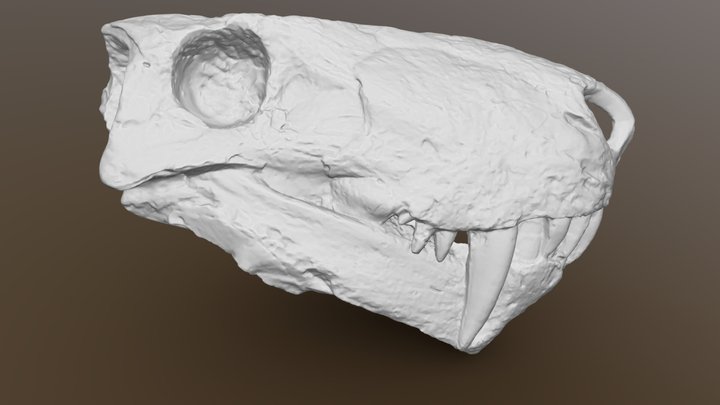
3D model
- Source
- Sketchfab
- Licence
- CC Attribution
- Commercial use
- cannot be read from the licence given — check the record
The description on this site
- Licence
- CC BY-SA 4.0
This is what the site found, which is not the same as what exists.
Keep going
What may have been alongside itInostranceviidae through timeFormations of the PermianThe world it lived on
Occurrence data from the Paleobiology Database, CC BY 4.0. Amalitski 1922