Anancus arvernensis
Anancus is an extinct genus of "tetralophodont gomphothere" native to Afro-Eurasia, that lived from the Tortonian stage of the late Miocene until its extinction during the Early Pleistocene, roughly from 8.5–2 million years ago.

Ghedoghedo · CC BY-SA 3.0 · via Wikipedia/Commons. May be a photograph of a specimen, or an artist’s reconstruction — an interpretation of a skeleton, since colour and soft tissue are almost never preserved.
On record
Recorded, not inferred- Sits inside
- AnancusPBDB
- Diet
- browserPBDB, for Gomphotheriidae
- Life habit
- ground dwellingPBDB, for Gomphotheriidae
- Motility
- actively mobilePBDB, for Osteichthyes
- Environment
- terrestrialPBDB, for Eutheria
Time the record covers
At least 4.5 million years on record.
The record covers at least 5.333 Mya to 774 ka. No occurrence read is dated outside 11.63 Mya to 11.7 ka.
106 occurrences of Anancus arvernensis on record, most of them in the Pliocene. Bar height is expected occurrences, not a count: each fossil is spread across the span it is dated to, so a tall narrow bar means tight dating and a low wide one means loose.
When
106 occurrences- Miocene3%
- Pliocene71%
- Pleistocene26%
These are dates about fossils, not the animal: the record can only begin after it arose and end before it died out, so either end may reach further. Shares are expected occurrences: a fossil dated to a span is counted partly in each period it straddles. More on what this infers.
Found in
11 formations
- Villamagna Formation4
- Sabbie di S. Giusto Formation2
- Venta del Moro-Villatoya Formation1
- Karboliya Formation1
- Karbolia Formation1
- Westkapelle Ground Formation1
Loading coastlines…
The named rock units Anancus arvernensis has been recovered from, largest first. Drawn where the rock is now, not where it formed. 91 occurrences have no formation on record, which is common for older literature.
Anancus arvernensis and its relatives
PlioceneWhere Anancus arvernensis and its relatives were recorded in the Pliocene.
Found in the same rock
520 taxa- Mammut borsoni24 sites
- Gazella23 sites
- Mammuthus meridionalis21 sites
- Hipparion20 sites
- Tapirus arvernensis20 sites
- Croizetoceros ramosus16 sites
- Leptobos16 sites
- Stephanorhinus etruscus16 sites
- Stephanorhinus jeanvireti16 sites
- Allohippus stenonis15 sites
- Eucladoceros13 sites
- Metacervocerus pardinensis13 sites
- Equus12 sites
- Stephanorhinus12 sites
- Canis11 sites
- Cervidae11 sites
- Mimomys11 sites
- Sus11 sites
- Cervus10 sites
- Ursus etruscus10 sites
- Castor fiber9 sites
- Gazellospira9 sites
- Dicerorhinus8 sites
- Homotherium crenatidens8 sites
The Paleobiology Database records 103 sites for Anancus arvernensis, and this reads all of them. The number is how many of those sites it was catalogued from too. The 24 sharing the most are listed.
This is not a list of everything alive at the time. It is only what has come out of the same ground as this animal and been written down.
Entered from
46 references- Catalogue of Tertiary Fossil Sites of the Land Mammals in the U.S.S.R.13
- I paleositi a vertebrati fossili della Provinia di Pisa10
- Large Ruscinian Mammalia in the Territory of the Former Soviet Union7
- Elementi di paleobiogeographia dei mammiferi Terziari dell Italia.7
- Principaux gisements villafranchiens de France: Listes fauniques et biostratigraphie6
- Pleistocene vertebrate faunas of Hungary4
- Pliocene and Pleistocene mammalian biostratigraphy in southeastern Transylvania (Romania)4
- Succession des Mammiferes Plio-Pleistocenes dans le Bassin Dacique (Roumanie)4
- Neues aus dem Villafranchium von Hajnacka bei Filakovo (Slowakei, cssr)3
- New finds of mastodonts from Macedonia (Greece)3
- A propos du Villafranchian du Caucase3
- Revision of the historical collections of Pliocene-Pleistocene large mammals from Le Riège and Saint-Palais localities, near Pézenas (Southern France)2
Each of the 106 occurrences read was entered from one of these publications, ordered by how many each accounts for. This is not a search for papers mentioning the name. 34 further references are not listed. Entries link to doi.org where the Paleobiology Database holds an identifier, and to its own record where it does not. Relayed as the Paleobiology Database holds them, not checked against what they resolve to.
Media and terms
Media content2
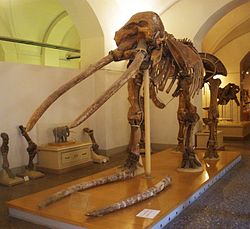
Picture of Anancus arvernensis
- Source
- Wikipedia/Commons
- Credit
- Ghedoghedo
- Licence
- CC BY-SA 3.0
- Commercial use
- the licence allows it
Photogrammetry
- Source
- MorphoSource
- Licence
- In Copyright
- Commercial use
- cannot be read from the licence given — check the record
- Specimen
- Anancus arvernensis · msn_fir:mgp:IGF 327
Smithsonian Open Access was not reached for this taxon, so this list is what the others held rather than everything there is.
The description on this site
- Source
- Wikipedia, “Anancus”
- Licence
- CC BY-SA 4.0
This is what the site found, which is not the same as what exists.
Keep going
What may have been alongside itAnancus through timeFormations of the PlioceneThe world it lived on
Occurrence data from the Paleobiology Database, CC BY 4.0. (Croizet and Jobert 1828)