Alligator sinensis
The Chinese alligator, also known as the Yangtze alligator, China alligator, or historically the muddy dragon, is a crocodilian endemic to China. It and the American alligator are the only living species in the genus Alligator of the family Alligatoridae. Dark gray or black in color with a fully armored body, the Chinese alligator grows to 1.5–2.1 metres (5–7 ft) in length and weighs 36–45 kilograms (80–100 lb) as an adult. It brumates in burrows in winter and is nocturnal in summer. Mating occurs in early summer, with females most commonly producing 20–30 eggs, which are smaller than those of any other crocodilian. The species is an opportunistic feeder, primarily eating fish and invertebrates. A vocal species, adults bellow during the mating season and young vocalize to communicate with their parents and other juveniles. Captive specimens have reached age 70, and wild specimens can live past 50.

Greg Hume · CC BY-SA 3.0 · via Wikipedia/Commons. May be a photograph of a specimen, or an artist’s reconstruction — an interpretation of a skeleton, since colour and soft tissue are almost never preserved.
On record
Recorded, not inferred- Also called
- Chinese alligatorPBDB
- Sits inside
- AlligatorPBDB
- Diet
- carnivorePBDB, for Crocodylia
- Motility
- actively mobilePBDB, for Osteichthyes
- Environment
- marinePBDB, for Mesoeucrocodylia
Time the record covers
At least 2.5 million years on record.
The record covers at least 2.58 Mya to 11.7 ka. No occurrence read is dated outside 3.6 Mya to 0 Mya.
28 occurrences of Alligator sinensis on record. The Paleobiology Database records this as a living group. Bar height is expected occurrences, not a count: each fossil is spread across the span it is dated to, so a tall narrow bar means tight dating and a low wide one means loose.
When
28 occurrences- Pliocene7%
- Pleistocene14%
- Holocene79%
These are dates about fossils, not the animal: the record can only begin after it arose and end before it died out, so either end may reach further. Shares are expected occurrences: a fossil dated to a span is counted partly in each period it straddles. More on what this infers.
Found in
1 formation
Loading coastlines…
The named rock units Alligator sinensis has been recovered from, largest first. Drawn where the rock is now, not where it formed. 26 occurrences have no formation on record, which is common for older literature.
Found in the same rock
90 taxa- Panthera tigris3 sites
- Ailuropoda melanoleuca2 sites
- Arctonyx collaris2 sites
- Capricornis sumatraensis2 sites
- Cervus2 sites
- Cuon2 sites
- Hystrix2 sites
- Macaca2 sites
- Panthera pardus2 sites
- Pongo pygmaeus2 sites
- Rhinoceros sinensis2 sites
- Stegodon insignis2 sites
- Sus scrofa2 sites
- Tapirus (Megatapirus) augustus2 sites
- Ursus thibetanus2 sites
- Amyda1 site
- Anourosorex1 site
- Atherurus macrourus1 site
- Balaenidae1 site
- Balaenopteridae1 site
- Belomys1 site
- Bovinae1 site
- Bubalus1 site
- Bubalus teilhardi1 site
The Paleobiology Database records 27 sites for Alligator sinensis, and this reads all of them. The number is how many of those sites it was catalogued from too. The 24 sharing the most are listed.
This is not a list of everything alive at the time. It is only what has come out of the same ground as this animal and been written down.
Entered from
7 references- Multi-isotope analysis on the Yangtze Alligator osteoderm unearthed from Yellow River Valley during the Longshan Period19
- Strontium isotope analysis of Yangtze alligator remains from Late Neolithic North China3
- The oldest record of Alligator sinensis from the Late Pliocene of Western Japan, and its biogeographic implication2
- The first fossil skull of Alligator sinensis from the Pleistocene, Taiwan, with a paleogeographic implication of the species1
- Geochronology of Ailuropoda–Stegodon fauna and Gigantopithecus in Guangxi Province, southern China1
- Late Cenozoic crocodilian fossils from Jiangsu1
- First discovery of Megalovis guangxiensis and Alligator cf. sinensis in Guangdong1
Each of the 28 occurrences read was entered from one of these publications, ordered by how many each accounts for. This is not a search for papers mentioning the name. Entries link to doi.org where the Paleobiology Database holds an identifier, and to its own record where it does not. Relayed as the Paleobiology Database holds them, not checked against what they resolve to.
Media and terms
Media content2
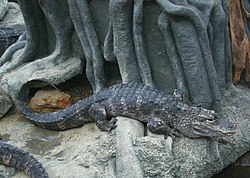
Picture of Alligator sinensis
- Source
- Wikipedia/Commons
- Credit
- Greg Hume
- Licence
- CC BY-SA 3.0
- Commercial use
- the licence allows it
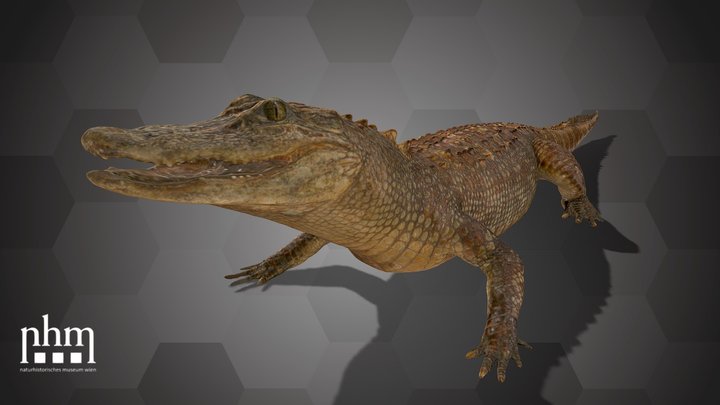
3D model
- Source
- Sketchfab
- Licence
- CC Attribution-NonCommercial
- Commercial use
- the licence does not allow it
Smithsonian Open Access and MorphoSource were not reached for this taxon, so this list is what the others held rather than everything there is.
The description on this site
- Licence
- CC BY-SA 4.0
This is what the site found, which is not the same as what exists.
Keep going
What may have been alongside itAlligator through timeThe world it lived on
Occurrence data from the Paleobiology Database, CC BY 4.0. Fauvel 1879