Adapisoriculidae
Adapisoriculidae is an extinct family of non-placental eutherian mammals which was present during the Paleogene and possibly the Late Cretaceous. They were once thought to be members of the order Erinaceomorpha, closely related to the hedgehog family (Erinaceidae), because of their similar dentition, or to be basal Euarchontans. They were also thought to be marsupials at one point. Most recent studies show them to be non-placental eutherians, however.

Eric De Bast, Bernard Sigé and Thierry Smith · CC BY 2.5 · via Wikipedia/Commons. May be a photograph of a specimen, or an artist’s reconstruction — an interpretation of a skeleton, since colour and soft tissue are almost never preserved.
On record
Recorded, not inferred- Sits inside
- EutheriaPBDB
- Diet
- insectivorePBDB, for Theria
- Life habit
- scansorialPBDB, for Eutheria
- Motility
- actively mobilePBDB, for Osteichthyes
- Environment
- terrestrialPBDB, for Eutheria
Time the record covers
At least 17 million years on record.
The record covers at least 66 Mya to 48.07 Mya. No occurrence read is dated outside 72.2 Mya to 41.03 Mya.
41 occurrences of Adapisoriculidae on record, most of them in the Paleocene. Bar height is expected occurrences, not a count: each fossil is spread across the span it is dated to, so a tall narrow bar means tight dating and a low wide one means loose.
When
41 occurrences- Late Cretaceous20%
- Paleocene66%
- Eocene15%
These are dates about fossils, not the animal: the record can only begin after it arose and end before it died out, so either end may reach further. Shares are expected occurrences: a fossil dated to a span is counted partly in each period it straddles. More on what this infers.
Found in
8 formations
- Hainin Formation5
- Jbel Guersif Formation · Subatlas Group4
- Conglomérat de Cernay Formation4
- Sables de Bracheux Formation2
- Ait Ouarhitane Formation · Subatlas Group2
- Calcaire de Ventenac Formation1
Loading coastlines…
The named rock units Adapisoriculidae has been recovered from, largest first. Drawn where the rock is now, not where it formed. 21 occurrences have no formation on record, which is common for older literature.
Adapisoriculidae and its relatives
PaleoceneWhere Adapisoriculidae and its relatives were recorded in the Paleocene.
Found in the same rock
377 taxa- Serpentes5 sites
- Anura4 sites
- Bustylus germanicus4 sites
- Condylarthra4 sites
- Eutheria4 sites
- Lacertidae4 sites
- Lacertilia4 sites
- Paschatherium dolloi4 sites
- Plesiadapis tricuspidens4 sites
- Adapisorex3 sites
- Adapisoriculus3 sites
- Afrodon3 sites
- Afrodon chleuhi3 sites
- Amphisbaenia3 sites
- Amphisbaenidae3 sites
- Anguidae3 sites
- Aves3 sites
- Berrulestes pellouini3 sites
- Berrulestes phelizoni3 sites
- Bustylus cernaysi3 sites
- Camptognathosaurus walbeckensis3 sites
- Deccanolestes3 sites
- Didelphodontinae3 sites
- Dipavali petri3 sites
The Paleobiology Database records 19 sites for Adapisoriculidae, and this reads all of them. The number is how many of those sites it was catalogued from too. The 24 sharing the most are listed.
This is not a list of everything alive at the time. It is only what has come out of the same ground as this animal and been written down.
Entered from
23 references- Presence of the genus Afrodon [Mammalia, Lipotyphla (?), Adapisoriculidae] in Europe; new data for the problem of trans-Tethyan relations between Africa and Europe around the K/T boundary5
- Nouvelles données sur les mammifères du Thanétien et de l'Yprésien du bassin d'Ouarzazate (Maroc) et leur contexte stratigraphique4
- Les mammifères Paléocènes du Bassin d'Quarzazate (Maroc). III. Adapisoriculidae et autres mammifères (Carnivora, ? Creodonta, Condylarthra, ? Ungulata et incertae sedis)4
- Diversity of the adapisoriculid mammals from the early Palaeocene of Hainin, Belgium3
- New Late Cretaceous mammals from the Intertrappean beds of Rangapur, India and paleobiogeographic framework3
- Bustylus cernaysi nov. gen., nov. sp., nouvel Adapisoriculidé (Mammalia, Eutheria) Paléocène d'Europe3
- A new late Paleocene micromammal fauna from Montchenot (Paris Basin). Preliminary results2
- New mammals from south-central Pyrenees (Tremp Formation, Spain) and their bearing on late Paleocene marine-continental correlations.2
- A new adapisoriculid mammal (Eutheria) from the early-middle Eocene of Namibia1
- The oldest Cenozoic mammal fauna of Europe: implication of the Hainin reference fauna for mammalian evolution and dispersals during the Paleocene1
- Tarsal diversity in the earliest Eocene mammal fauna of Dormaal, Belgium1
- New mammals from the marine Selandian of Maret, Belgium, and their implications for the age of the Paleocene continental deposits of Walbeck, Germany1
Each of the 41 occurrences read was entered from one of these publications, ordered by how many each accounts for. This is not a search for papers mentioning the name. 11 further references are not listed. Entries link to doi.org where the Paleobiology Database holds an identifier, and to its own record where it does not. Relayed as the Paleobiology Database holds them, not checked against what they resolve to.
Media and terms
Media content1
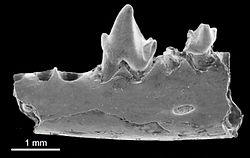
Picture of Adapisoriculidae
- Source
- Wikipedia/Commons
- Credit
- Eric De Bast, Bernard Sigé and Thierry Smith
- Licence
- CC BY 2.5
- Commercial use
- the licence allows it
No 3D scan was found. Smithsonian Open Access, MorphoSource and Sketchfab were all searched.
The description on this site
- Licence
- CC BY-SA 4.0
This is what the site found, which is not the same as what exists.
Keep going
What may have been alongside itEutheria through timeFormations of the PaleoceneThe world it lived on
Occurrence data from the Paleobiology Database, CC BY 4.0. Van Valen 1967