Acrocanthosaurus
Acrocanthosaurus is a genus of carcharodontosaurid dinosaurs that existed in what is now North America during the Barremian and early Cenomanian stages of the Early Cretaceous and Late Cretaceous, from 125 to 99.6 million years ago. Like most dinosaur genera, Acrocanthosaurus contains only a single species, A. atokensis. It had a continent-wide range, with fossil remains known from the U.S. states of Oklahoma, Texas, and Wyoming in the west and Maryland in the east. However, most of these remains are assigned to the species based on the assumption that Acrocanthosaurus is the only large carcharodontosaurid from North America during this time, and the possibility exists that some referred specimens could represent distinct taxa.

Famille Wielosz-Caron · CC BY 2.0 · via Wikipedia/Commons. May be a photograph of a specimen, or an artist’s reconstruction — an interpretation of a skeleton, since colour and soft tissue are almost never preserved.
On record
Recorded, not inferred- Sits inside
- CarcharodontosauridaePBDB
- Diet
- carnivorePBDB, for Theropoda
- Life habit
- ground dwelling, solitaryPBDB, for Theropoda
- Motility
- actively mobilePBDB, for Theropoda
- Environment
- terrestrialPBDB, for Theropoda
- Length
- 11.5 mWikidata
Time the record covers
At least 6.9 million years on record.
The record covers at least 113.2 Mya to 106.3 Mya. No occurrence read is dated outside 121.4 Mya to 93.9 Mya.
14 occurrences of Acrocanthosaurus on record, most of them in the Early Cretaceous. Bar height is expected occurrences, not a count: each fossil is spread across the span it is dated to, so a tall narrow bar means tight dating and a low wide one means loose.
When
14 occurrencesThese are dates about fossils, not the animal: the record can only begin after it arose and end before it died out, so either end may reach further. Shares are expected occurrences: a fossil dated to a span is counted partly in each period it straddles. More on what this infers.
Found in
7 formations
- Antlers Formation · Trinity Group5
- Cloverly Formation3
- Arundel Clay Formation · Potomac Group2
- Twin Mountains Formation · Trinity Group1
- Turney Ranch Formation · Bisbee Group1
- Cedar Mountain Formation · Dakota Group1
Loading coastlines…
The named rock units Acrocanthosaurus has been recovered from, largest first. Drawn where the rock is now, not where it formed.
Acrocanthosaurus and its relatives
Early CretaceousWhere Acrocanthosaurus and its relatives were recorded in the Early Cretaceous.
Found in the same rock
101 taxa- Deinonychus antirrhopus4 sites
- Crocodylia3 sites
- Mesoeucrocodylia3 sites
- Testudines3 sites
- Theropoda3 sites
- Amiidae2 sites
- Anura2 sites
- Bernissartiidae2 sites
- Deinonychus2 sites
- Goniopholididae2 sites
- Lepidotes2 sites
- Lonchidion anitae2 sites
- Macronaria2 sites
- Naomichelys2 sites
- Naomichelys speciosa2 sites
- Osteichthyes2 sites
- Paramacellodidae2 sites
- Pholidosauridae2 sites
- Richardoestesia2 sites
- Sauropelta2 sites
- Sauropelta edwardsorum2 sites
- Sauropoda2 sites
- Sauroposeidon proteles2 sites
- Teleostei2 sites
The Paleobiology Database records 12 sites for Acrocanthosaurus, and this reads all of them. The number is how many of those sites it was catalogued from too. The 24 sharing the most are listed.
This is not a list of everything alive at the time. It is only what has come out of the same ground as this animal and been written down.
Entered from
11 references- Paleobiology and geographic range of the large-bodied Cretaceous theropod dinosaur Acrocanthosaurus atokensis3
- Acrocanthosaurus atokensis, a new genus and species of Lower Cretaceous Theropoda from Oklahoma2
- “Here be dragons”: shed teeth potentially Indicate the presence of multiple unidentified allosauroids from the Early Cretaceous Cedar Mountain Formation of Utah1
- First definitive record of Acrocanthosaurus (Theropoda: Carcharodontosauridae) in the Lower Cretaceous of eastern North America1
- A new vertebrate fauna from the Lower Cretaceous Holly Creek Formation of the Trinity Group, southwest Arkansas, USA1
- Faunal composition and paleoenvironment of the Arundel Clay (Potomac Formation; Early Cretaceous), Maryland, USA1
- The Medial Cretaceous in East-Central Utah—the Cedar Mountain Formation and its Bounding Strata. Society of Vertebrate Paleontology Field Trip Guide1
- The McLeod sites (a supplement to Field Trip 2)1
- A new specimen of <i>Acrocanthosaurus atokensis</i> (Theropoda, Dinosauria) from the Lower Cretaceous Antlers Formation (Lower Cretaceous, Aptian) of Oklahoma, USA1
- First occurrence of Deinonychus antirrhopus (Dinosauria: Theropoda) from the Antlers Formation (Lower Cretaceous: Aptian-Albian) of Oklahoma1
- A reanalysis of Acrocanthosaurus atokensis, its phylogenetic status, and paleobiogeographic implications, based on a new specimen from Texas1
Each of the 14 occurrences read was entered from one of these publications, ordered by how many each accounts for. This is not a search for papers mentioning the name. Entries link to doi.org where the Paleobiology Database holds an identifier, and to its own record where it does not. Relayed as the Paleobiology Database holds them, not checked against what they resolve to.
Media and terms
Media content2

Picture of Acrocanthosaurus
- Source
- Wikipedia/Commons
- Credit
- Famille Wielosz-Caron
- Licence
- CC BY 2.0
- Commercial use
- the licence allows it
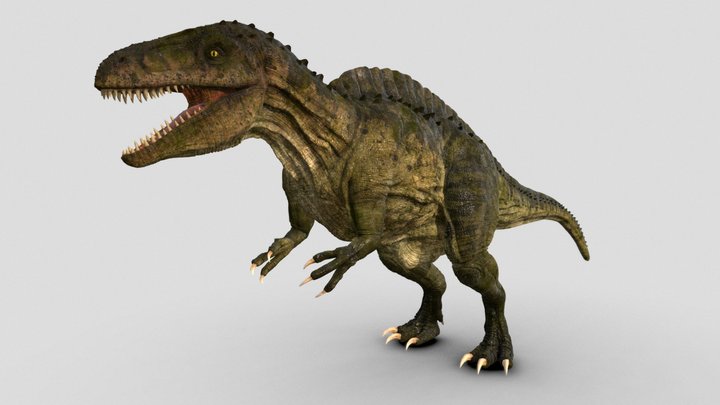
3D model
- Source
- Sketchfab
- Credit
- Julian Johnson-Mortimer
- Licence
- CC Attribution
- Commercial use
- cannot be read from the licence given — check the record
The description on this site
- Licence
- CC BY-SA 4.0
This is what the site found, which is not the same as what exists.
Keep going
What may have been alongside itCarcharodontosauridae through timeFormations of the Early CretaceousThe world it lived on
Occurrence data from the Paleobiology Database, CC BY 4.0. Stovall and Langston 1950