Acanthoceras
Acanthoceras is an extinct cephalopod genus belonging to the subclass Ammonoidea and family Acanthoceratidae that lived from the Albian to early Coniacian stages of the Cretaceous.

Hectonichus · CC BY-SA 3.0 · via Wikipedia/Commons. May be a photograph of a specimen, or an artist’s reconstruction — an interpretation of a skeleton, since colour and soft tissue are almost never preserved.
On record
Recorded, not inferred- Sits inside
- AcanthoceratinaePBDB
- Diet
- carnivorePBDB, for Ammonoidea
- Life habit
- nektonicPBDB, for Ammonoidea
- Motility
- fast-movingPBDB, for Ammonoidea
- Vision
- well-developedPBDB, for Cephalopoda
- Environment
- marinePBDB, for Cephalopoda
Time the record covers
At least 16 million years on record.
The record covers at least 110.1 Mya to 93.9 Mya. No occurrence read is dated outside 113.2 Mya to 89.8 Mya.
149 occurrences of Acanthoceras on record, most of them in the Late Cretaceous. Bar height is expected occurrences, not a count: each fossil is spread across the span it is dated to, so a tall narrow bar means tight dating and a low wide one means loose.
When
149 occurrences- Early Cretaceousunder 1%
- Late Cretaceous99%
These are dates about fossils, not the animal: the record can only begin after it arose and end before it died out, so either end may reach further. Shares are expected occurrences: a fossil dated to a span is counted partly in each period it straddles. More on what this infers.
Found in
39 formations
- Dakota Sandstone Formation9
- Frontier Formation · Colorado Group9
- Beer Head Limestone Formation · Grey Chalk Group8
- Woodbine Formation7
- Eagle Ford Formation6
- Craie de Rouen Formation6
Loading coastlines…
The named rock units Acanthoceras has been recovered from, largest first. Drawn where the rock is now, not where it formed. 15 further formations hold fewer occurrences each and are not listed. 41 occurrences have no formation on record, which is common for older literature.
Acanthoceras and its relatives
Late CretaceousWhere Acanthoceras and its relatives were recorded in the Late Cretaceous.
Found in the same rock
503 taxa- Turrilites costatus38 sites
- Inoceramus29 sites
- Gnesioceramus cripsii15 sites
- Calycoceras14 sites
- Schloenbachia12 sites
- Turrilites scheuchzerianus12 sites
- Turrilites acutus11 sites
- Inoceramus arvanus10 sites
- Sciponoceras10 sites
- Holaster9 sites
- Sciponoceras baculoides9 sites
- Stomohamites9 sites
- Cunningtoniceras cunningtoni8 sites
- Orbirhynchia mantelliana8 sites
- Pycnodonte8 sites
- Scaphites equalis8 sites
- Tarrantoceras sellardsi8 sites
- Anisoceras plicatilis7 sites
- Scaphites obliquus7 sites
- Schloenbachia varians7 sites
- Ostrea beloiti6 sites
- Puzosia6 sites
- Actinocamax primus5 sites
- Amphidonte5 sites
The Paleobiology Database records 124 sites for Acanthoceras, and this reads all of them. The number is how many of those sites it was catalogued from too. The 24 sharing the most are listed.
This is not a list of everything alive at the time. It is only what has come out of the same ground as this animal and been written down.
Entered from
53 references- Die Oberkreide der Sack-Mulde bei Alfeld (Cenoman-Unter-Coniac) Lithologie, Biostratigraphie und Inoceramen24
- Faunes d’ammonites et biostratigraphie compareé du Cénomanien du nord-ouest de la France (Normandie) et du sud de l’Angleterre10
- A correlation of the uppermost Albian and the Cenomanian of South-West England10
- A condensed middle Cenomanian succession in the Dakota Sandstone (Upper Cretaceous), Sevilleta National Wildlife Refuge, Socorro County, New Mexico7
- Larger invertebrate fossils of the Woodbine formation (Cenomanian) of Texas7
- Some Middle Cenomanian (Upper Cretaceous) acanthoceratid ammonites from the Western Interior of the United States6
- Middle Cenomanian (Late Cretaceous) molluscan fauna from the base of the Boquillas Formation, Cerro de Muleros, Dona Ana County, New Mexico5
- Die geologische Entwicklung von Süd-Mozambique seit der Unterkreide und die Ammoniten-Fauna von Unterkreide und Cenoman5
- Description and paleobiogeographic significance of a rare Cenomanian molluscan faunule from Bathurst Island, northern Australia4
- Palaeoceanographic events in the Middle Cenomanian of northwest Europe4
- Cretaceous system in northern Peru4
- Upper Cretaceous ammonites from the Calabar region, south-east Nigeria3
Each of the 149 occurrences read was entered from one of these publications, ordered by how many each accounts for. This is not a search for papers mentioning the name. 41 further references are not listed. Entries link to doi.org where the Paleobiology Database holds an identifier, and to its own record where it does not. Relayed as the Paleobiology Database holds them, not checked against what they resolve to.
Media and terms
Media content2

Picture of Acanthoceras
- Source
- Wikipedia/Commons
- Credit
- Hectonichus
- Licence
- CC BY-SA 3.0
- Commercial use
- the licence allows it
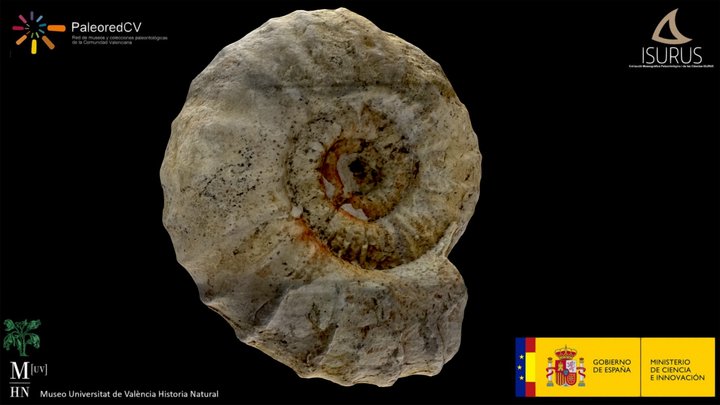
3D model
- Source
- Sketchfab
- Licence
- CC Attribution
- Commercial use
- cannot be read from the licence given — check the record
The description on this site
- Licence
- CC BY-SA 4.0
This is what the site found, which is not the same as what exists.
Keep going
What may have been alongside itAcanthoceratinae through timeFormations of the Late CretaceousThe world it lived on
Occurrence data from the Paleobiology Database, CC BY 4.0. Neumayr 1875