Zonitoides arboreus
Zonitoides arboreus, commonly known as the quick gloss snail, is a species of small air-breathing land snail, a terrestrial pulmonate gastropod mollusk in the family Gastrodontidae.

Scott Bauer, USDA Agricultural Research Service, Bugwood.org · CC BY 3.0 us · via Wikipedia/Commons. May be a photograph of a specimen, or an artist’s reconstruction — an interpretation of a skeleton, since colour and soft tissue are almost never preserved.
On record
Recorded, not inferred- Also called
- quick glossPBDB
- Sits inside
- ZonitoidesPBDB
- Life habit
- epifaunalPBDB, for Gastropoda
- Motility
- actively mobilePBDB, for Gastropoda
- Vision
- limitedPBDB, for Gastropoda
- Environment
- terrestrialPBDB, for Zonitidae
Time the record covers
At least 81 thousand years on record.
The record covers at least 210 ka to 129 ka. No occurrence read is dated outside 1.4 Mya to 11.7 ka.
6 occurrences of Zonitoides arboreus on record, most of them in the Pleistocene. The Paleobiology Database records this as a living group. Bar height is expected occurrences, not a count: each fossil is spread across the span it is dated to, so a tall narrow bar means tight dating and a low wide one means loose.
When
6 occurrences- Pleistocene100%
These are dates about fossils, not the animal: the record can only begin after it arose and end before it died out, so either end may reach further. Shares are expected occurrences: a fossil dated to a span is counted partly in each period it straddles. More on what this infers.
Found in
5 formations
- Sappa Formation1
- Shuler Formation1
- Fort Thompson Formation1
- San Pedro Sand Formation1
- Palos Verdes Sand Formation1
Loading coastlines…
The named rock units Zonitoides arboreus has been recovered from, largest first. Drawn where the rock is now, not where it formed. 1 occurrence has no formation on record, which is common for older literature.
Zonitoides arboreus and its relatives
PleistoceneWhere Zonitoides arboreus and its relatives were recorded in the Pleistocene.
Found in the same rock
701 taxa- Helisoma trivolvis4 sites
- Gastrocopta armifera3 sites
- Gyraulus3 sites
- Hawaiia3 sites
- Physa3 sites
- Sphaerium3 sites
- Acteocina culcitella2 sites
- Ameritella modesta2 sites
- Antisabia panamensis2 sites
- Brachystomia nemo2 sites
- Bufo2 sites
- Caecum crebricinctum2 sites
- Caesia fossatus2 sites
- Caesia perpinguis2 sites
- Callianax baetica2 sites
- Callianax biplicata2 sites
- Calliostoma canaliculatum2 sites
- Calyptraea contorta2 sites
- Cancer productus2 sites
- Canis latrans2 sites
- Carychium2 sites
- Cerithiopsida diegensis2 sites
- Chlamys hastata2 sites
- Coluber constrictor2 sites
The Paleobiology Database records 5 sites for Zonitoides arboreus, and this reads all of them. The number is how many of those sites it was catalogued from too. The 24 sharing the most are listed.
This is not a list of everything alive at the time. It is only what has come out of the same ground as this animal and been written down.
Entered from
5 references- Eshelman and Hager, 19842
- Mollusca: Fort Thompson Formation (Late Pleistocene)1
- The Moore Pit local fauna; Pleistocene of Texas1
- An Upper Pleistocene fauna from the Baldwin Hills, Los Angeles County, California1
- The fossils of the Lower San Pedro fauna of the Nob Hill cut, San Pedro, California1
Each of the 6 occurrences read was entered from one of these publications, ordered by how many each accounts for. This is not a search for papers mentioning the name. Entries link to doi.org where the Paleobiology Database holds an identifier, and to its own record where it does not. Relayed as the Paleobiology Database holds them, not checked against what they resolve to.
Media and terms
Media content1
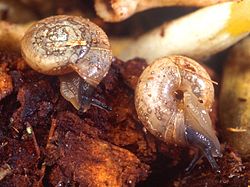
Picture of Zonitoides arboreus
- Source
- Wikipedia/Commons
- Credit
- Scott Bauer, USDA Agricultural Research Service, Bugwood.org
- Licence
- CC BY 3.0 us
- Commercial use
- the licence allows it
No 3D scan of Zonitoides arboreus was found in Sketchfab.
Smithsonian Open Access and MorphoSource were not reached for this taxon, so this list is what the others held rather than everything there is.
The description on this site
- Licence
- CC BY-SA 4.0
This is what the site found, which is not the same as what exists.
Keep going
What may have been alongside itZonitoides through timeFormations of the PleistoceneThe world it lived on
Occurrence data from the Paleobiology Database, CC BY 4.0. (Say 1817)