Zeugmatolepadidae
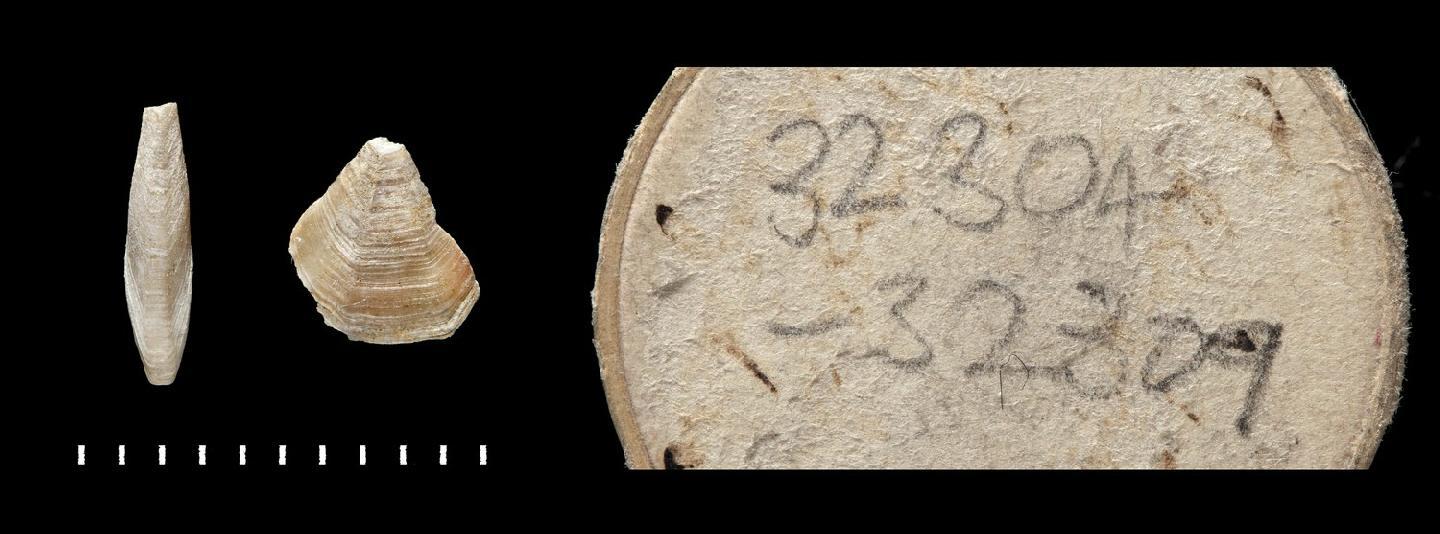
Not Zeugmatolepadidae. This is Aporolepas reflexa (J.de C.Sowerby), a relative — both are Zeugmatolepadidae.
J. d. Sowerby · CC0 · via GBIF. May be a photograph of a specimen, or an artist’s reconstruction — an interpretation of a skeleton, since colour and soft tissue are almost never preserved.
On record
Recorded, not inferred- Sits inside
- PollicipomorphaPBDB
- Diet
- suspension feederPBDB, for Cirripedia
- Life habit
- epifaunalPBDB, for Cirripedia
- Motility
- stationary, attached, epibiontPBDB, for Cirripedia
- Vision
- limitedPBDB, for Cirripedia
Time the record covers
At least 88 million years on record.
The record covers at least 125.77 Mya to 37.71 Mya. No occurrence read is dated outside 132.6 Mya to 33.9 Mya.
50 occurrences of Zeugmatolepadidae on record, most of them in the Early Cretaceous. Bar height is expected occurrences, not a count: each fossil is spread across the span it is dated to, so a tall narrow bar means tight dating and a low wide one means loose.
When
50 occurrencesThese are dates about fossils, not the animal: the record can only begin after it arose and end before it died out, so either end may reach further. Shares are expected occurrences: a fossil dated to a span is counted partly in each period it straddles. More on what this infers.
Found in
18 formations
- Gault Formation7
- Dry Branch Formation4
- Yazoo Clay Formation3
- Weno Formation · Washita Group3
- Crescent Formation2
- Black Creek Formation2
Loading coastlines…
The named rock units Zeugmatolepadidae has been recovered from, largest first. Drawn where the rock is now, not where it formed. 16 occurrences have no formation on record, which is common for older literature.
Zeugmatolepadidae and its relatives
Early CretaceousWhere Zeugmatolepadidae and its relatives were recorded in the Early Cretaceous.
Found in the same rock
285 taxa- Aporolepas howei9 sites
- Zeugmatolepas cretae9 sites
- Ostrea8 sites
- Zeugmatolepas mockleri8 sites
- Arcuatoscalpellum arcuatum7 sites
- Cretiscalpellum striatum7 sites
- Cretiscalpellum unguis7 sites
- Pycnolepas rigida7 sites
- Texaslepas holterhoffi7 sites
- Diotascalpellum fossula6 sites
- Dentalium5 sites
- Jaegerscalpellum comptum5 sites
- Pollicipes nitidum5 sites
- Virgiscalpellum5 sites
- Aporolepas4 sites
- Diotascalpellum angustatum4 sites
- Erginus vaderensis4 sites
- Hesperibalanus huddlestuni4 sites
- Kathpalmeria georgiana4 sites
- Zeugmatolepas4 sites
- Brachylepas naissanti3 sites
- Bryozoa3 sites
- Chlamys3 sites
- Glycymeris3 sites
The Paleobiology Database records 47 sites for Zeugmatolepadidae, and this reads all of them. The number is how many of those sites it was catalogued from too. The 24 sharing the most are listed.
This is not a list of everything alive at the time. It is only what has come out of the same ground as this animal and been written down.
Entered from
17 references- A new record of the Late Cretaceous cirripede Eoverruca hewitti (Verrucomorpha, Proverrucidae) from southern Poland8
- Cirripedes (Thoracica, Crustacea) from the Cretaceous (Albian and Cenomanian) of Texas and Oklahoma, USA7
- Recent advances in the knowledge of Gault Cirripedia7
- Barnacles of the Jacksonian (Upper Eocene) Griffins Landing Member, Dry Branch Formation in South Carolina and Georgia6
- Thoracican cirripedes (Crustacea) from the Hauterivian (Lower Cretaceous) of Hannover, northern Germany5
- Stratigraphic Distribution of Paleocene and Eocene Fossils in the Eastern Gulf Coast Region3
- New Species of Middle Eocene Gastropods from the Northern Doty Hills, Southwestern Washington2
- Macropaleontology of the Eocene Crescent Formation in the Little River Area, Southern Olympic Peninsula, Washington2
- Scalpelloid barnacles from the Upper Cretaceous of southeastern North Carolina2
- Origin and phylogeny of the Cretaceous thoracican cirripede family Stramentidae1
- Taxonomy and palaeoecology of thoracican cirripedes (Crustacea) from a Campanian rocky shoreline at Ivö Klack, southern Sweden1
- A guide to the Frankstown vertebrate fossil locality (Upper Cretaceous), Prentiss County, Mississippi1
Each of the 50 occurrences read was entered from one of these publications, ordered by how many each accounts for. This is not a search for papers mentioning the name. 5 further references are not listed. Entries link to doi.org where the Paleobiology Database holds an identifier, and to its own record where it does not. Relayed as the Paleobiology Database holds them, not checked against what they resolve to.
Media and terms
Media content1
Picture of Aporolepas reflexa (J.de C.Sowerby)
- Source
- GBIF
- Credit
- J. d. Sowerby
- Licence
- CC0
- Commercial use
- the licence allows it
No 3D scan of Zeugmatolepadidae was found in MorphoSource and Sketchfab.
Smithsonian Open Access was not reached for this taxon, so this list is what the others held rather than everything there is.
This is what the site found, which is not the same as what exists.
Keep going
What may have been alongside itPollicipomorpha through timeFormations of the Early CretaceousThe world it lived on
Occurrence data from the Paleobiology Database, CC BY 4.0. Newman 2004