Vulcanisphaera
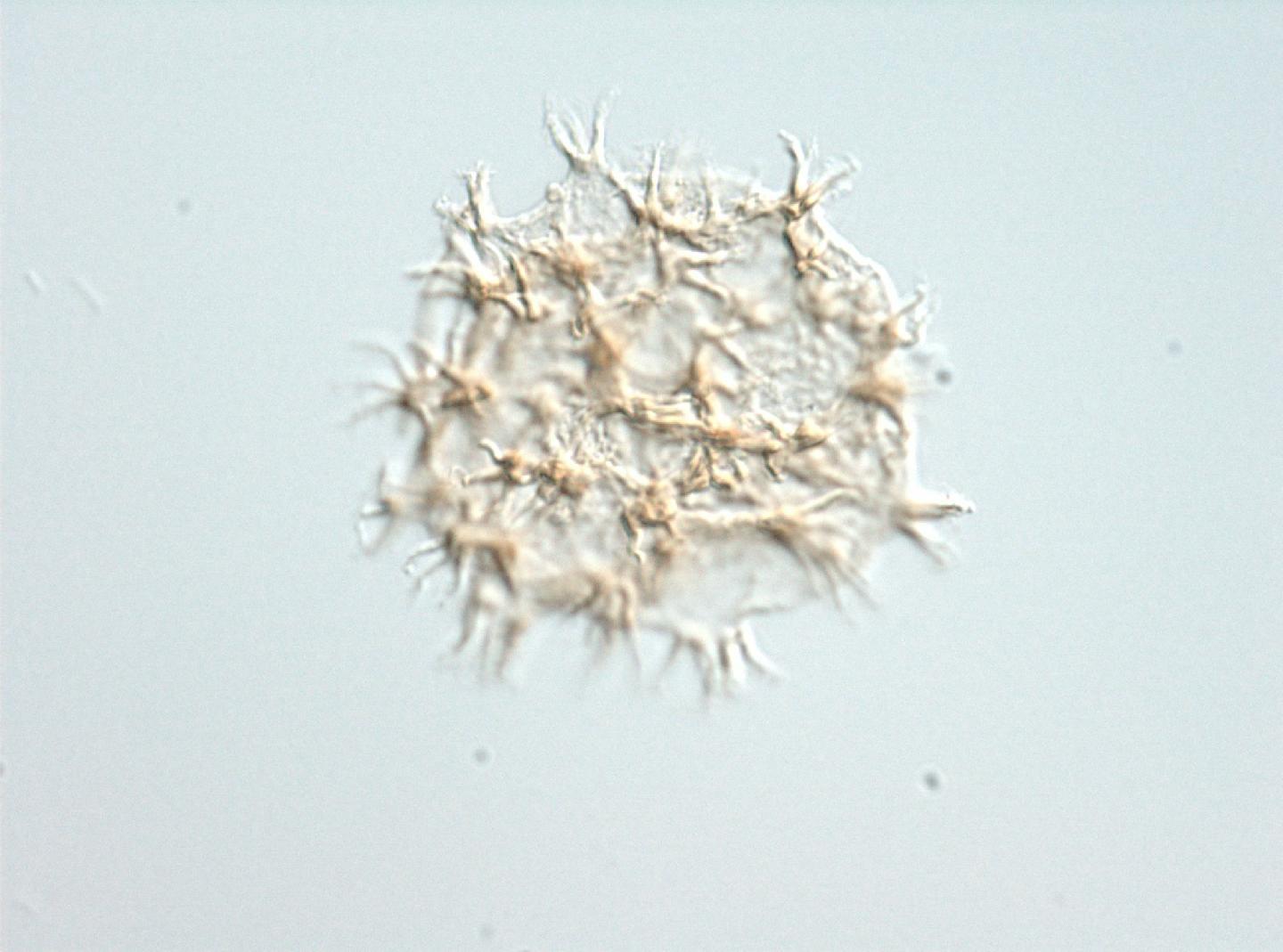
via iDigBio · CC BY · via iDigBio. May be a photograph of a specimen, or an artist’s reconstruction — an interpretation of a skeleton, since colour and soft tissue are almost never preserved.
On record
Recorded, not inferred- Sits inside
- DinophyceaePBDB
- Diet
- "photoautotroph"PBDB, for Dinoflagellata
- Environment
- freshwaterPBDB, for Dinophyceae
Time the record covers
At least 20 million years on record.
The record covers at least 506.5 Mya to 486.4 Mya. No occurrence read is dated outside 538.8 Mya to 477.1 Mya.
2 occurrences of Vulcanisphaera on record, most of them in the Cambrian. Bar height is expected occurrences, not a count: each fossil is spread across the span it is dated to, so a tall narrow bar means tight dating and a low wide one means loose.
When
2 occurrences- Cambrian50%
- Ordovician50%
These are dates about fossils, not the animal: the record can only begin after it arose and end before it died out, so either end may reach further. Shares are expected occurrences: a fossil dated to a span is counted partly in each period it straddles. More on what this infers.
Found in
1 formation
Loading coastlines…
The named rock units Vulcanisphaera has been recovered from, largest first. Drawn where the rock is now, not where it formed. 1 occurrence has no formation on record, which is common for older literature.
Vulcanisphaera and its relatives
CambrianWhere Vulcanisphaera and its relatives were recorded in the Cambrian.
Found in the same rock
36 taxa- Acanthodiacrodium2 sites
- Goniosphaeridium2 sites
- Micrhystridium2 sites
- Arbusculidium sp.1 site
- Archaeodiscina1 site
- Archaeofavosina1 site
- Asaphellus1 site
- Bavarilla1 site
- Comasphaeridium1 site
- Cymatiogalea1 site
- Cymatiosphaera1 site
- Dictyodium sp.1 site
- Dikelokephalina1 site
- Ectenoglossa1 site
- Eupoikilofusa1 site
- Geragnostus1 site
- Granomarginata1 site
- Hystrichosphaeridium1 site
- Leiomarginata1 site
- Leiosphaeridia1 site
- Leiovalia sp.1 site
- Lingulepis1 site
- Lingulobolus1 site
- Lophosphaeridium1 site
The Paleobiology Database records 2 sites for Vulcanisphaera, and this reads all of them. The number is how many of those sites it was catalogued from too. The 24 sharing the most are listed.
This is not a list of everything alive at the time. It is only what has come out of the same ground as this animal and been written down.
Entered from
2 references- The lower and upper boundary of the Ordovician System of some selected regions (Celtiberia, eastern Sierra Morena) in Spain; Part I, The Lower Ordovician sequence of Celtiberia1
- Lower Cambrian fossils and acritarchs in the sedimentary rocks of Soderfjarden, Western Finland1
Each of the 2 occurrences read was entered from one of these publications, ordered by how many each accounts for. This is not a search for papers mentioning the name. Entries link to doi.org where the Paleobiology Database holds an identifier, and to its own record where it does not. Relayed as the Paleobiology Database holds them, not checked against what they resolve to.
Media and terms
Media content1
Picture of Vulcanisphaera
- Source
- iDigBio
- Credit
- via iDigBio
- Licence
- CC BY
- Commercial use
- the licence allows it
No 3D scan of Vulcanisphaera was found in Smithsonian Open Access and Sketchfab.
MorphoSource was not reached for this taxon, so this list is what the others held rather than everything there is.
This is what the site found, which is not the same as what exists.
Keep going
What may have been alongside itDinophyceae through timeFormations of the CambrianThe world it lived on
Occurrence data from the Paleobiology Database, CC BY 4.0. Deunff 1961