Vombatus ursinus
The common wombat, also known as the bare-nosed wombat, is a marsupial, one of three extant species of wombats and the sole extant member of the genus Vombatus. It has three subspecies: Vombatus ursinus hirsutus, found on the Australian mainland; Vombatus ursinus tasmaniensis, found in Tasmania; and Vombatus ursinus ursinus, found on Flinders Island and Maria Island in the Bass Strait.

JJ Harrison ( jjharrison89@facebook.com ) · CC BY-SA 3.0 · via Wikipedia/Commons. May be a photograph of a specimen, or an artist’s reconstruction — an interpretation of a skeleton, since colour and soft tissue are almost never preserved.
On record
Recorded, not inferred- Also called
- common wombatPBDB
- Sits inside
- VombatusPBDB
- Diet
- herbivorePBDB, for Vombatidae
- Life habit
- ground dwellingPBDB, for Vombatus
- Motility
- actively mobilePBDB, for Osteichthyes
- Environment
- terrestrialPBDB, for Mammalia
Time the record covers
At most 2.6 million years on record.
Every occurrence read is dated to somewhere between 2.58 Mya and 0 Mya, and nothing in the dating separates them, so that window is what the record shows rather than a span.
13 occurrences of Vombatus ursinus on record, most of them in the Pleistocene. The Paleobiology Database records this as a living group. Bar height is expected occurrences, not a count: each fossil is spread across the span it is dated to, so a tall narrow bar means tight dating and a low wide one means loose.
When
13 occurrences- Pleistocene91%
- Holocene9%
These are dates about fossils, not the animal: the record can only begin after it arose and end before it died out, so either end may reach further. Shares are expected occurrences: a fossil dated to a span is counted partly in each period it straddles. More on what this infers.
Found in
1 formation
Loading coastlines…
The named rock units Vombatus ursinus has been recovered from, largest first. Drawn where the rock is now, not where it formed. 12 occurrences have no formation on record, which is common for older literature.
Vombatus ursinus and its relatives
PleistoceneWhere Vombatus ursinus and its relatives were recorded in the Pleistocene.
Found in the same rock
167 taxa- Thylacoleo carnifex10 sites
- Macropus (Macropus) giganteus7 sites
- Rattus7 sites
- Thylacinus cynocephalus7 sites
- Bettongia6 sites
- Macropus6 sites
- Protemnodon6 sites
- Simosthenurus occidentalis6 sites
- Trichosurus vulpecula6 sites
- Cercartetus nanus5 sites
- Dasyurus viverrinus5 sites
- Macropus rufogriseus5 sites
- Mastacomys5 sites
- Phascolarctos cinereus5 sites
- Potorous tridactylus5 sites
- Pseudocheirus peregrinus5 sites
- Pseudomys5 sites
- Wallabia bicolor5 sites
- Zygomaturus trilobus5 sites
- Agamidae4 sites
- Isoodon obesulus4 sites
- Metasthenurus newtonae4 sites
- Potorous platyops4 sites
- Procoptodon gilli4 sites
The Paleobiology Database records 13 sites for Vombatus ursinus, and this reads all of them. The number is how many of those sites it was catalogued from too. The 24 sharing the most are listed.
This is not a list of everything alive at the time. It is only what has come out of the same ground as this animal and been written down.
Entered from
11 references- Pleistocene fossil vertebrate sites of the South East region of South Australia3
- Late Holocene hunting economies in coastal southeastern Australia: Insights from the archaeological fauna of Curracurrang 1 Rockshelter, Royal National Park1
- An assessment of ancient DNA preservation in Holocene-Pleistocene fossil bone excavated from the world heritage Naracoorte Caves, South Australia1
- Man and megafauna in Tasmania: closing the gap1
- A diverse Pleistocene marsupial trackway assemblage from the Victorian volcanic plains, Australia1
- Pleistocene fossil vertebrate sites of the South East region of South Australia II1
- Pedal morphology of the marsupial lion Thylacoleo carnifex (Diprotodontia: Thylacoleonidae) from the Pleistocene of Australia1
- The upper fossil fauna of the Henschke fossil cave, Naracoorte, South Australia1
- Warendja wakefieldi, a new genus of wombat (Maruspialia , Vombatidae) from Pleistocene sediments in McEacherns Cave, western Victoria1
- The fossil vertebrate fauna from Pleistocene deposits at Cement Mills, Gore, southern Queensland1
- Late Pleistocene mammals from the "Keilor cranium site," southern Victoria, Australia1
Each of the 13 occurrences read was entered from one of these publications, ordered by how many each accounts for. This is not a search for papers mentioning the name. Entries link to doi.org where the Paleobiology Database holds an identifier, and to its own record where it does not. Relayed as the Paleobiology Database holds them, not checked against what they resolve to.
Media and terms
Media content2

Picture of Vombatus ursinus
- Source
- Wikipedia/Commons
- Credit
- JJ Harrison ( jjharrison89@facebook.com )
- Licence
- CC BY-SA 3.0
- Commercial use
- the licence allows it
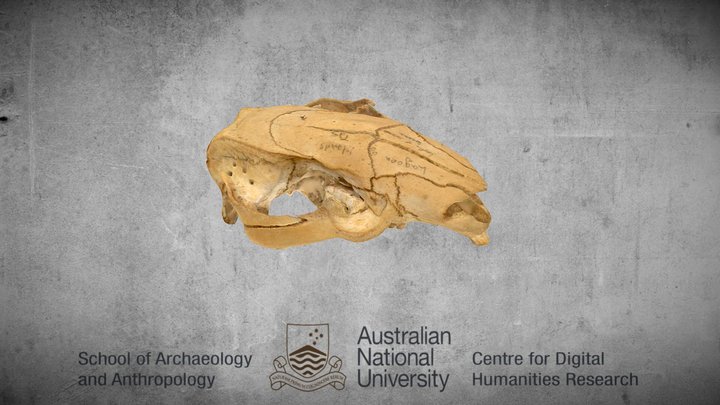
3D model
- Source
- Sketchfab
- Licence
- CC Attribution
- Commercial use
- cannot be read from the licence given — check the record
Smithsonian Open Access and MorphoSource were not reached for this taxon, so this list is what the others held rather than everything there is.
The description on this site
- Licence
- CC BY-SA 4.0
This is what the site found, which is not the same as what exists.
Keep going
What may have been alongside itVombatus through timeFormations of the PleistoceneThe world it lived on
Occurrence data from the Paleobiology Database, CC BY 4.0. (Shaw 1800)