Vokesimurex rubidus
Vokesimurex rubidus, common name : the rose murex, is a species of sea snail, a marine gastropod mollusk in the family Muricidae, the murex snails or rock snails.

Naturalis Biodiversity Center · CC0 · via Wikipedia/Commons. May be a photograph of a specimen, or an artist’s reconstruction — an interpretation of a skeleton, since colour and soft tissue are almost never preserved.
On record
Recorded, not inferred- Sits inside
- VokesimurexPBDB
- Diet
- carnivorePBDB, for Muricidae
- Life habit
- epifaunalPBDB, for Muricidae
- Motility
- actively mobilePBDB, for Muricidae
- Vision
- limitedPBDB, for Gastropoda
Time the record covers
At least 645 thousand years on record.
The record covers at least 774 ka to 129 ka. No occurrence read is dated outside 3.6 Mya to 11.7 ka.
12 occurrences of Vokesimurex rubidus on record, most of them in the Pleistocene. The Paleobiology Database records this as a living group. Bar height is expected occurrences, not a count: each fossil is spread across the span it is dated to, so a tall narrow bar means tight dating and a low wide one means loose.
When
12 occurrences- Pliocene3%
- Pleistocene97%
These are dates about fossils, not the animal: the record can only begin after it arose and end before it died out, so either end may reach further. Shares are expected occurrences: a fossil dated to a span is counted partly in each period it straddles. More on what this infers.
Found in
1 formation
Loading coastlines…
The named rock units Vokesimurex rubidus has been recovered from, largest first. Drawn where the rock is now, not where it formed. 3 occurrences have no formation on record, which is common for older literature.
Vokesimurex rubidus and its relatives
PleistoceneWhere Vokesimurex rubidus and its relatives were recorded in the Pleistocene.
Found in the same rock
25 taxa- Calotrophon ostrearum11 sites
- Chicoreus (Chicoreus) floridanus10 sites
- Typhis (Rugotyphis) floridanus9 sites
- Anadara (Caloosarca) crassicosta8 sites
- Murexiella macgintyi8 sites
- Subpterynotus textilis6 sites
- Dermomurex (Dermomurex) engonatus5 sites
- Miltha caloosaensis5 sites
- Murexiella (Murexiella) shilohensis5 sites
- Aspella senex4 sites
- Arcopagia fausta2 sites
- Murexiella (Murexiella) glypta2 sites
- Anadara (Caloosarca) aequalitas1 site
- Attiliosa striata1 site
- Chicoreus (Chicoreus) dilectus1 site
- Ctenoides (Ctenoides) floridana1 site
- Dermomurex (Trialatella) antecessor1 site
- Limaria (Limaria) chipolana1 site
- Miltha carmenae1 site
- Murexiella (Murexiella) macgintyi faceta1 site
- Murexiella (Murexiella) macgintyi faceta n. sp.1 site
- Trajana pyta1 site
- Turbinella1 site
- Turbinella scolymoides1 site
The Paleobiology Database records 12 sites for Vokesimurex rubidus, and this reads all of them. The number is how many of those sites it was catalogued from too. The 24 sharing the most are listed.
This is not a list of everything alive at the time. It is only what has come out of the same ground as this animal and been written down.
Entered from
1 referenceEach of the 12 occurrences read was entered from one of these publications, ordered by how many each accounts for. This is not a search for papers mentioning the name. Each entry links to the Paleobiology Database's own record for the work.
Media and terms
Media content2

Picture of Vokesimurex rubidus
- Source
- Wikipedia/Commons
- Credit
- Naturalis Biodiversity Center
- Licence
- CC0
- Commercial use
- the licence allows it
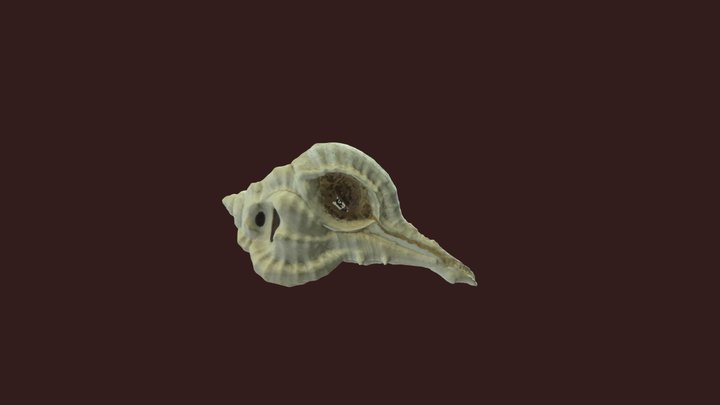
3D model
- Source
- Sketchfab
- Credit
- Shellie Luallin
- Licence
- CC Attribution
- Commercial use
- cannot be read from the licence given — check the record
Smithsonian Open Access and MorphoSource were not reached for this taxon, so this list is what the others held rather than everything there is.
The description on this site
- Licence
- CC BY-SA 4.0
This is what the site found, which is not the same as what exists.
Keep going
What may have been alongside itVokesimurex through timeFormations of the PleistoceneThe world it lived on
Occurrence data from the Paleobiology Database, CC BY 4.0. (Baker 1897)