Varanus komodoensis
The Komodo dragon, also known as the Komodo monitor, is a large reptile of the monitor lizard family Varanidae that is endemic to the Indonesian islands of Komodo, Rinca, Flores, Gili Dasami, and Gili Motang. The largest extant population lives within the Komodo National Park in Eastern Indonesia. It is the largest extant species of lizard, with the males growing to a maximum length of 3 m (10 ft) and weighing up to 150 kg (330 lb).

James Jolokia ( james1203 ) · CC BY 4.0 · via Wikipedia/Commons. May be a photograph of a specimen, or an artist’s reconstruction — an interpretation of a skeleton, since colour and soft tissue are almost never preserved.
On record
Recorded, not inferred- Also called
- Komodo dragonPBDB
- Sits inside
- VaranusPBDB
- Diet
- carnivorePBDB, for Varanidae
- Life habit
- scansorialPBDB, for Varanidae
- Motility
- actively mobilePBDB, for Osteichthyes
- Environment
- terrestrialPBDB, for Varanidae
- Length
- 1.5 mWikidata
- Mass
- 70 kgWikidata
Time the record covers
At most 2.6 million years on record.
Every occurrence read is dated to somewhere between 2.58 Mya and 11.7 ka, and nothing in the dating separates them, so that window is what the record shows rather than a span.
4 occurrences of Varanus komodoensis on record, most of them in the Pleistocene. The Paleobiology Database records this as a living group. Bar height is expected occurrences, not a count: each fossil is spread across the span it is dated to, so a tall narrow bar means tight dating and a low wide one means loose.
When
4 occurrences- Pleistocene100%
These are dates about fossils, not the animal: the record can only begin after it arose and end before it died out, so either end may reach further. Shares are expected occurrences: a fossil dated to a span is counted partly in each period it straddles. More on what this infers.
Found in
1 formation
Loading coastlines…
The named rock units Varanus komodoensis has been recovered from, largest first. Drawn where the rock is now, not where it formed. 3 occurrences have no formation on record, which is common for older literature.
Varanus komodoensis and its relatives
PleistoceneWhere Varanus komodoensis and its relatives were recorded in the Pleistocene.
Found in the same rock
26 taxa- Amyda cartilaginea1 site
- Batagur affinis1 site
- Bos (Bibos)1 site
- Bubalus palaeokerabau1 site
- Cervus lydekkeri1 site
- Chitra chitra1 site
- Crocodylus siamensis1 site
- Duboisia santeng1 site
- Gavialis bengawanicus1 site
- Geochelone1 site
- Homo erectus1 site
- Hystrix1 site
- Macaca fascicularis1 site
- Mececyon trinilensis1 site
- Megalochelys sivalensis1 site
- Muntiacus muntjak1 site
- Muridae1 site
- Panthera tigris1 site
- Prionailurus bengalensis1 site
- Rhinoceros sondaicus1 site
- Stegodon sondaari1 site
- Stegodon sumbaensis1 site
- Stegodon trigonocephalus1 site
- Sus brachygnathus1 site
The Paleobiology Database records 4 sites for Varanus komodoensis, and this reads all of them. The number is how many of those sites it was catalogued from too. The 24 sharing the most are listed.
This is not a list of everything alive at the time. It is only what has come out of the same ground as this animal and been written down.
Entered from
3 references- Varanus (Reptilia, Sauria) from the Pleistocene of Timor2
- Quaternary vertebrate faunas from Sumba, Indonesia: implications for Wallacean biogeography and evolution1
- The Late Neogene elephantoid-bearing faunas of Indonesia and their palaeozoogeographic implications. A study of the terrestrial faunal succession of Sulawesi, Flores and Java, including evidence for early hominid dispersal east of Wallace's Line1
Each of the 4 occurrences read was entered from one of these publications, ordered by how many each accounts for. This is not a search for papers mentioning the name. Entries link to doi.org where the Paleobiology Database holds an identifier, and to its own record where it does not. Relayed as the Paleobiology Database holds them, not checked against what they resolve to.
Media and terms
Media content2

Picture of Varanus komodoensis
- Source
- Wikipedia/Commons
- Credit
- James Jolokia ( james1203 )
- Licence
- CC BY 4.0
- Commercial use
- the licence allows it
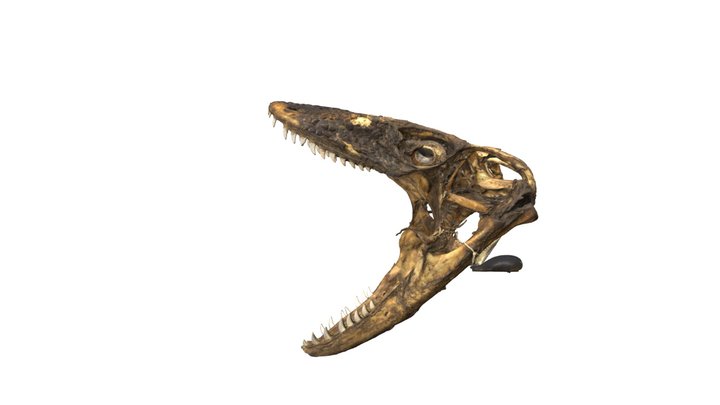
3D model
- Source
- Sketchfab
- Credit
- Blackburn Lab
- Licence
- CC Attribution
- Commercial use
- cannot be read from the licence given — check the record
Smithsonian Open Access and MorphoSource were not reached for this taxon, so this list is what the others held rather than everything there is.
The description on this site
- Licence
- CC BY-SA 4.0
This is what the site found, which is not the same as what exists.
Keep going
What may have been alongside itVaranus through timeFormations of the PleistoceneThe world it lived on
Occurrence data from the Paleobiology Database, CC BY 4.0. Ouwens 1912