Uintatherium
Uintatherium is an extinct genus of dinoceratan mammal that lived during the Eocene epoch. Two species are currently recognized: U. anceps is found in the United States and lived during the early to middle Eocene, while U. insperatus is found in China and lived during the middle and late Eocene. The first fossils of Uintatherium were recovered from the Fort Bridger Basin and were initially believed to belong to a new species of brontothere. Several previously recognized species, as well as genera such as Edward Drinker Cope's Loxolophodon and Othniel Charles Marsh's Tinoceras, are now assigned to Uintatherium anceps.

Shadowgate from Novara, ITALY · CC BY 2.0 · via Wikipedia/Commons. May be a photograph of a specimen, or an artist’s reconstruction — an interpretation of a skeleton, since colour and soft tissue are almost never preserved.
On record
Recorded, not inferred- Sits inside
- UintatheriinaePBDB
- Diet
- herbivorePBDB, for Dinocerata
- Life habit
- ground dwellingPBDB, for Dinocerata
- Motility
- actively mobilePBDB, for Osteichthyes
- Environment
- terrestrialPBDB, for Mammalia
- Length
- 4 mWikidata
- Mass
- 4500 kgWikidata
Time the record covers
At least 2.1 million years on record.
The record covers at least 48.07 Mya to 45.9 Mya. No occurrence read is dated outside 56 Mya to 37.71 Mya.
35 occurrences of Uintatherium on record, most of them in the Eocene. Bar height is expected occurrences, not a count: each fossil is spread across the span it is dated to, so a tall narrow bar means tight dating and a low wide one means loose.
When
35 occurrences- Eocene100%
These are dates about fossils, not the animal: the record can only begin after it arose and end before it died out, so either end may reach further. Shares are expected occurrences: a fossil dated to a span is counted partly in each period it straddles. More on what this infers.
Found in
12 formations
- Bridger Formation21
- Uinta Formation3
- Aycross Formation1
- Fowkes Formation1
- Santiago Formation1
- Devil's Graveyard Formation1
Loading coastlines…
The named rock units Uintatherium has been recovered from, largest first. Drawn where the rock is now, not where it formed. 1 occurrence has no formation on record, which is common for older literature.
Uintatherium and its relatives
EoceneWhere Uintatherium and its relatives were recorded in the Eocene.
Found in the same rock
228 taxa- Hyrachyus eximius7 sites
- Notharctus robustior6 sites
- Hyrachyus modestus5 sites
- Helohyus plicodon4 sites
- Homacodon vagans4 sites
- Hyopsodus paulus4 sites
- Patriofelis ferox4 sites
- Telmatherium validus4 sites
- Triplopus obliquidens4 sites
- Amynodon advenus3 sites
- Apatemys bellus3 sites
- Baena arenosa3 sites
- Epihippus gracilis3 sites
- Harpagolestes uintensis3 sites
- Hemiacodon gracilis3 sites
- Hyrachyus3 sites
- Orohippus3 sites
- Palaeosyops robustus3 sites
- Saniwa ensidens3 sites
- Stylinodon mirus3 sites
- Achaenodon2 sites
- Amynodon2 sites
- Anosteira ornata2 sites
- Antiacodon pygmaeus2 sites
The Paleobiology Database records 31 sites for Uintatherium, and this reads all of them. The number is how many of those sites it was catalogued from too. The 24 sharing the most are listed.
This is not a list of everything alive at the time. It is only what has come out of the same ground as this animal and been written down.
Entered from
16 references- Revision of the Uintatheres18
- Magnetic stratigraphy and biostratigraphy of the middle Eocene Uinta Formation, Uinta Basin, Utah2
- The geology and paleontology of the Elk Mountain and Tabernacle Butte area, Wyoming2
- Mammals from the earliest Uintan (middle Eocene) Turtle Bluff Member, Bridger Formation, southwestern Wyoming, USA, Part 2: Apatotheria, Lipotyphla, Carnivoramorpha, Condylartha, Dinocerata, Perissodactyla and Artiodactyla1
- New materials of Eocene Dinocerata (Mammalia) from the Erlian Basin, Nei Mongol (Inner Mongolia)1
- Synonymies and reidentifications of North American fossil mammals1
- Biostratigraphy and magnetostratigraphy of the Bridgerian-Uintan Washakie Formation, Washakie Basin, Wyoming1
- Middle Eocene mammal faunas of San Diego County, California1
- Some Eocene Mammals From the Uqbulak Area of the Junggar Basin, Xinjiang1
- The middle Eocene Arshanto fauna (Mammalia) of Inner Mongolia1
- Fossil Mammals from the Lower Buck Hill Group, Eocene of Trans-Pecos Texas: Marsupicarnivora, Primates, Taeniodonta, Condylarthra, Bunodont Artiodactyla, and Dinocerata1
- A Skull of Uintatherium from Henan1
Each of the 35 occurrences read was entered from one of these publications, ordered by how many each accounts for. This is not a search for papers mentioning the name. 4 further references are not listed. Entries link to doi.org where the Paleobiology Database holds an identifier, and to its own record where it does not. Relayed as the Paleobiology Database holds them, not checked against what they resolve to.
Media and terms
Media content2
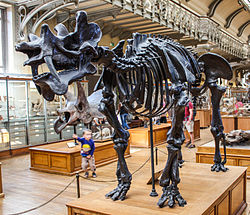
Picture of Uintatherium
- Source
- Wikipedia/Commons
- Credit
- Shadowgate from Novara, ITALY
- Licence
- CC BY 2.0
- Commercial use
- the licence allows it
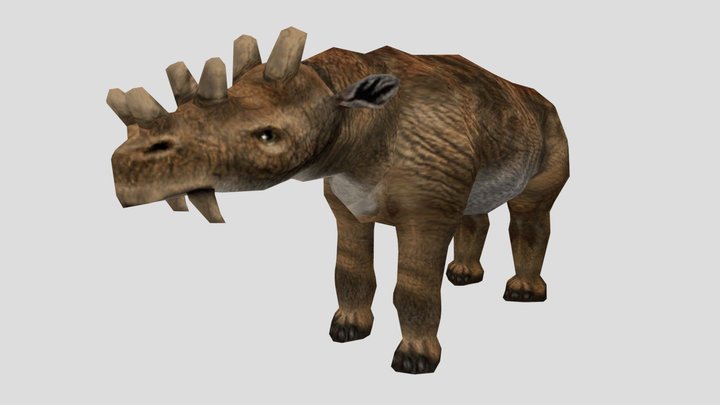
3D model
- Source
- Sketchfab
- Credit
- Ziggertron
- Licence
- CC Attribution
- Commercial use
- cannot be read from the licence given — check the record
Smithsonian Open Access and MorphoSource were not reached for this taxon, so this list is what the others held rather than everything there is.
The description on this site
- Licence
- CC BY-SA 4.0
This is what the site found, which is not the same as what exists.
Keep going
What may have been alongside itUintatheriinae through timeFormations of the EoceneThe world it lived on
Occurrence data from the Paleobiology Database, CC BY 4.0. Leidy 1872