Tunicata
Tunicates are marine invertebrates belonging to the subphylum Tunicata. This grouping is part of the Chordata, a phylum which includes all animals with dorsal nerve cords and notochords. The subphylum was at one time called Urochordata, and the term urochordates is still sometimes used for these animals.

Nhobgood Nick Hobgood · CC BY-SA 3.0 · via Wikipedia/Commons. May be a photograph of a specimen, or an artist’s reconstruction — an interpretation of a skeleton, since colour and soft tissue are almost never preserved.
On record
Recorded, not inferred- Also called
- tunicatePBDB
- Sits inside
- ChordataPBDB
- Diet
- suspension feederPBDB
- Life habit
- low-level epifaunalPBDB
- Motility
- stationary, attachedPBDB
Time the record covers
At least 515 million years on record.
The record covers at least 516 Mya to 129 ka. No occurrence read is dated outside 521 Mya to 0 Mya.
184 occurrences of Tunicata on record, most of them in the Miocene. The Paleobiology Database records this as a living group. Bar height is expected occurrences, not a count: each fossil is spread across the span it is dated to, so a tall narrow bar means tight dating and a low wide one means loose.
When
184 occurrences- Cambrian5%
- Silurianunder 1%
- Permian13%
- Late Triassic3%
- Miocene41%
- Pliocene10%
- Pleistocene28%
- Holoceneunder 1%
These are dates about fossils, not the animal: the record can only begin after it arose and end before it died out, so either end may reach further. Shares are expected occurrences: a fossil dated to a span is counted partly in each period it straddles. More on what this infers.
Found in
14 formations
- Balang Formation6
- Cassian Formation5
- Capitan Formation4
- Sisophon Formation3
- Patrick Burn Formation · Priesthill Group1
- Changxing Formation1
Loading coastlines…
The named rock units Tunicata has been recovered from, largest first. Drawn where the rock is now, not where it formed. 156 occurrences have no formation on record, which is common for older literature.
Tunicata and its relatives
MioceneWhere Tunicata and its relatives were recorded in the Miocene.
Found in the same rock
831 taxa- Reticulofenestra110 sites
- Helicosphaera carteri94 sites
- Umbilicosphaera93 sites
- Sphenolithus abies79 sites
- Pontosphaera76 sites
- Calcidiscus leptoporus64 sites
- Syracosphaera61 sites
- Coccolithus pelagicus50 sites
- Umbilicosphaera jafari49 sites
- Pseudoemiliania48 sites
- Gephyrocapsa46 sites
- Discoaster brouweri39 sites
- Florisphaera37 sites
- Discoaster34 sites
- Rhabdosphaera29 sites
- Cyclicargolithus floridanus28 sites
- Discoaster variabilis28 sites
- Calcidiscus macintyrei26 sites
- Hayaster24 sites
- Oolithotus23 sites
- Coronocyclus22 sites
- Discoaster deflandrei19 sites
- Scyphosphaera18 sites
- Sphenolithus heteromorphus15 sites
The Paleobiology Database records 168 sites for Tunicata, and this reads all of them. The number is how many of those sites it was catalogued from too. The 24 sharing the most are listed.
This is not a list of everything alive at the time. It is only what has come out of the same ground as this animal and been written down.
Entered from
26 references- Site U146656
- Site U146746
- Site U146815
- Site U146510
- Site U14718
- A Cambrian soft-bodied biota after the first Phanerozoic mass extinction6
- The first tunicate with a calcareous exoskeleton (Upper Triassic, Northern Italy)6
- Site U14726
- Site U14744
- Strengths and weaknesses of the reef guild concept and quantitative data: Application to the Upper Capitan-massive community (Permian), Guadalupe Mountains, New Mexico-Texas4
- The Development and Change of Marine Organisms at the Palaeozoic-Mesozoic Boundary3
- Sul Permiano di Sicilia (fossili del calcare con Fusulina di Palazzo Adriano non descritti dal Prof. G. Gemmellaro conservati nel mio privato gabinetto)3
Each of the 184 occurrences read was entered from one of these publications, ordered by how many each accounts for. This is not a search for papers mentioning the name. 14 further references are not listed. Entries link to doi.org where the Paleobiology Database holds an identifier, and to its own record where it does not. Relayed as the Paleobiology Database holds them, not checked against what they resolve to.
Media and terms
Media content1
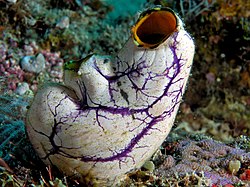
Picture of Tunicata
- Source
- Wikipedia/Commons
- Credit
- Nhobgood Nick Hobgood
- Licence
- CC BY-SA 3.0
- Commercial use
- the licence allows it
No 3D scan of Tunicata was found in MorphoSource and Sketchfab.
Smithsonian Open Access was not reached for this taxon, so this list is what the others held rather than everything there is.
The description on this site
- Source
- Wikipedia, “Tunicate”
- Licence
- CC BY-SA 4.0
This is what the site found, which is not the same as what exists.
Keep going
What may have been alongside itChordata through timeFormations of the MioceneThe world it lived on
Occurrence data from the Paleobiology Database, CC BY 4.0. Lamarck 1816