Reticulofenestra
Reticulofenestra is a genus of calcareous nannoplankton belonging to the haptophyte group. It first emerged during the early Eocene and underwent rapid expansion following the Early Eocene Climatic Optimum—a period characterized by elevated CO2, global warmth and ocean stratification.
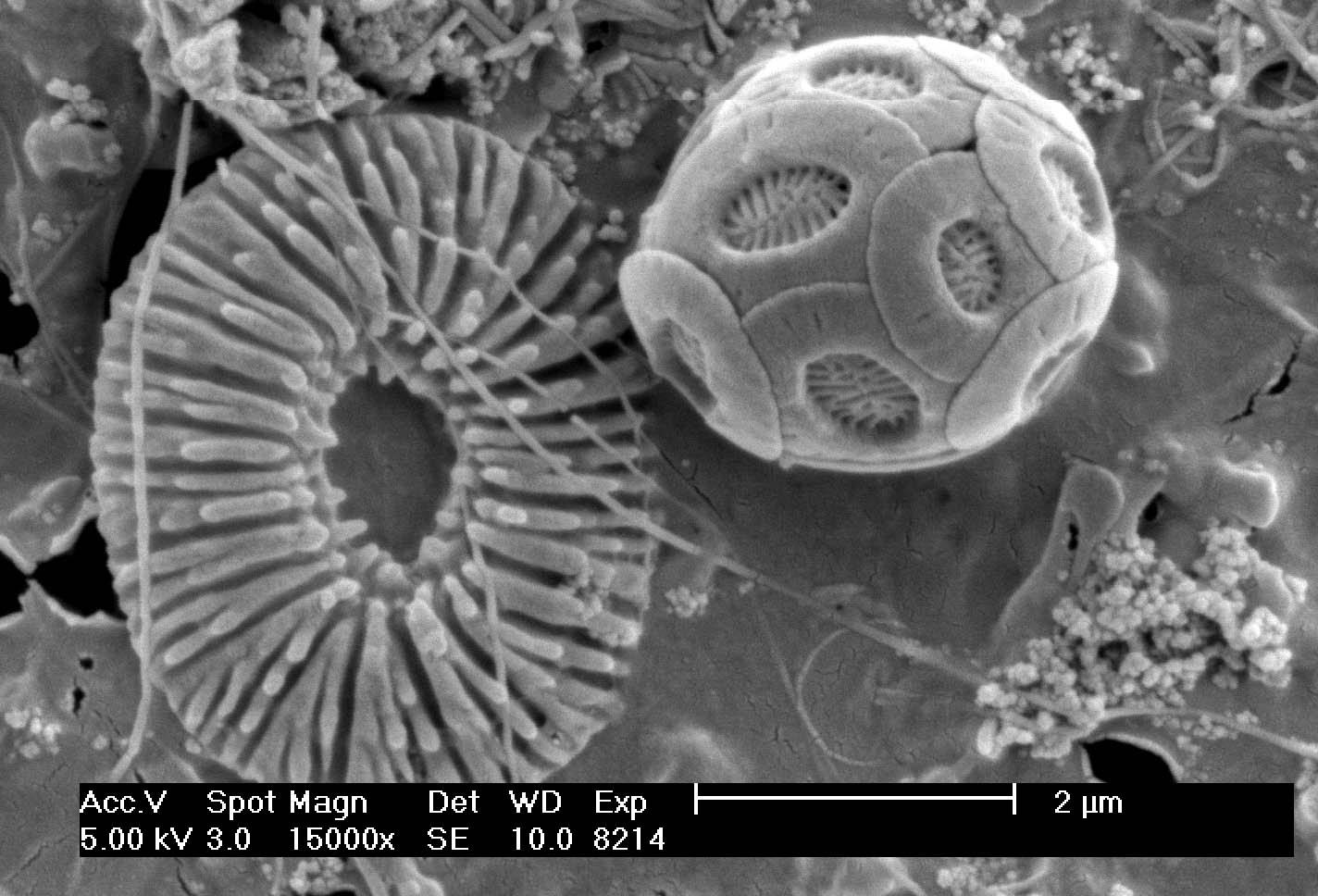
via iDigBio · CC BY · via iDigBio. May be a photograph of a specimen, or an artist’s reconstruction — an interpretation of a skeleton, since colour and soft tissue are almost never preserved.
On record
Recorded, not inferred- Sits inside
- HaptophytaPBDB
- Diet
- "photoautotroph"PBDB, for Haptophyta
- Life habit
- planktonic, depth=surfacePBDB, for Haptophyta
- Motility
- passively mobilePBDB, for Haptophyta
- Environment
- oceanic,oligotrophic,marine,brackishPBDB, for Haptophyta
Time the record covers
At least 93 million years on record.
The record covers at least 93.9 Mya to 11.7 ka. No occurrence read is dated outside 100.5 Mya to 0 Mya.
12,000+ occurrences of Reticulofenestra on record. The Paleobiology Database records this as a living group. Bar height is expected occurrences, not a count: each fossil is spread across the span it is dated to, so a tall narrow bar means tight dating and a low wide one means loose.
When
12,000 occurrences read- Late Cretaceousunder 1%
- Paleoceneunder 1%
- Eocene6%
- Oligocene6%
- Miocene41%
- Pliocene21%
- Pleistocene25%
- Holoceneunder 1%
These are dates about fossils, not the animal: the record can only begin after it arose and end before it died out, so either end may reach further. Shares are expected occurrences: a fossil dated to a span is counted partly in each period it straddles. The read hit its cap, so every figure above is a floor and the shares are of the occurrences read. More on what this infers.
Found in
at least 18 formations
- Campo Bola Formation16
- Butano Formation15
- Kuma Formation5
- Wadi Esh-Shallala Formation2
- Borbon Formation2
- Quilon Limestone Formation · Warkalli Group2
Loading coastlines…
The named rock units Reticulofenestra has been recovered from, largest first. Drawn where the rock is now, not where it formed. The read hit its cap, so each count is a floor. 11,943 occurrences have no formation on record, which is common for older literature.
Found in the same rock
780 taxa- Coccolithus pelagicus201 sites
- Discoaster deflandrei135 sites
- Sphenolithus moriformis134 sites
- Discoaster115 sites
- Calcidiscus leptoporus104 sites
- Sphenolithus97 sites
- Coronocyclus88 sites
- Calcidiscus82 sites
- Umbilicosphaera81 sites
- Cyclicargolithus floridanus78 sites
- Triquetrorhabdulus78 sites
- Coccolithus74 sites
- Helicosphaera carteri61 sites
- Umbilicosphaera jafari47 sites
- Clausicoccus43 sites
- Pontosphaera43 sites
- Discoaster variabilis38 sites
- Helicopontosphaera granulata38 sites
- Sphenolithus abies38 sites
- Discoaster brouweri37 sites
- Pseudoemiliania36 sites
- Calcidiscus macintyrei35 sites
- Gephyrocapsa34 sites
- Sphenolithus heteromorphus30 sites
The Paleobiology Database records at least 810 sites for Reticulofenestra, and this reads 240 of them. The number is how many of those sites it was catalogued from too. The 24 sharing the most are listed.
This is not a list of everything alive at the time. It is only what has come out of the same ground as this animal and been written down.
Entered from
at least 143 references- Site U1456642
- Site U1457522
- Site U1471506
- Site U1474449
- Site U1467447
- Site U1518423
- Site U1466350
- Site U1476326
- Site U1505313
- Site U1462293
- Site U1468293
- Site U1335284
Each of the 12,000 occurrences read was entered from one of these publications, ordered by how many each accounts for. This is not a search for papers mentioning the name. That read hit its cap, so each count is a floor. 131 further references are not listed. Entries link to doi.org where the Paleobiology Database holds an identifier, and to its own record where it does not. Relayed as the Paleobiology Database holds them, not checked against what they resolve to.
Media and terms
Media content1
Picture of Reticulofenestra
- Source
- iDigBio
- Credit
- via iDigBio
- Licence
- CC BY
- Commercial use
- the licence allows it
No 3D scan was found. Smithsonian Open Access, MorphoSource and Sketchfab were all searched.
The description on this site
- Licence
- CC BY-SA 4.0
This is what the site found, which is not the same as what exists.
Keep going
What may have been alongside itHaptophyta through timeThe world it lived on
Occurrence data from the Paleobiology Database, CC BY 4.0. Hay et al. 1966