Trigonidiidae
The Trigonidiidae are a family of crickets consisting of two subfamilies:Subfamily Nemobiinae Saussure, 1877 – wood crickets or ground crickets Subfamily Trigonidiinae Saussure, 1874 – sword-tail crickets

Katja Schulz from Washington, D. C., USA · CC BY 2.0 · via Wikipedia/Commons. May be a photograph of a specimen, or an artist’s reconstruction — an interpretation of a skeleton, since colour and soft tissue are almost never preserved.
On record
Recorded, not inferred- Sits inside
- GrylloideaPBDB
- Diet
- herbivorePBDB, for Ensifera
- Life habit
- ground dwelling, gregariousPBDB, for Ensifera
- Motility
- fast-movingPBDB, for Ensifera
- Vision
- well-developedPBDB, for Ensifera
- Environment
- terrestrialPBDB, for Ensifera
Time the record covers
At least 93 million years on record.
The record covers at least 93.9 Mya to 11.7 ka. No occurrence read is dated outside 100.5 Mya to 0 Mya.
28 occurrences of Trigonidiidae on record, most of them in the Late Cretaceous. The Paleobiology Database records this as a living group. Bar height is expected occurrences, not a count: each fossil is spread across the span it is dated to, so a tall narrow bar means tight dating and a low wide one means loose.
When
28 occurrences- Late Cretaceous32%
- Eocene32%
- Miocene25%
- Holocene11%
These are dates about fossils, not the animal: the record can only begin after it arose and end before it died out, so either end may reach further. Shares are expected occurrences: a fossil dated to a span is counted partly in each period it straddles. More on what this infers.
Found in
3 formations
- Green River Formation6
- Bouldnor Formation · Solent Group1
- La Toca Formation1
Loading coastlines…
The named rock units Trigonidiidae has been recovered from, largest first. Drawn where the rock is now, not where it formed. 20 occurrences have no formation on record, which is common for older literature.
Trigonidiidae and its relatives
Late CretaceousWhere Trigonidiidae and its relatives were recorded in the Late Cretaceous.
Found in the same rock
1,256 taxa- Gryllinae6 sites
- Eoerianthus eocaenicus5 sites
- Pteromogoplistes smithii5 sites
- Eotetrix unicornis4 sites
- Pronemobius tertiarius4 sites
- Ectobius kohlsi3 sites
- Eogryllus unicolor3 sites
- Proanaxipha latoca3 sites
- Pronemobius3 sites
- Pteromogoplistes3 sites
- Abanaxipha longispina2 sites
- Anaxipha dominica2 sites
- Birmaninemobius hirsutus2 sites
- Brachypogon (Isohelea)2 sites
- Cariblattoides labandeirai2 sites
- Cicadellidae2 sites
- Dolichoderus kohlsi2 sites
- Eneopterinae2 sites
- Eoformica pinguis2 sites
- Eogryllus elongatus2 sites
- Eomortoniellus handlirschi2 sites
- Eozacla arachnomorpha2 sites
- Forcipomyia2 sites
- Gryllidae2 sites
The Paleobiology Database records 18 sites for Trigonidiidae, and this reads all of them. The number is how many of those sites it was catalogued from too. The 24 sharing the most are listed.
This is not a list of everything alive at the time. It is only what has come out of the same ground as this animal and been written down.
Entered from
12 references- Eocene Orthoptera from Green River Formation of Wyoming (USA)6
- New genera and species of Trigonidiidae (Orthoptera: Grylloidea) from the mid-Cretaceous of Myanmar with a redescription of Birmaninemobius hirsutus4
- New and little known orthopteroid insects (Polyneoptera) from fossil resins: communication 34
- Crickets (Grylloptera: Grylloidea) in Dominican amber4
- Orthoptères fossiles et subfossiles de l'ambre et du copal3
- A new cricket (Orthoptera: Trigonidiidae) from mid-Cretaceous Kachin amber in northern Myanmar1
- New Cretaceous crickets of the subfamilies Nemobiinae and Podoscirtinae (Orthoptera, Grylloidea: Trigonidiidae, Oecanthidae) attest the antiquity of these clades1
- A new genus and a new species of Trigonidiidae (Orthoptera: Grylloidea) from north Myanmar amber1
- A new genus with a new species of cricket from mid-Cretaceous Burmese Kachin amber (Orthoptera: Trigonidiidae)1
- The first ground cricket (Orthoptera: Trigonidiidae: Nemobiinae) from mid-Cretaceous Burmese amber1
- Zeuner, 19391
- Descriptions of new genera and species of fossil Saltatoria (Orthoptera)1
Each of the 28 occurrences read was entered from one of these publications, ordered by how many each accounts for. This is not a search for papers mentioning the name. Entries link to doi.org where the Paleobiology Database holds an identifier, and to its own record where it does not. Relayed as the Paleobiology Database holds them, not checked against what they resolve to.
Media and terms
Media content1
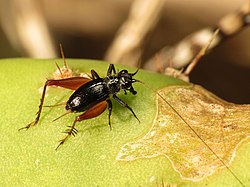
Picture of Trigonidiidae
- Source
- Wikipedia/Commons
- Credit
- Katja Schulz from Washington, D. C., USA
- Licence
- CC BY 2.0
- Commercial use
- the licence allows it
No 3D scan was found. Smithsonian Open Access, MorphoSource and Sketchfab were all searched.
The description on this site
- Licence
- CC BY-SA 4.0
This is what the site found, which is not the same as what exists.
Keep going
What may have been alongside itGrylloidea through timeFormations of the Late CretaceousThe world it lived on
Occurrence data from the Paleobiology Database, CC BY 4.0. (Saussure 1874)