Sulevorthis lyckholmiensis
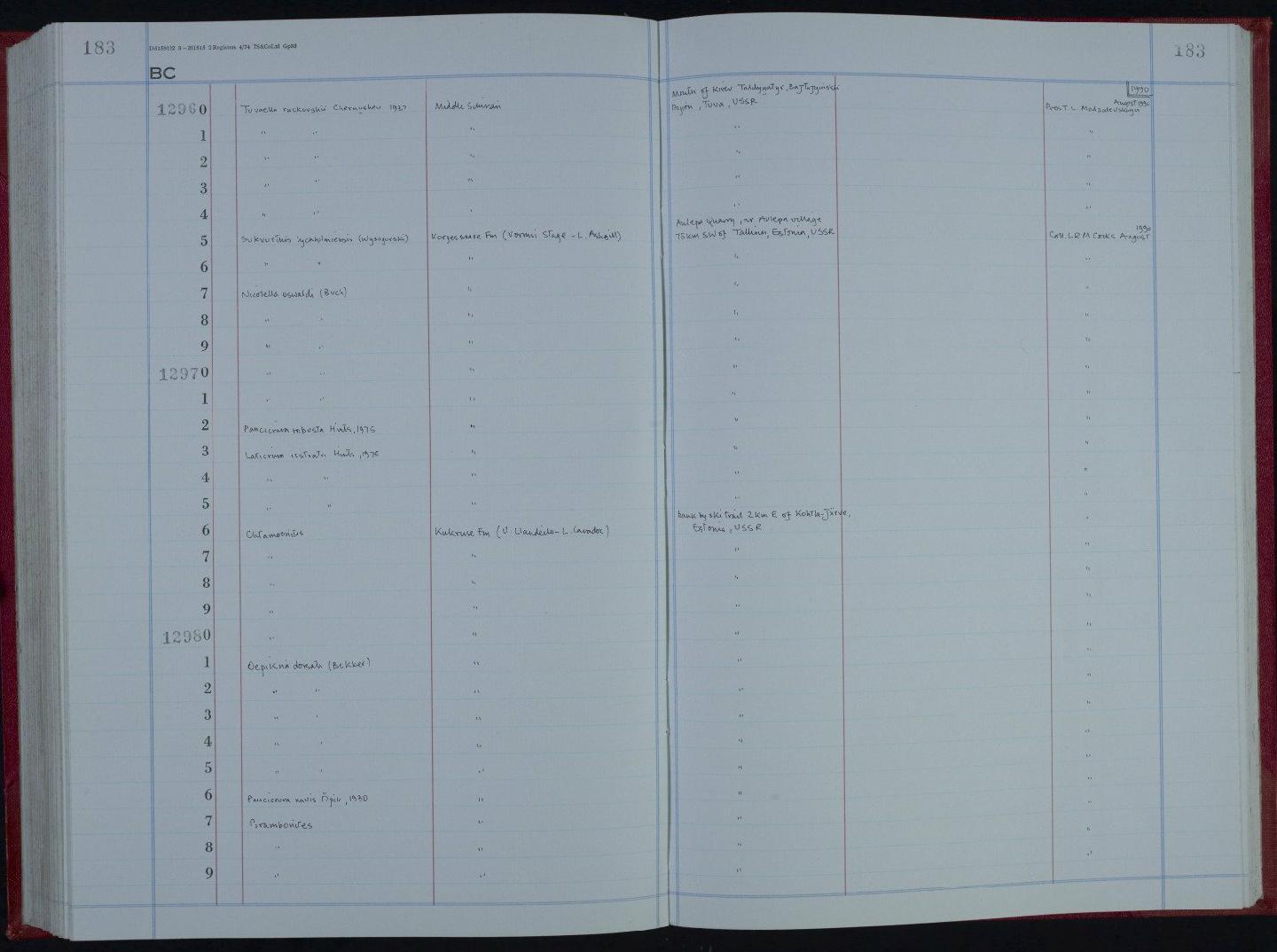
Dr L. Robin M. Cocks · CC0 · via GBIF. May be a photograph of a specimen, or an artist’s reconstruction — an interpretation of a skeleton, since colour and soft tissue are almost never preserved.
On record
Recorded, not inferred- Sits inside
- SulevorthisPBDB
- Diet
- suspension feederPBDB, for Orthida
- Life habit
- epifaunalPBDB, for Orthida
- Motility
- stationary, attachedPBDB, for Orthida
- Vision
- blindPBDB, for Rhynchonellata
- Environment
- marinePBDB, for Lophophorata
Time the record covers
At least 400 thousand years on record.
The record covers at least 449.9 Mya to 449.5 Mya. No occurrence read is dated outside 450.5 Mya to 445.2 Mya.
19 occurrences of Sulevorthis lyckholmiensis on record, most of them in the Ordovician. Bar height is expected occurrences, not a count: each fossil is spread across the span it is dated to, so a tall narrow bar means tight dating and a low wide one means loose.
When
19 occurrences- Ordovician100%
These are dates about fossils, not the animal: the record can only begin after it arose and end before it died out, so either end may reach further. Shares are expected occurrences: a fossil dated to a span is counted partly in each period it straddles. More on what this infers.
Found in
9 formations
- Kõrgessaare Formation6
- Tudulinna Formation3
- Moe Formation2
- Paekna Formation2
- Körgessaare Formation2
- Hulderstad Formation1
Loading coastlines…
The named rock units Sulevorthis lyckholmiensis has been recovered from, largest first. Drawn where the rock is now, not where it formed.
Sulevorthis lyckholmiensis and its relatives
OrdovicianWhere Sulevorthis lyckholmiensis and its relatives were recorded in the Ordovician.
Found in the same rock
123 taxa- Nicolella oswaldi7 sites
- Boreadorthis sadewitzensis5 sites
- Dinorthis (Plaesiomys) saxbyana5 sites
- Streptelasma (Kenophyllum) siluricum5 sites
- Dictyonema4 sites
- Dinorthis (Plaesiomys) solaris4 sites
- Glyptorthis plana4 sites
- Oxoplecia4 sites
- Paucicrura robusta4 sites
- Skenidioides4 sites
- Hulterstadia cor3 sites
- Kiaeromena (Bekkeromena) vormsina3 sites
- Laticrura rostrata3 sites
- Nicolella3 sites
- Ogmoplecia plicata3 sites
- Platystrophia3 sites
- Platystrophia saxbyensis3 sites
- Rectigrewingkia anthelion3 sites
- Vellamo verneuili3 sites
- Atraktoprion2 sites
- Barbarorthis foraminifera2 sites
- Bekkeromena semipartita2 sites
- Belonechitina2 sites
- Boreadorthis crassa2 sites
The Paleobiology Database records 19 sites for Sulevorthis lyckholmiensis, and this reads all of them. The number is how many of those sites it was catalogued from too. The 24 sharing the most are listed.
This is not a list of everything alive at the time. It is only what has come out of the same ground as this animal and been written down.
Entered from
5 references- Einige Vertreter der Superfamilie Orthacea des Oberordoviziums Estlands9
- Locality 9:1 Silurian Sequences at Särghaua Field Station4
- Hulterstad brachiopods and associated faunas in the Vormsi Stage (Upper Ordovician, Katian) of the Lelle core, Central Estonia2
- Review of the Ordovician rhynchonelliformean Brachiopoda of the East Baltic: Their distribution and biofacies2
- Orthambonites and related Ordovician brachiopod genera2
Each of the 19 occurrences read was entered from one of these publications, ordered by how many each accounts for. This is not a search for papers mentioning the name. Entries link to doi.org where the Paleobiology Database holds an identifier, and to its own record where it does not. Relayed as the Paleobiology Database holds them, not checked against what they resolve to.
Media and terms
Media content1
Picture of Sulevorthis lyckholmiensis
- Source
- GBIF
- Credit
- Dr L. Robin M. Cocks
- Licence
- CC0
- Commercial use
- the licence allows it
No 3D scan of Sulevorthis lyckholmiensis was found in MorphoSource and Sketchfab.
Smithsonian Open Access was not reached for this taxon, so this list is what the others held rather than everything there is.
This is what the site found, which is not the same as what exists.
Keep going
What may have been alongside itSulevorthis through timeFormations of the OrdovicianThe world it lived on
Occurrence data from the Paleobiology Database, CC BY 4.0. (Wysogorski 1900)