Stephanocyathus

Cairns S, Kitahara M (2012) · CC BY 3.0 · via Wikidata/Commons. May be a photograph of a specimen, or an artist’s reconstruction — an interpretation of a skeleton, since colour and soft tissue are almost never preserved.
On record
Recorded, not inferred- Sits inside
- CaryophylliinaePBDB
- Diet
- microcarnivorePBDB, for Caryophylliidae
- Life habit
- low-level epifaunal, solitary, clonalPBDB, for Caryophylliidae
- Motility
- stationary, attachedPBDB, for Caryophylliidae
- Vision
- blindPBDB, for Anthozoa
- Environment
- marinePBDB, for Scleractinia
Time the record covers
At least 65 million years on record.
The record covers at least 66 Mya to 774 ka. No occurrence read is dated outside 72.2 Mya to 129 ka.
41 occurrences of Stephanocyathus on record, most of them in the Miocene. The Paleobiology Database records this as a living group, and the chart stops with its fossils rather than at the present. Bar height is expected occurrences, not a count: each fossil is spread across the span it is dated to, so a tall narrow bar means tight dating and a low wide one means loose.
When
41 occurrences- Late Cretaceous2%
- Paleocene5%
- Eocene20%
- Oligocene17%
- Miocene37%
- Pliocene9%
- Pleistocene11%
These are dates about fossils, not the animal: the record can only begin after it arose and end before it died out, so either end may reach further. Shares are expected occurrences: a fossil dated to a span is counted partly in each period it straddles. More on what this infers.
Found in
13 formations
- Bateque Formation3
- Sicilian Formation3
- Qom Formation1
- Agatdal Formation1
- Tapui Glauconitic Sandstone Formation · Tokarahi Group1
- Wharekuri Greensand Formation1
Loading coastlines…
The named rock units Stephanocyathus has been recovered from, largest first. Drawn where the rock is now, not where it formed. 24 occurrences have no formation on record, which is common for older literature.
Stephanocyathus and its relatives
MioceneWhere Stephanocyathus and its relatives were recorded in the Miocene.
Found in the same rock
505 taxa- Caryophyllia3 sites
- Desmophyllum3 sites
- Pseudophragmina clarki3 sites
- Antillia batequensis2 sites
- Calliostoma2 sites
- Caryophyllia konincki2 sites
- Ceratocyathus pressulus2 sites
- Ceratotrochus multispinosus2 sites
- Clionidae2 sites
- Conotrochus2 sites
- Crassatella2 sites
- Cyathoceras tortoniensis2 sites
- Dasycladaceae2 sites
- Deltocyathus italicus2 sites
- Eocernina hannibali2 sites
- Flabellum2 sites
- Flabellum anderssoni2 sites
- Flabellum zuffardii2 sites
- Fusinus2 sites
- Galaxea2 sites
- Gyrodes2 sites
- Hipponix2 sites
- Madracis ornata2 sites
- Madrepora2 sites
The Paleobiology Database records 17 sites for Stephanocyathus, and this reads all of them. The number is how many of those sites it was catalogued from too. The 24 sharing the most are listed.
This is not a list of everything alive at the time. It is only what has come out of the same ground as this animal and been written down.
Entered from
17 references- The Cretaceous and Tertiary corals of New Zealand12
- Recherches sur les Madreporaires et les formations recifales Miocenes de la Mediterranee occidentale [Miocene corals and reefs from the western Mediterranean]4
- Paleontology of the Eocene Bateque Formation, Baja California Sur, Mexico3
- Nuove osservazioni sulla corallofauna delle argille pleistoceniche di Archi (Reggio Calabria) [New observations of Pleistocene coral fauna from Archi (Calabria)]3
- Scleractinian corals from the Upper Cretaceous and Lower Tertiary of Nugssuaq, West Greenland3
- Die Anthozoenfauna des Jungtertiärs von Borneo [Anthozoa from the Upper Tertiary of Borneo]3
- The psychrospheric coral fauna from the Lower Pliocene of northern Italy2
- Eozänkorallen aus Österreich [Eocene corals from Austria]2
- Scleractinian corals from the Oligocene of the Qom Formation (Esfahan-Sirjan fore-arc basin, Iran)1
- Unusual fossil corals from Hengchun Peninsula, southern Taiwan1
- Notes on Indo-Pacific Scleractinian Corals. Part 10. Late Pleistocene ahermatypic corals from Vanuatu1
- Lower Miocene corals from the Waitakere Ranges, North Auckland, New Zealand1
Each of the 41 occurrences read was entered from one of these publications, ordered by how many each accounts for. This is not a search for papers mentioning the name. 5 further references are not listed. Entries link to doi.org where the Paleobiology Database holds an identifier, and to its own record where it does not. Relayed as the Paleobiology Database holds them, not checked against what they resolve to.
Media and terms
Media content2
Picture of Stephanocyathus
- Source
- Wikidata/Commons
- Credit
- Cairns S, Kitahara M (2012)
- Licence
- CC BY 3.0
- Commercial use
- the licence allows it
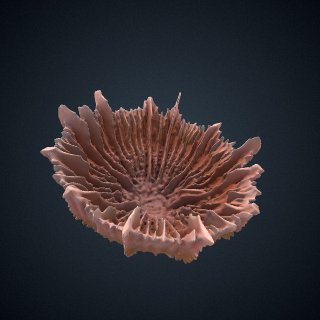
3D scan
- Source
- Smithsonian
- Licence
- CC0 — this site’s default, not the record’s
- Commercial use
- the licence allows it
- Specimen
- Stephanocyathus (Stephanocyathus) diadema
This is what the site found, which is not the same as what exists.
Keep going
What may have been alongside itCaryophylliinae through timeFormations of the MioceneThe world it lived on
Occurrence data from the Paleobiology Database, CC BY 4.0. Seguenza 1864