Madrepora
Madrepora is a genus of stony corals, often found forming reefs or islands in tropical locations. The names Madrepore and Madreporaria were formerly applied universally to any stony coral of the family Scleractinia. They reproduce in three separate ways, as discovered by the marine zoologist Anne Thynne (1800–1866). It is commonly known as horn coral. A colony is branched with small polyps in cylindrical cups separated by a perforated coenosteum. Terminal polyps bear six tentacles, while lateral polyps bear twelve tentacles. Madrepora is economically important, since it contributes to the formation of coral reefs.

NURC/UNCW and NOAA/FGBNMS · Public Domain · via Wikipedia/Commons. May be a photograph of a specimen, or an artist’s reconstruction — an interpretation of a skeleton, since colour and soft tissue are almost never preserved.
On record
Recorded, not inferred- Sits inside
- OculinidaePBDB
- Diet
- suspension feederPBDB
- Life habit
- colonial, clonalPBDB, for Faviina
- Motility
- stationary, attachedPBDB, for Oculinidae
- Vision
- blindPBDB, for Anthozoa
- Environment
- marinePBDB, for Scleractinia
Time the record covers
At least 65 million years on record.
The record covers at least 66 Mya to 129 ka. No occurrence read is dated outside 72.2 Mya to 11.7 ka.
71 occurrences of Madrepora on record, most of them in the Eocene. The Paleobiology Database records this as a living group. Bar height is expected occurrences, not a count: each fossil is spread across the span it is dated to, so a tall narrow bar means tight dating and a low wide one means loose.
When
71 occurrences- Late Cretaceous4%
- Paleocene8%
- Eocene27%
- Oligocene15%
- Miocene20%
- Pliocene4%
- Pleistocene21%
These are dates about fossils, not the animal: the record can only begin after it arose and end before it died out, so either end may reach further. Shares are expected occurrences: a fossil dated to a span is counted partly in each period it straddles. More on what this infers.
Found in
17 formations
- Red Bluff Tuff Formation · Kekerione Group3
- Termofourà Formation3
- Jagüel Formation · Malargüe Group3
- Gelingseh Formation3
- Faluns de Bois-Gouët Formation3
- Byram Marl Formation3
Loading coastlines…
The named rock units Madrepora has been recovered from, largest first. Drawn where the rock is now, not where it formed. 41 occurrences have no formation on record, which is common for older literature.
Madrepora and its relatives
EoceneWhere Madrepora and its relatives were recorded in the Eocene.
Found in the same rock
816 taxa- Desmophyllum4 sites
- Flabellum4 sites
- Spondylus4 sites
- Caryophyllia3 sites
- Cerithium3 sites
- Dendrophyllia3 sites
- Dictyaraea anomala3 sites
- Dictyaraea micrantha3 sites
- Flabellum avicula3 sites
- Flabellum zuffardii3 sites
- Isis3 sites
- Lophelia pertusa3 sites
- Probolarina3 sites
- Trochocyathus3 sites
- Alveopora daedalea2 sites
- Alveopora polyacantha2 sites
- Amphihelia alternans2 sites
- Astarte similis2 sites
- Balanophyllia2 sites
- Balanophyllia (Eupsammia) cylindrica2 sites
- Calliomphalus2 sites
- Calliostoma2 sites
- Caryophyllia (Acanthocyathus)2 sites
- Caryophyllia (Acanthocyathus) laterocristatus2 sites
The Paleobiology Database records 26 sites for Madrepora, and this reads all of them. The number is how many of those sites it was catalogued from too. The 24 sharing the most are listed.
This is not a list of everything alive at the time. It is only what has come out of the same ground as this animal and been written down.
Entered from
33 references- Polypiers Eocenes de la Loire-inferieure7
- The Cretaceous and Tertiary corals of New Zealand6
- Pleistocene to recent scleractinian deep-water corals and coral facies in the eastern Mediterranean5
- Recherches sur les Madreporaires et les formations recifales Miocenes de la Mediterranee occidentale [Miocene corals and reefs from the western Mediterranean]5
- Cretaceous-Cenozoic geology and biostratigraphy of the Chatham Islands, New Zealand4
- Magyarorszagi Oligocen korallok [Oligocene corals from Hungary]4
- Die Anthozoenfauna des Jungtertiärs von Borneo [Anthozoa from the Upper Tertiary of Borneo]4
- First Mesozoic record of the scleractinian Madrepora from the Maastrichtian siliceous limestones of Poland3
- Molluscs at the K/Pg boundary in Argentina: Extinction and recovery patterns. unpublished Ph.D. thesis3
- Observations on the Eocene formations, and descriptions of one hundred and five new fossils from that period, from the vicinity of Vicksburg, Mississippi; with an appendix3
- Upper Pleistocene cold‑water corals from the Inner Sea of the Maldives: taphonomy and environment2
- Notes on Indo-Pacific Scleractinian Corals. Part 10. Late Pleistocene ahermatypic corals from Vanuatu2
Each of the 71 occurrences read was entered from one of these publications, ordered by how many each accounts for. This is not a search for papers mentioning the name. 21 further references are not listed. Entries link to doi.org where the Paleobiology Database holds an identifier, and to its own record where it does not. Relayed as the Paleobiology Database holds them, not checked against what they resolve to.
Media and terms
Media content2
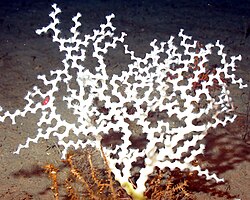
Picture of Madrepora
- Source
- Wikipedia/Commons
- Credit
- NURC/UNCW and NOAA/FGBNMS
- Licence
- Public Domain
- Commercial use
- the licence allows it
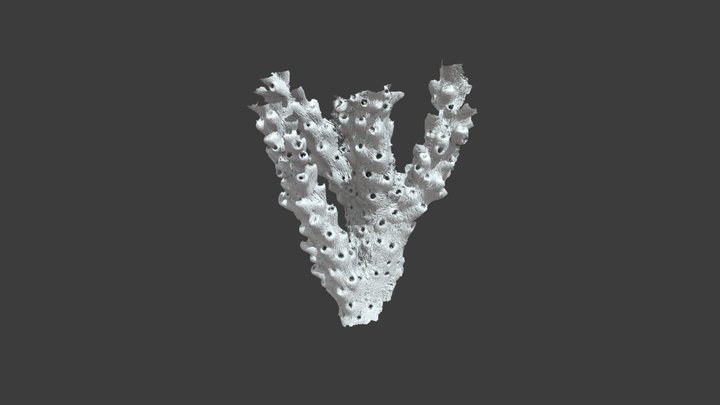
3D model
- Source
- Sketchfab
- Licence
- CC0 Public Domain
- Commercial use
- the licence allows it
Smithsonian Open Access was not reached for this taxon, so this list is what the others held rather than everything there is.
The description on this site
- Source
- Wikipedia, “Madrepora”
- Licence
- CC BY-SA 4.0
This is what the site found, which is not the same as what exists.
Keep going
What may have been alongside itOculinidae through timeFormations of the EoceneThe world it lived on
Occurrence data from the Paleobiology Database, CC BY 4.0. Linne 1758