Stegomastodon mirificus

via iDigBio · CC BY-NC-SA · via iDigBio. May be a photograph of a specimen, or an artist’s reconstruction — an interpretation of a skeleton, since colour and soft tissue are almost never preserved.
On record
Recorded, not inferred- Sits inside
- StegomastodonPBDB
- Diet
- grazerPBDB, for Stegomastodon
- Life habit
- ground dwellingPBDB, for Stegomastodon
- Motility
- actively mobilePBDB, for Osteichthyes
- Environment
- terrestrialPBDB, for Eutheria
Time the record covers
At least 1.1 million years on record.
The record covers at least 2.58 Mya to 1.4 Mya. No occurrence read is dated outside 4.7 Mya to 11.7 ka.
18 occurrences of Stegomastodon mirificus on record. Bar height is expected occurrences, not a count: each fossil is spread across the span it is dated to, so a tall narrow bar means tight dating and a low wide one means loose.
When
18 occurrences- Pliocene58%
- Pleistocene42%
These are dates about fossils, not the animal: the record can only begin after it arose and end before it died out, so either end may reach further. Shares are expected occurrences: a fossil dated to a span is counted partly in each period it straddles. More on what this infers.
Found in
8 formations
- Gila Conglomerate Formation3
- Blanco Formation3
- Glenns Ferry Formation1
- Ballard Formation1
- Crooked Creek Formation1
- Sierra Ladrones Formation1
Loading coastlines…
The named rock units Stegomastodon mirificus has been recovered from, largest first. Drawn where the rock is now, not where it formed. 6 occurrences have no formation on record, which is common for older literature.
Found in the same rock
118 taxa- Platygonus8 sites
- Camelops6 sites
- Plesippus simplicidens6 sites
- Hemiauchenia5 sites
- Nannippus peninsulatus5 sites
- Equus4 sites
- Megalonyx leptostomus4 sites
- Antilocapridae3 sites
- Borophagus diversidens3 sites
- Canis lepophagus3 sites
- Megalonyx3 sites
- Odocoileus3 sites
- Castor californicus2 sites
- Chasmaporthetes ossifragus2 sites
- Geomys2 sites
- Gigantocamelus spatulus2 sites
- Glyptotherium texanum2 sites
- Gomphotheriidae2 sites
- Gopherus hexagonatus2 sites
- Hesperotestudo turgida2 sites
- Homotherium idahoensis2 sites
- Hypolagus furlongi2 sites
- Megatylopus2 sites
- Mictomys vetus2 sites
The Paleobiology Database records 17 sites for Stegomastodon mirificus, and this reads all of them. The number is how many of those sites it was catalogued from too. The 24 sharing the most are listed.
This is not a list of everything alive at the time. It is only what has come out of the same ground as this animal and been written down.
Entered from
16 references- Small mammal fossils and correlation of continental deposits, Safford and Duncan basins, Arizona2
- Pliocene mammals of southeast Oregon and adjacent Idaho2
- Synonymies and reidentifications of North American fossil mammals1
- Morgan and Lucas, 19991
- Pliocene (Blancan) vertebrates from Pearson Mesa, Duncan Basin, New Mexico-Arizona border1
- Association of Cuvieronius, Stegomastodon, and Mammuthus (Mammalia: Proboscidea) in the early Irvingtonian of New Mexico1
- The Early Pleistocene (Latest Blancan-Earliest Irvingtonian) Froman Ferry Fauna and History of the Glenns Ferry Formation, Southwestern Idaho1
- Pinsof, 19851
- Vertebrate Fossils From the Blanco Local Fauna of Texas1
- Early Pleistocene pre-glacial and glacial rocks and faunas of north-central Nebraska1
- Nonmarine Lower Pliocene Sediments in California. A Geochronologic-Stratigraphic Classification1
- Hibbard, 19511
Each of the 18 occurrences read was entered from one of these publications, ordered by how many each accounts for. This is not a search for papers mentioning the name. 4 further references are not listed. Entries link to doi.org where the Paleobiology Database holds an identifier, and to its own record where it does not. Relayed as the Paleobiology Database holds them, not checked against what they resolve to.
Media and terms
Media content2
Picture of Stegomastodon mirificus
- Source
- iDigBio
- Credit
- via iDigBio
- Licence
- CC BY-NC-SA
- Commercial use
- the licence does not allow it
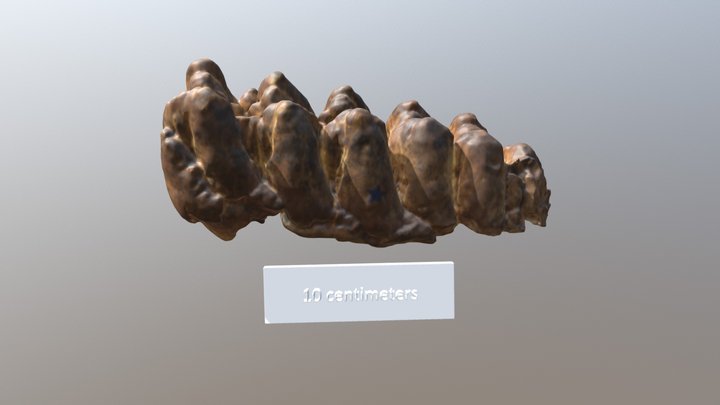
3D model
- Source
- Sketchfab
- Credit
- Virtual Curation Lab
- Licence
- CC Attribution-NonCommercial-NoDerivs
- Commercial use
- the licence does not allow it
Smithsonian Open Access and MorphoSource were not reached for this taxon, so this list is what the others held rather than everything there is.
This is what the site found, which is not the same as what exists.
Keep going
What may have been alongside itStegomastodon through timeThe world it lived on
Occurrence data from the Paleobiology Database, CC BY 4.0. (Leidy 1858)