Sphaerocoryphe punctata
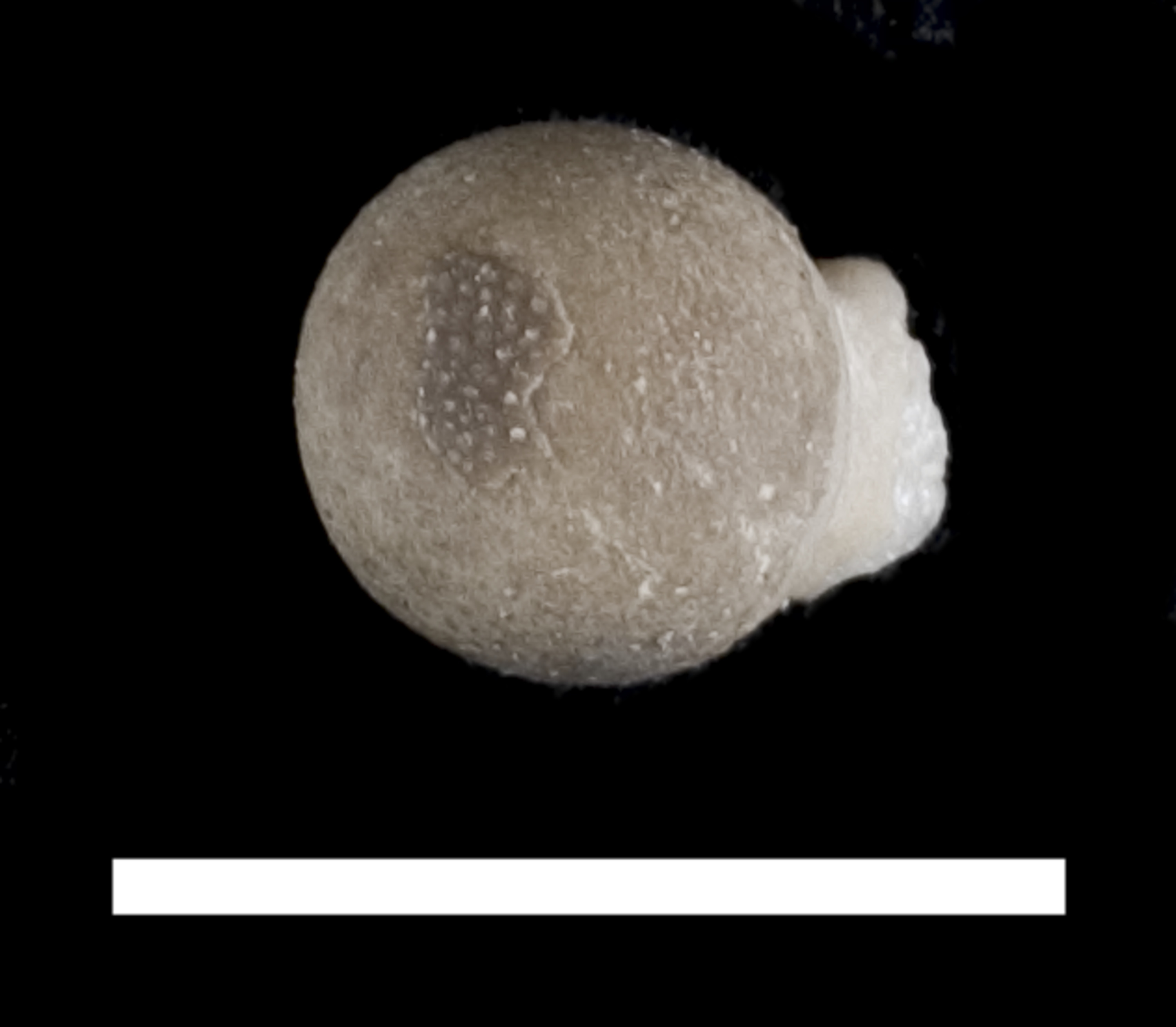
via iDigBio · via iDigBio. May be a photograph of a specimen, or an artist’s reconstruction — an interpretation of a skeleton, since colour and soft tissue are almost never preserved.
On record
Recorded, not inferred- Sits inside
- SphaerocoryphePBDB
- Diet
- carnivorePBDB, for Cheiruridae
- Life habit
- low-level epifaunalPBDB, for Trilobita
- Motility
- fast-movingPBDB, for Trilobita
- Vision
- well-developedPBDB, for Sphaerocoryphe
- Environment
- marinePBDB, for Trilobita
Time the record covers
At least 3.6 million years on record.
The record covers at least 448.8 Mya to 445.2 Mya. No occurrence read is dated outside 452.8 Mya to 443.1 Mya.
11 occurrences of Sphaerocoryphe punctata on record, most of them in the Ordovician. Bar height is expected occurrences, not a count: each fossil is spread across the span it is dated to, so a tall narrow bar means tight dating and a low wide one means loose.
When
11 occurrences- Ordovician100%
These are dates about fossils, not the animal: the record can only begin after it arose and end before it died out, so either end may reach further. Shares are expected occurrences: a fossil dated to a span is counted partly in each period it straddles. More on what this infers.
Found in
5 formations
- Boda Limestone Formation4
- Kirkley Bank Formation · Dent Group3
- Kildare Limestone Formation2
- Keisley Formation1
- Öjlemyr Formation1
Loading coastlines…
The named rock units Sphaerocoryphe punctata has been recovered from, largest first. Drawn where the rock is now, not where it formed.
Sphaerocoryphe punctata and its relatives
OrdovicianWhere Sphaerocoryphe punctata and its relatives were recorded in the Ordovician.
Found in the same rock
356 taxa- Sphaerexochus calvus6 sites
- Holotrachelus punctillosus5 sites
- Illaenus (Parillaenus) roemeri5 sites
- Eobronteus laticauda4 sites
- Hibbertia costatus4 sites
- Illaenus linnarssoni4 sites
- Pseudosphaerexochus conformis4 sites
- Tornquistia4 sites
- Amphilichas lineatus3 sites
- Decoroproetus3 sites
- Decoroproetus asellus3 sites
- Encrinurus striatus3 sites
- Gravicalymene3 sites
- Isbergia planifrons3 sites
- Isocolus sjogreni3 sites
- Lichas affinis3 sites
- Panarchaeogonus trigodus3 sites
- Pharostoma leptaenarum3 sites
- Stenopareia oviformis3 sites
- Trochurus tornquisti3 sites
- Acidaspis2 sites
- Acidaspis bispinosa2 sites
- Ambonychinia corrugata2 sites
- Amphilichas dalecarlicus2 sites
The Paleobiology Database records 11 sites for Sphaerocoryphe punctata, and this reads all of them. The number is how many of those sites it was catalogued from too. The 24 sharing the most are listed.
This is not a list of everything alive at the time. It is only what has come out of the same ground as this animal and been written down.
Entered from
4 references- The Trilobites of the Leptæna Limestone in Dalarne6
- The age, stratigraphy and genesis of the Coniston Limestone Group in the southern Lake District3
- Late Ordovician rostroconchs (Mollusca) from fluvial erratics in northwestern Europe1
- The Trilobites of the Chair of Kildare Limestone (Upper Ordovician) of Eastern Ireland. Part I.1
Each of the 11 occurrences read was entered from one of these publications, ordered by how many each accounts for. This is not a search for papers mentioning the name. Entries link to doi.org where the Paleobiology Database holds an identifier, and to its own record where it does not. Relayed as the Paleobiology Database holds them, not checked against what they resolve to.
Media and terms
Media content1
Picture of Sphaerocoryphe punctata
- Source
- iDigBio
- Credit
- via iDigBio
- Licence
- not stated by the source
- Commercial use
- cannot be read from the licence given — check the record
No 3D scan was found. Smithsonian Open Access, MorphoSource and Sketchfab were all searched.
This is what the site found, which is not the same as what exists.
Keep going
What may have been alongside itSphaerocoryphe through timeFormations of the OrdovicianThe world it lived on
Occurrence data from the Paleobiology Database, CC BY 4.0. Angelin 1854